HomeAPEnglish Language
PopularRhetorical Analysis

AP English Language Tutoring & Prep Course

Short answer

The AP English Language & Composition group course is live online: 50 lessons, 90 minutes each, 75 hours in all.

Group lessons are taught in classes of at most 6 students.

The current group's lessons began on 29 September 2026. The group course fee is €1,573 in one payment.

Try the free AP English Language & Composition practice test

AP English Language and Composition tutoring focused on rhetorical analysis, synthesis and argument essays for a score of 5.

One-to-one and small groups · Live online · College Board curriculum

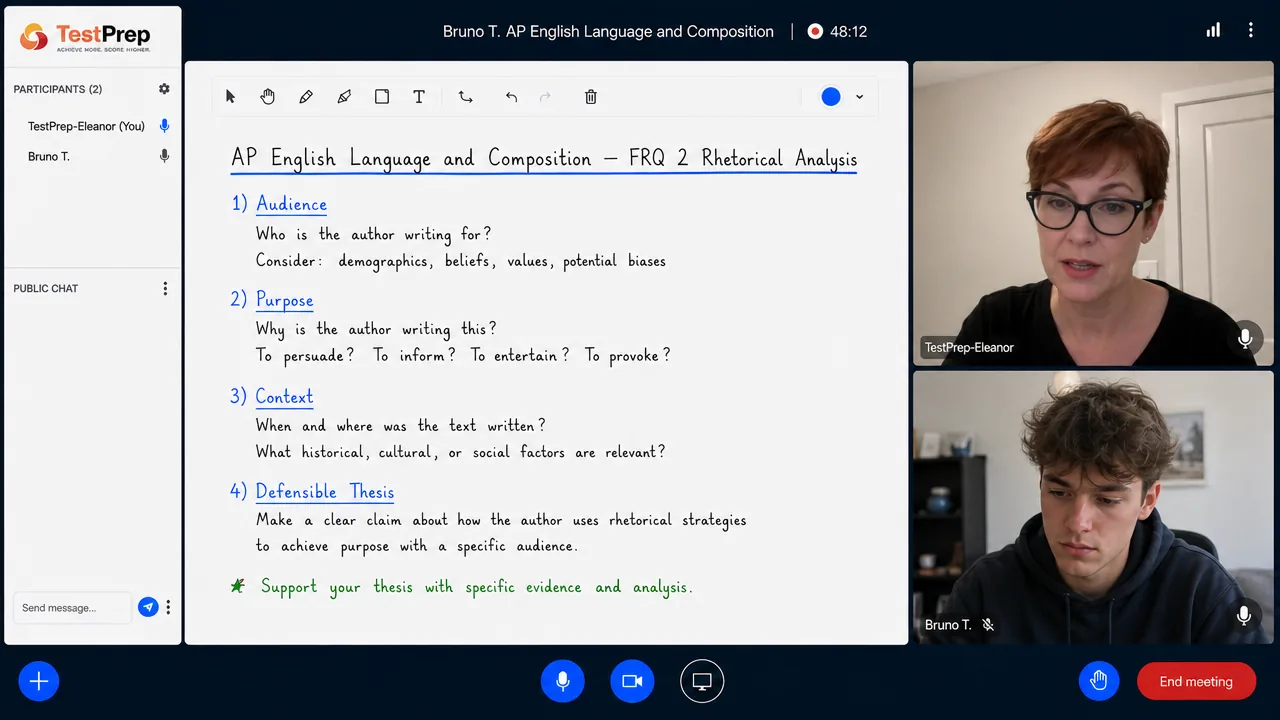
From a TestPrep AP English Language and Composition private lesson

100% live online lessons

About the subject

AP English Language & Composition: what it covers and who it suits

AP English Language and Composition tutoring at TestPrep Europe drills the three free-response essays — rhetorical analysis, argument, and synthesis — alongside the MCQ reading and writing sections. The course teaches the rubric's three rows (thesis, evidence + commentary, sophistication) explicitly, because most students lose points on commentary, not on evidence.

  • All three FRQs — rhetorical analysis, argument, synthesis — drilled to rubric
  • MCQ reading and MCQ writing-revision questions practised separately
  • Commentary writing taught for the rubric's evidence-and-commentary row (up to 4 of 6 points)
Read more

AP English Language and Composition develops the rhetorical analysis and argumentative writing skills that universities expect across every discipline. Strong scores demonstrate clear academic prose to admissions committees and place students out of the first writing-intensive course at most US universities.

AP English Language and Composition trains students to read non-fiction critically and to write effective arguments. Across the year students engage with journalism, political speeches, scientific writing and literary non-fiction, analysing how writers use rhetorical strategies to inform, persuade and move audiences. The exam's three essays — synthesis, rhetorical analysis and argument — each test a distinct skill, and each has a predictable rubric structure. Our programme drills the structural moves that the AP rubric rewards: a defensible thesis stated early, evidence integrated cleanly, commentary that explains how the evidence supports the claim, and a concluding move toward complexity. Students write a full essay weekly with individualised rubric-aligned feedback.

One-to-one AP English Language & Composition tutoring

Our one-to-one AP tutoring is built entirely around the student's current level and target score. Each lesson works on your specific weak topics, drills exam-format questions and teaches free-response and essay technique with the College Board's scoring guidelines in front of us. Our tutors follow every revision of the Course and Exam Description, so the work you put in matches what is rewarded in May.

AP English Language & Composition small-group course

Our small-group AP courses (no more than 6 students per class) give you a structured weekly programme alongside students aiming for the same score. The syllabus follows the College Board's Course and Exam Description unit by unit, and every lesson is taught live online.

Exam

AP English Language & Composition exam format

The College Board runs the AP English Language & Composition exam every May. Sections, timing and weighting:

  • Section I: Multiple Choice

    45%

    45 questions in 1 hour — 23-25 reading questions and 20-22 writing questions.

  • Section II: Free Response

    55%

    3 essays in 2 hours 15 minutes (including a 15-minute reading period): synthesis, rhetorical analysis and argument.

One-to-one AP tutoring

AP English Language & Composition Private Tutoring

Private AP lessons planned around you: the units you find hardest, your school's pace and the score you are aiming for. Every lesson is live and online, with a tutor who teaches this subject.

  • A lesson plan built around your target score
  • Every unit of the College Board course, in the order you need it
  • Multiple-choice and free-response technique, checked against College Board scoring guidelines
  • Lesson times that fit around your school week

How it works

  1. 1

    Tell us your goal

    We start from your school syllabus, your exam date and the result you are aiming for.

  2. 2

    Your own plan

    We map out the lessons you need, unit by unit.

  3. 3

    Live one-to-one lessons

    Meet your tutor online at times that suit your week.

  4. 4

    Regular progress checks

    Homework and a short check after each lesson show how you are getting on.

Start one-to-one AP English Language & Composition

Per lesson in a package

From €58

Single lesson €63

See all prices

Right for you if you want a plan built entirely around you, flexible lesson times and a tutor's full attention.

Book one-to-one lessons

Before choosing a package, you can book one paid lesson.

Our AP tutors began teaching in 2018 or earlier.

Group course calendar

AP English Language and Composition Group Course Calendar

50 lessons in total (40 topic lessons + 10 past-paper lessons). Topic lessons on Tuesday and Thursday, 18:00–19:30; past-paper lessons on Tuesday, 18:00–19:30 (Türkiye time). Lessons are taught in English.

2027-28 classes

First lesson

28 September 2027

Last lesson

18 April 2028

Enrolment deadline

25 September 2027

AP exam

10 May 2028 (estimated)

Course fee

€1,573single payment

or 3 instalments of €524

Enrol now
  • 50 lessons in total
  • 40 topic lessons
  • 10 past-paper lessons
  • Lesson recordings available for 14 days

Lesson-by-lesson calendar

Topic lessonPast-paper lesson
Lesson-by-lesson calendar
DateTopic
28 Sep 2027Tue18:00–19:30Unit 1 (1/5) — Rhetorical Situation and Close Reading of Non-Fiction (1/1)
30 Sep 2027Thu18:00–19:30Unit 1 (2/5) — Rhetorical Situation and Close Reading of Non-Fiction (1/1)
5 Oct 2027Tue18:00–19:30Unit 1 (3/5) — Rhetorical Situation and Close Reading of Non-Fiction (1/1)
7 Oct 2027Thu18:00–19:30Unit 1 (4/5) — Rhetorical Situation and Close Reading of Non-Fiction (1/1)
12 Oct 2027Tue18:00–19:30Unit 1 (5/5) — Rhetorical Situation and Close Reading of Non-Fiction (1/1)
14 Oct 2027Thu18:00–19:30Unit 2 (1/5) — Claims, Thesis Statements and Evidence (1/1)
19 Oct 2027Tue18:00–19:30Unit 2 (2/5) — Claims, Thesis Statements and Evidence (1/1)
21 Oct 2027Thu18:00–19:30Unit 2 (3/5) — Claims, Thesis Statements and Evidence (1/1)
26 Oct 2027Tue18:00–19:30Unit 2 (4/5) — Claims, Thesis Statements and Evidence (1/1)
28 Oct 2027Thu18:00–19:30Unit 2 (5/5) — Claims, Thesis Statements and Evidence (1/1)

Good to know

  • College Board has not yet published the May 2028 AP exam schedule, so the exam date is estimated from the 2027 schedule. Once it is confirmed, we will adjust the programme to match.
  • 100% First-Lesson Money-Back Guarantee

    Not satisfied? Full refund, no questions asked.

    We do not offer free trial lessons. Payment is required before your first lesson.

  • Secure Payments

    Powered by Stripe with 256-bit encryption.

    Stripe
  • Flexible Billing

    Local cards welcome, instalments available.

Lessons cancelled less than 3 hours before the start count as taken. Full terms

Practice test · Question bank · TestPrep AI Tutor

Practise AP English Language & Composition on your own

Three ways to practise between lessons. Each one is a separate product.

  • Coming soon

    AP English Language & Composition Question Bank

    The AP English Language & Composition question bank is on its way. Until then, you can explore the other AP subjects in the question bank.

    Explore the AP question bank
  • AP English Language & Composition Practice Test

    A full-length test in the real exam format, with a detailed score report. Two attempts per test, and 12 months to use them.

    Go to the practice test
  • TestPrep AI Tutor

    Talks you through the questions you got wrong on a practice test, out loud. Your first 2 mistakes are free.

    How TestPrep AI Tutor works

Syllabus

AP English Language & Composition topics

Unit and topic names are the College Board's own.

1

Unit 1

  • Identifying the purpose and intended audience of a text
  • Examining how evidence supports a claim
  • Developing paragraphs as part of an effective argument
2

Unit 2

  • Analyzing audience and its relationship to the purpose of an argument
  • Building an argument with relevant and strategic evidence
  • Developing thesis statements
  • Developing structure and integrating evidence to reflect a line of reasoning
3

Unit 3

  • Identifying and describing different claims or lines of reasoning
  • Identifying and avoiding flawed lines of reasoning
  • Introducing and integrating sources and evidence
  • Using sufficient evidence for an argument
  • Attributing and citing references
  • Developing parts of a text with cause-effect and narrative methods
4

Unit 4

  • Developing and connecting thesis statements and lines of reasoning
  • Developing introductions and conclusions
  • Developing parts of a text with comparison–contrast and definition–description methods
5

Unit 5

  • Developing commentary throughout paragraphs
  • Maintaining ideas throughout an argument
  • Using modifiers to qualify an argument and convey perspective
  • Using transitions
6

Unit 6

  • Incorporating multiple perspectives strategically into an argument
  • Recognizing and accounting for bias
  • Adjusting an argument to address new evidence
  • Analyzing tone and shifts in tone
7

Unit 7

  • Examining complexities in issues
  • Considering how words, phrases, and clauses can modify and limit an argument
  • Examining how counterargument or alternative perspectives affect an argument
  • Exploring how sentence development affects an argument
8

Unit 8

  • Choosing comparisons based on an audience
  • Considering how sentence development and word choice affect how the writer is perceived by an audience
  • Considering how all choices made in an argument affect the audience
  • Considering how style affects an argument
9

Unit 9

  • Strategically conceding, rebutting, or refuting information
  • Crafting an argument through stylistic choices like word choice and description

Approach

How we teach AP English Language & Composition

Study plan

  1. 1

    Phase 1 — Reading and rhetorical situation

    Author's purpose, audience, context, claim/evidence/reasoning

    • Annotate model passages by rhetorical situation
    • Identify claim, evidence, reasoning in MCQ-style passages
  2. 2

    Phase 2 — Rhetorical analysis essay

    Device → effect → contribution to the argument

    • Practise topic sentences that explain effect, not technique
    • Score released essays against the official rubric
  3. 3

    Phase 3 — Argument essay

    Defensible thesis, evidence selection, commentary

    • Build a personal evidence bank (history, lit, current events)
    • Drill counter-argument-and-respond paragraphs
  4. 4

    Phase 4 — Synthesis + MCQ revision questions + mock

    Source integration, MCQ writing-revision, full timed paper

    • Synthesis with 3-of-7 sources, all properly cited
    • MCQ revision-question patterns (transition, conciseness, clarity)
    • Full-length timed practice exam

How lessons work

  • Commentary-first writing

    Every essay drill starts with commentary sentences before evidence. Most lost points are on the 4-point evidence + commentary row, not on thesis or sophistication.

  • Rubric-by-row scoring

    Released essays are scored row-by-row against the College Board rubric, so students see exactly which row is costing them points and which is already secure.

  • Fixed planning routine

    Each essay starts with a 5-minute planning template — thesis, three claim points, evidence list — so the prose is built on a structure, not improvised.

Advice

AP English Language & Composition: common mistakes and study tips

  • MistakeSummarising the source text instead of analysing it.

    FixEvery body paragraph must do one of: explain how a rhetorical choice creates an effect, or defend a claim with reasoning. Plot retelling earns zero analysis points.

  • MistakeGeneric thesis ('the author uses many devices').

    FixDefend a defensible interpretation — what the author argues and how — not a list of techniques.

  • MistakeQuote-bombing without commentary.

    FixEvery quotation needs at least two sentences of commentary that connect it back to the thesis; quotation alone earns the evidence point but never the commentary point.

  • MistakeTreating synthesis as 'use as many sources as possible'.

    FixThe rubric rewards using sources as evidence for a defensible position, not for source count. Three well-integrated sources beat six listed ones.

  • MistakeIgnoring the rhetorical situation (audience, purpose, occasion).

    FixOpen with one sentence on situation before any device analysis; the rubric's sophistication row depends on it.

  • MistakeRunning out of time on essay 3.

    FixUse a fixed time split (rhetorical 40 min / argument 40 min / synthesis 55 min) and start with the strongest essay first.

Study tips

  • On rhetorical analysis essays, never just identify a device — explain its effect. The rubric rewards "how it works on the reader", not "what it is".
  • Synthesis essays must take a clear position; students who summarise sources without an argument cap out at a 4/6.
  • Time discipline is everything: budget 5 minutes planning, 30 minutes writing, 5 minutes revising per essay.
  • Read non-fiction widely (The Atlantic, The Economist, classic American essays) so you have a stockpile of evidence and rhetorical strategies to draw on.

Ready to raise your AP English Language & Composition score?

You can start one-to-one AP English Language & Composition lessons with a single lesson. Every package and price is on one page.

  • Live one-to-one lessons online
  • No package needed — book a single lesson
  • Lesson times that fit your school week
FAQ

AP English Language & Composition Prep — Frequently Asked Questions

The questions students ask most about AP English Language & Composition preparation.

Different rather than harder. AP Lang is non-fiction argument and rhetoric; AP Lit is poetry and fiction. Students stronger at journalistic / analytical writing usually find Lang more natural.

Knowing common terms (ethos, pathos, anaphora, juxtaposition) helps, but the rubric rewards effect, not labelling. A student who explains effect without naming the device can still earn full credit.

We aim for at least 8–12 timed essays per FRQ type by exam day, scored against the rubric. Volume matters more for Lang than for content APs.

The rubric scores argument quality, not surface-level fluency. We focus on commentary clarity and structure; minor language errors rarely change the score row.

The money-back guarantee covers live lessons. If you are not satisfied after your first private lesson, we refund your payment in full. The question bank and practice tests are not part of it. We do not offer free trial lessons. Payment is required before your first lesson.

Practice tests, question banks and TestPrep AI Tutor time are digital content. You can ask for a refund of a digital product you have not used within 14 days of the payment date. A product counts as used once any practice test in the pack has been started, any question in a paid section of the question bank has been opened, or any second of TestPrep AI Tutor time has been used; a used product is not refunded.

You can cancel a lesson package at any time. Lessons already given are charged at the single-lesson price and the rest is refunded. The first-lesson guarantee applies on top.

Lessons cancelled less than 3 hours before the start count as taken and are not refunded. A lesson that has not been paid for 3 hours before it starts is cancelled automatically.

AP English Language & Composition reviews

Be the first to review this programme.

Share your experience

Your comment will appear after approval.

Your rating

All TestPrep Europe reviews