AP Physics 1 Tutoring & Prep Course
Short answer
The AP Physics 1 group course is live online: 50 lessons, 90 minutes each, 75 hours in all.
Group lessons are taught in classes of at most 6 students.
The current group's lessons began on 10 October 2026. The group course fee is €1,573 in one payment.
Try the free AP Physics 1 practice test
AP Physics 1 tutoring covering mechanics, oscillations and fluids with rigorous FRQ practice aligned to College Board scoring for a score of 5.
One-to-one and small groups · Live online · College Board curriculum
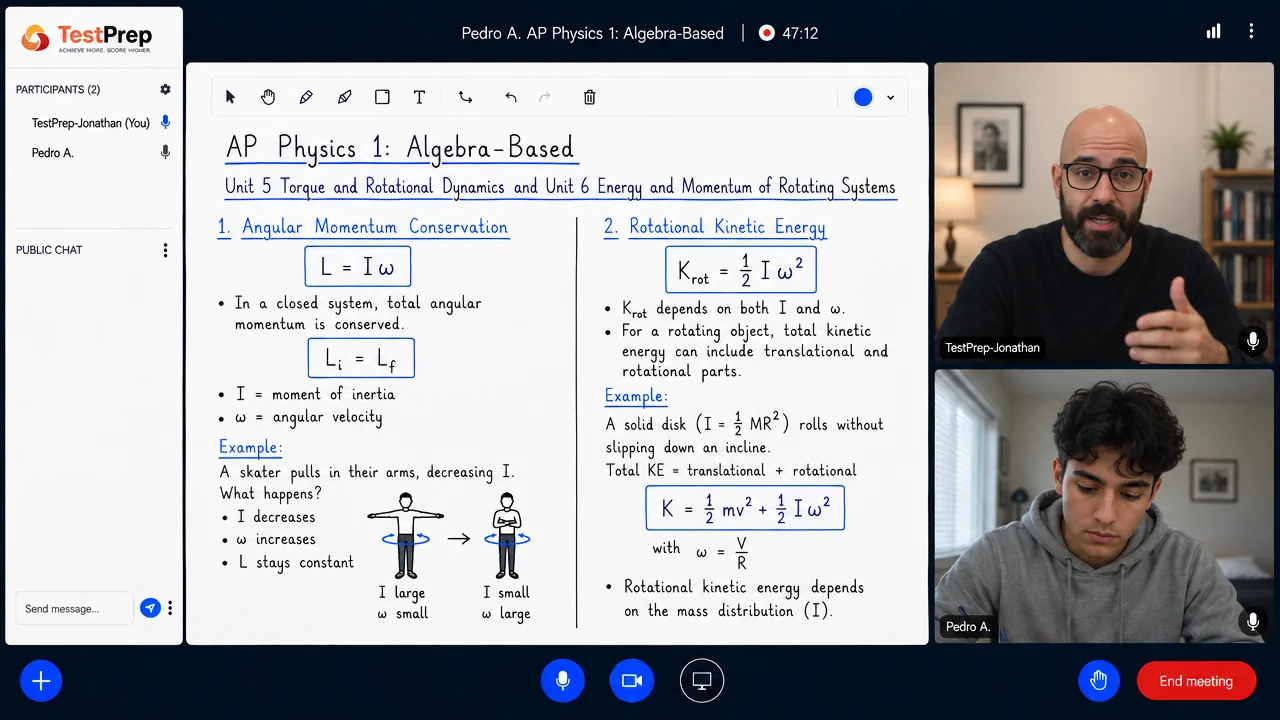
100% live online lessons
About the subject
AP Physics 1: what it covers and who it suits
AP Physics 1 tutoring at TestPrep Europe covers algebra-based mechanics, from kinematics through rotation and oscillations to fluids — the College Board's first-year physics course. The exam emphasises qualitative reasoning and free-response justification as much as calculation, so we drill both reflexively.
Your lessons are taught by Ali Ertan, who teach AP Physics 1.
- All 8 units covered: Unit 1: Kinematics to Unit 8: Fluids
- Free-response justification practised against the official rubric
- Qualitative-reasoning items drilled separately from calculation items
Read more
AP Physics 1 is an algebra-based introduction to mechanics: kinematics, forces, energy, momentum, rotation, oscillations and fluids. Waves, sound and electric circuits are no longer part of the course. It is one of the most conceptually demanding AP exams: 10.2% of test-takers earned a 5 in 2024, and although the rate rose to 19.8% in 2025 on the redesigned course, the exam still rewards physical reasoning and experimental design over formula application.
AP Physics 1 earned its reputation as one of the toughest AP exams under the old course, when only 8–10% of candidates scored a 5 (2022–2024); on the redesigned course the 5-rate was 19.8% in 2025. Either way, the exam rewards conceptual depth, scientific argumentation and experimental thinking — not just plug-and-chug formula use. The course covers Newtonian mechanics, energy, momentum, rotational motion, simple harmonic motion and fluids. FRQs frequently ask students to design an experiment, analyse data tables or explain a phenomenon in writing. Our programme mixes hands-on problem solving, simulation-based labs and weekly mock FRQ practice with detailed feedback against the AP rubric.
One-to-one AP Physics 1 tutoring
Our one-to-one AP tutoring is built entirely around the student's current level and target score. Each lesson works on your specific weak topics, drills exam-format questions and teaches free-response and essay technique with the College Board's scoring guidelines in front of us. Our tutors follow every revision of the Course and Exam Description, so the work you put in matches what is rewarded in May.
AP Physics 1 small-group course
Our small-group AP courses (no more than 6 students per class) give you a structured weekly programme alongside students aiming for the same score. The syllabus follows the College Board's Course and Exam Description unit by unit, and every lesson is taught live online.
Exam
AP Physics 1 exam format
The College Board runs the AP Physics 1 exam every May. Sections, timing and weighting:
Section I: Multiple Choice
50%42 questions in 1 hour 25 minutes. Question count and section timing were updated effective with the May 2027 exam. Calculators permitted.
Section II: Free Response
50%4 questions in 1 hour 35 minutes — one each of mathematical routines, translation between representations, experimental design and analysis, and qualitative/quantitative translation.
Exam delivery
Hybrid digitalMultiple choice is answered in Bluebook; free-response answers are handwritten in a paper booklet.
One-to-one AP tutoring
AP Physics 1 Private Tutoring
Private AP lessons planned around you: the units you find hardest, your school's pace and the score you are aiming for. Every lesson is live and online, with a tutor who teaches this subject.
- A lesson plan built around your target score
- Every unit of the College Board course, in the order you need it
- Multiple-choice and free-response technique, checked against College Board scoring guidelines
- Lesson times that fit around your school week
How it works
- 1
Tell us your goal
We start from your school syllabus, your exam date and the result you are aiming for.
- 2
Your own plan
We map out the lessons you need, unit by unit.
- 3
Live one-to-one lessons
Meet your tutor online at times that suit your week.
- 4
Regular progress checks
Homework and a short check after each lesson show how you are getting on.
Start one-to-one AP Physics 1
Right for you if you want a plan built entirely around you, flexible lesson times and a tutor's full attention.
Book one-to-one lessonsBefore choosing a package, you can book one paid lesson.
Our AP tutors began teaching in 2018 or earlier.
No group is open right now
Group course
A Private Group for This Subject
There is no open group timetable for this subject in 2026–27. If 3 or more of you sign up together, we open a private group course for you — at the same price as the open group course. Lessons are taught in English.
Course fee
€1,573the same as an open group course
At least 3 students · you set the weekly timetable together
Each student buys their own place online, and we let you know as soon as your group is ready.
or 3 instalments of €524Questions first? Get in touch- Classes of no more than 6 students
- Live online lessons you can watch again
- A lesson plan that follows the College Board course
- Not satisfied after the first week of your group course? Full (100%) refund. We do not offer free trial lessons. Payment is required before your first lesson.
100% First-Lesson Money-Back Guarantee
Not satisfied? Full refund, no questions asked.
We do not offer free trial lessons. Payment is required before your first lesson.
Secure Payments
Powered by Stripe with 256-bit encryption.

Flexible Billing
Local cards welcome, instalments available.
Lessons cancelled less than 3 hours before the start count as taken. Full terms
Practice test · Question bank · TestPrep AI Tutor
Practise AP Physics 1 on your own
Three ways to practise between lessons. Each one is a separate product.
AP Physics 1 Question Bank
College Board-style questions unit by unit, with an explanation for every question. The first 30 questions are free.
Try it freeAP Physics 1 Practice Test
A full-length test in the real exam format, with a detailed score report. Two attempts per test, and 12 months to use them.
Go to the practice testTestPrep AI Tutor
Talks you through the questions you got wrong on a practice test, out loud. Your first 2 mistakes are free.
How TestPrep AI Tutor works
Syllabus
AP Physics 1 topics
Unit and topic names are the College Board's own. Percentages are each unit's share of the multiple-choice score, as the College Board publishes them.
1Unit 1: Kinematics
10–15%
- Scalars and vectors in one dimension
- Displacement, velocity, and acceleration
- Representing motion
- Reference frames and relative motion
- Vectors and motion in two dimensions
2Unit 2: Force and Translational Dynamics
18–23%
- Systems and center of mass
- Forces and free-body diagrams
- Newton's Third Law
- Newton's First Law
- Newton's Second Law
- Gravitational force
- Kinetic and static friction
- Spring forces
- Circular motion
3Unit 3: Work, Energy, and Power
18–23%
- Translational kinetic energy
- Work
- Potential energy
- Conservation of energy
- Power
4Unit 4: Linear Momentum
10–15%
- Linear momentum
- Change in momentum and impulse
- Conservation of linear momentum
- Elastic and inelastic collisions
5Unit 5: Torque and Rotational Dynamics
10–15%
- Rotational kinematics
- Connecting linear and rotational motion
- Torque
- Rotational inertia
- Rotational equilibrium and Newton's First Law in rotational form
- Newton's Second Law in rotational form
6Unit 6: Energy and Momentum of Rotating Systems
5–8%
- Rotational kinetic energy
- Torque and work
- Angular momentum and angular impulse
- Conservation of angular momentum
- Rolling
- Motion of orbiting satellites
7Unit 7: Oscillations
5–8%
- Defining simple harmonic motion (SHM)
- Frequency and period of SHM
- Representing and analyzing SHM
- Energy of simple harmonic oscillators
8Unit 8: Fluids
10–15%
- Internal structure and density
- Pressure
- Fluids and Newton's laws
- Fluids and conservation laws
Approach
How we teach AP Physics 1
Study plan
- 1
Phase 1 — Kinematics and forces
Units 1–2
- 1-D and 2-D kinematics
- Newton's laws and free-body diagrams
- 2
Phase 2 — Energy and momentum
Units 3–4
- Work-energy theorem
- Conservation of momentum
- Collisions
- 3
Phase 3 — Rotation and oscillations
Units 5–7
- Torque and rotational dynamics
- Angular momentum and rolling
- Simple harmonic motion
- 4
Phase 4 — Fluids + mock
Unit 8 + full exam
- Pressure, buoyancy and fluid dynamics
- Full-length timed practice exam
How lessons work
Free-body diagrams as a reflex
Every mechanics problem starts with a free-body diagram drawn before any equation is written. Skipping this step costs marks.
Qualitative + quantitative split
AP Physics 1 has a heavy qualitative-reasoning component. Each topic is practised in both modes so the student isn't surprised by FRQs that ask for a sentence instead of a number.
Released FRQ scoring
Released FRQs are scored against the official rubric so the student sees how partial credit accrues for diagrams, equations, substitution, and final answer.
Advice
AP Physics 1: common mistakes and study tips
MistakeAdding forces along a curved path as if motion were straight.
FixAlways draw a free-body diagram in the instantaneous direction of motion; centripetal forces point toward the centre, not along the arc.
MistakeConfusing average and instantaneous quantities on a v–t graph.
FixAverage velocity is total displacement / total time. Instantaneous velocity is the slope at a point. Different objects, different methods.
MistakeTreating momentum and energy as interchangeable.
FixMomentum is conserved in collisions; kinetic energy is conserved only in elastic collisions. Decide which conservation law applies before writing equations.
MistakeSkipping unit checks under time pressure.
FixAP Physics rubrics deduct for missing or wrong units. Write units in every line of working.
MistakeJustifying with a formula instead of a sentence.
FixFRQs ask 'justify your answer' — the rubric requires words. A formula is supporting evidence, not a justification.
Study tips
- Draw a free-body diagram for every dynamics problem, no exceptions. The diagram is worth points and prevents sign errors downstream.
- Practise the paragraph-argument FRQ: explaining a physical phenomenon in continuous prose is a learnable skill, not an afterthought.
- On experimental-design questions, name your independent and dependent variables, control variables and sources of error explicitly.
- Know which formulas appear on the equation sheet and which you must derive yourself; don't waste exam time re-deriving what is provided.
Ready to raise your AP Physics 1 score?
You can start one-to-one AP Physics 1 lessons with a single lesson. Every package and price is on one page.
- Live one-to-one lessons online
- No package needed — book a single lesson
- Lesson times that fit your school week
You can also write to us through our contact page.
Other subjects
Related and other AP subjects
Often taken alongside this subject
- AP Physics 2Direct continuation: thermodynamics, electromagnetism, optics, modern physics.
- AP Calculus ABCalculus pairs naturally with physics for STEM-bound applicants.
- AP ChemistryCommon second-science AP combination.
All AP subjects
- AP Calculus AB
- AP Calculus BC
- AP Statistics
- AP Precalculus
- AP Computer Science A
- AP Computer Science Principles
- AP Physics 2
- AP Physics C: Mechanics
- AP Physics C: Electricity & Magnetism
- AP Chemistry
- AP Biology
- AP Environmental Science
- AP English Language & Composition
- AP English Literature & Composition
- AP US History (APUSH)
- AP World History: Modern
- AP European History
- AP US Government & Politics
- AP Comparative Government & Politics
- AP Human Geography
- AP Microeconomics
- AP Macroeconomics
- AP Psychology
- AP Art History
- AP Music Theory
- AP Spanish Language & Culture
- AP French Language & Culture
- AP Chinese Language & Culture
- AP Business with Personal Finance
- AP Cybersecurity
- AP African American Studies
AP Physics 1 Prep — Frequently Asked Questions
The questions students ask most about AP Physics 1 preparation.