HomeAPU.S. Government and Politics
ConstitutionSCOTUS Cases

AP U.S. Government and Politics Tutoring & Prep Course

One-to-one AP U.S. Government and Politics tutoring, with full past-paper practice and a personalised study plan built around your target grade.

Since 2008, TestPrep Europe has taught AP US Government & Politics through one-to-one tutoring and small-group courses on its own online learning platform. The programme combines the AP syllabus with subject teaching, problem solving and past-paper practice.

One-to-one and small groups · Live online · College Board curriculum

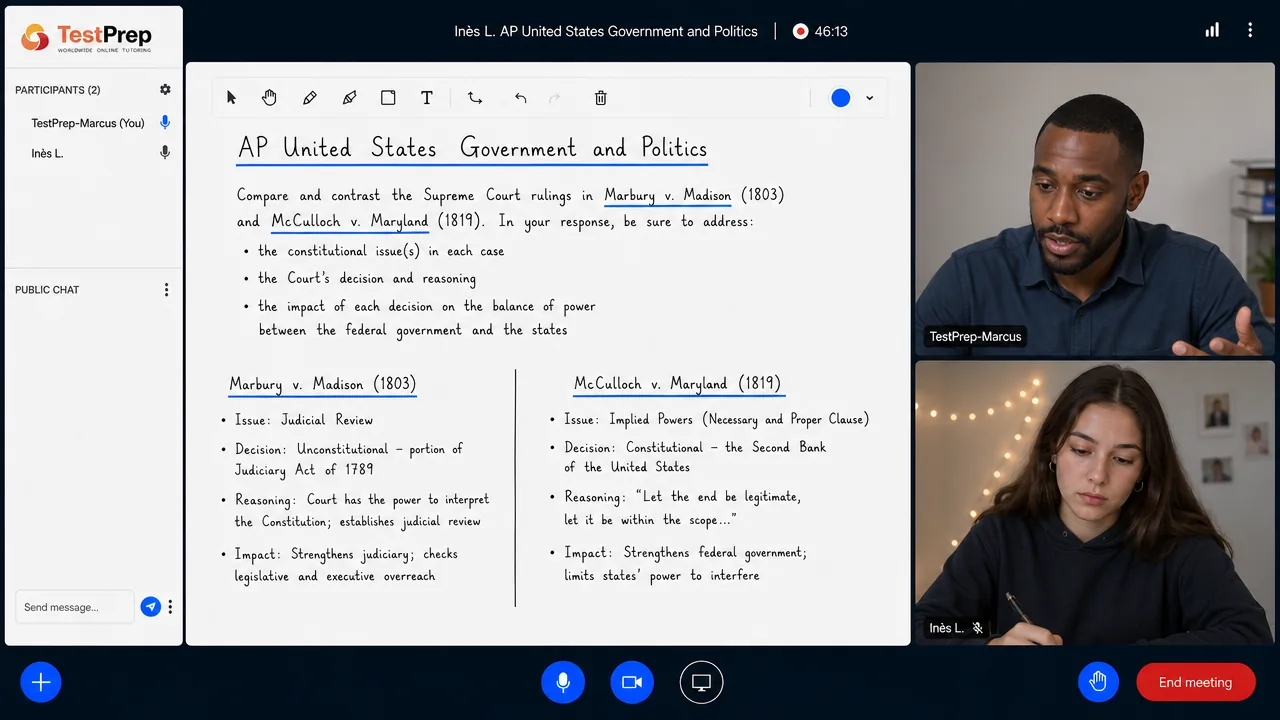
From a TestPrep AP United States Government and Politics private lesson

100% live online lessons

About the subject

AP US Government & Politics: what it covers and who it suits

AP US Government and Politics tutoring at TestPrep Europe drills the five units — foundations of American democracy, interactions among the branches, civil liberties and civil rights, political ideologies and beliefs, political participation — alongside MCQ and four FRQ types: concept application, quantitative analysis, SCOTUS comparison, and the argument essay. The exam draws on 13 required foundational documents (four were added for 2026-27) and 14 required Supreme Court cases.

  • All 5 units, foundations through political participation
  • 13 foundational documents and 14 required SCOTUS cases drilled as a fixed canon
  • Four FRQ types — concept, quantitative, SCOTUS comparison, argument — practised separately
Read more

AP US Government and Politics covers the American constitutional system, the institutions of federal government, political parties, elections and civil liberties. It is foundational for students considering law, political science or public policy in the United States, and the exam emphasises applying constitutional principles to real-world scenarios.

AP US Government and Politics is a study of American democracy: its constitutional foundations, its institutional structure and its contemporary political dynamics. The course starts with the drafting of the Constitution and the principles of federalism, then works through Congress, the Presidency and the Supreme Court in detail. Civil liberties and civil rights are taught through the required Supreme Court cases, 14 on the current list. The course also rests on 13 required foundational documents since four were added for 2026-27: the Emancipation Proclamation, Federalist No. 39, the Gettysburg Address and core principles from Adam Smith's The Wealth of Nations. The second half of the course covers political participation: voter behaviour, elections, political parties, interest groups and the media. Our programme is particularly tailored to students applying to US universities; sessions cover SCOTUS case analysis, quantitative-data interpretation and argument-essay writing.

One-to-one AP US Government & Politics tutoring

Our one-to-one AP tutoring is built entirely around the student's current level and target score. Each lesson works on your specific weak topics, drills exam-format questions and teaches free-response and essay technique with the College Board's scoring guidelines in front of us. Our tutors follow every revision of the Course and Exam Description, so the work you put in matches what is rewarded in May.

AP US Government & Politics small-group course

Our small-group AP courses (no more than 6 students per class) give you a structured weekly programme alongside students aiming for the same score. The syllabus follows the College Board's Course and Exam Description unit by unit, and every lesson is taught live online.

Exam

AP US Government & Politics exam format

The College Board runs the AP US Government & Politics exam every May. Sections, timing and weighting:

  • Section I: Multiple Choice

    50%

    55 questions in 1 hour 20 minutes; text, graphic and quantitative stimuli.

  • Section II: Free Response

    50%

    4 questions in 1 hour 40 minutes: concept application, quantitative analysis, SCOTUS comparison and argument essay.

How do I register for the exam?
  • You can take AP Exams without taking the AP course at your school, but you can't register on your own.
  • Find a school that runs AP Exams and ask its AP coordinator to place you in an "exam only" section; enter the join code in My AP as soon as you get it. In some countries, College Board also lists authorized AP test centers you can register with directly.
  • Schools place their exam orders by mid-November; late additions, up to about mid-March, cost extra. Contact schools by the end of October at the latest.
  • College Board's AP Course Ledger lists the schools that offer AP; search it by country and city.

AP Course LedgerAuthorized AP test centers outside the U.S.

One-to-one AP tutoring

AP US Government & Politics Private Tutoring

Private AP lessons planned around you: the units you find hardest, your school's pace and the score you are aiming for. Every lesson is live and online, with a tutor who teaches this subject.

  • A lesson plan built around your target score
  • Every unit of the College Board course, in the order you need it
  • Multiple-choice and free-response technique, checked against College Board scoring guidelines
  • Lesson times that fit around your school week

How it works

  1. 1

    Tell us your goal

    We start from your school syllabus, your exam date and the result you are aiming for.

  2. 2

    Your own plan

    We map out the lessons you need, unit by unit.

  3. 3

    Live one-to-one lessons

    Meet your tutor online at times that suit your week.

  4. 4

    Regular progress checks

    Homework and a short check after each lesson show how you are getting on.

Start one-to-one AP US Government & Politics

Per lesson in a package, from

€54

See all prices

Right for you if you want a plan built entirely around you, flexible lesson times and a tutor's full attention.

Book one-to-one lessons

No package needed — you can book a single lesson.

Even our newest AP tutor has been teaching AP prep since 2016.

Group course calendar

AP United States Government and Politics Group Course Calendar

50 lessons in total (40 topic lessons + 10 past-paper lessons). Topic lessons on Monday and Wednesday, 17:30–19:00; past-paper lessons on Monday, 17:30–19:00 (Türkiye time). Lessons are taught in English.

2026-27 intake

Full

First lesson

28 September 2026

Last lesson

26 April 2027

Enrolment deadline

25 September 2026

AP exam

4 May 2027

Course fee

€1,567single payment

or 3 instalments of €522

  • 50 lessons in total
  • 40 topic lessons
  • 10 past-paper lessons
  • Lesson recordings available for 14 days

Every one of our 2026-27 AP group courses is full — thank you for the interest. The 2027-28 start dates are published on 1 November, and you can enrol now.

If three or more of you enrol together, you can have a group of your own at the same group course price. Each of you can buy a place online now, and we let you know as soon as your group is ready.

Buy a private group place

Lesson-by-lesson calendar

Topic lessonPast-paper lesson
Lesson-by-lesson calendar
DateTopic
28 Sep 2026 (done)Mon · 17:30–19:00Unit 1: Foundations of American Democracy (1/8)
30 Sep 2026 (done)Wed · 17:30–19:00Unit 1: Foundations of American Democracy (2/8)
5 Oct 2026 (done)Mon · 17:30–19:00Unit 1: Foundations of American Democracy (3/8)
7 Oct 2026Wed · 17:30–19:00Unit 1: Foundations of American Democracy (4/8)
12 Oct 2026Mon · 17:30–19:00Unit 1: Foundations of American Democracy (5/8)
14 Oct 2026Wed · 17:30–19:00Unit 1: Foundations of American Democracy (6/8)
19 Oct 2026Mon · 17:30–19:00Unit 1: Foundations of American Democracy (7/8)
21 Oct 2026Wed · 17:30–19:00Unit 1: Foundations of American Democracy (8/8)
26 Oct 2026Mon · 17:30–19:00Unit 2: Interactions Among Branches of Government (1/12)
28 Oct 2026Wed · 17:30–19:00Unit 2: Interactions Among Branches of Government (2/12)

Good to know

  • 50 lessons in total: 40 teaching lessons and 10 exam walkthroughs.
  • Teaching phase: two lessons a week (Monday and Wednesday), 17:30–19:00.
  • Walkthrough phase: one lesson a week (Monday), 17:30–19:00.
  • There is no lesson in the week of 8 March 2027.
  • Past exams are worked through from 2026 back to 2017. The 2020 exam was a shortened, free-response-only online exam, so a TestPrep practice test takes its place.
  • Lessons per unit follow the exam weighting in the College Board AP US Government and Politics course: Unit 2 carries the most weight, Unit 4 the least.
  • 100% First-Lesson Money-Back Guarantee

    Not satisfied? Full refund, no questions asked.

  • Secure Payments

    Powered by Stripe with 256-bit encryption.

    Stripe
  • Flexible Billing

    Pay in EUR — local cards welcome, instalments available.

Lessons cancelled less than 3 hours before the start count as taken. Full terms

Practice test · Question bank · AI Tutor

Practise AP US Government & Politics on your own

Three ways to practise between lessons. Each one is a separate product.

  • Coming soon

    AP US Government & Politics Question Bank

    The AP US Government & Politics question bank is on its way. Until then, you can explore the other AP subjects in the question bank.

    Explore the AP question bank
  • AP US Government & Politics Practice Test

    A full-length test in the real exam format, with a detailed score report. Two attempts per test, and 12 months to use them.

    Go to the practice test
  • AI Tutor

    Talks you through the questions you got wrong on a practice test, out loud. Your first 2 mistakes are free.

    Meet the AI Tutor

Syllabus

AP US Government & Politics topics

Unit and topic names are the College Board's own. Percentages are each unit's share of the multiple-choice score, as the College Board publishes them.

1

Unit 1: Foundations of American Democracy

15–22%
  • The ideals of democracy as shown in the Declaration of Independence and the Constitution
  • Federalist and Anti-Federalist views on central government and democracy
  • Separation of powers and “checks and balances”
  • The relationship between the states and the national government (federalism)
  • How federalism has been interpreted differently over time
2

Unit 2: Interactions Among Branches of Government

25–36%
  • The structures, powers, and functions of each house of Congress
  • The roles and powers of the president
  • The roles and powers of the Supreme Court and other federal courts
  • The roles of the federal bureaucracy (departments, agencies, commissions, and government corporations)
3

Unit 3: Civil Liberties and Civil Rights

13–18%
  • The intent of the Bill of Rights
  • The First Amendment (freedom of speech, freedom of religion, and freedom of the press) and how the Supreme Court has interpreted it
  • The Second Amendment (the right to bear arms) and how the Supreme Court has interpreted it
  • Supreme Court interpretations of other amendments
  • How the due process and equal protection clauses of the Fourteenth Amendment have motivated social movements
4

Unit 4: American Political Ideologies and Beliefs

10–15%
  • How cultural and social factors affect citizens' beliefs about government
  • How polls are used to gather data about public opinion
  • The ideologies of the Democratic and Republican parties
  • How political ideologies affect policy on economic and social issues
5

Unit 5: Political Participation

20–27%
  • Laws that protect the right to vote
  • Why it's hard for third parties and independent candidates to succeed
  • Interest groups and their influence
  • Campaign finance and its role in elections
  • The media's role in elections

Approach

How we teach AP US Government & Politics

Study plan

  1. 1

    Phase 1 — Foundations + branches (Units 1–2)

    Constitutional foundations, federalism, Congress, presidency, courts, bureaucracy

    • All 13 required documents read and annotated, including the four added for 2026-27
    • Federalism vs separation of powers comparison
    • Powers and checks across branches; judicial review
    • Bureaucracy, oversight, iron triangles
  2. 2

    Phase 2 — Civil liberties and civil rights (Unit 3)

    Bill of Rights, selective incorporation, equal protection

    • Civil liberties cases by amendment
    • Required SCOTUS cases: facts, holding, reasoning
    • Civil rights from the Emancipation Proclamation to Brown v. Board of Education
  3. 3

    Phase 3 — Ideologies + participation (Units 4–5)

    Political ideologies, parties, elections, media

    • Ideology mapping with policy examples
    • Linkage institutions and their reform
    • Voter behaviour data
  4. 4

    Phase 4 — FRQ practice + mock

    All four FRQ types

    • Concept application FRQs
    • Quantitative analysis FRQs
    • SCOTUS comparison FRQs
    • Argument essay to rubric

How lessons work

  • Required documents and cases as a closed canon

    Students learn the 13 documents and 14 SCOTUS cases by clause and ruling, not by general gist. The rubric tests these as the unit of evidence.

  • Argument essay as a structured product

    Every argument essay starts with thesis, three claim points, and named evidence from the canon. Improvisation is replaced with a fixed planning routine.

  • Four FRQ types as four genres

    Concept application, quantitative analysis, SCOTUS comparison and argument each have distinct rubrics. We drill each as a separate genre, not as 'the FRQ section'.

Advice

AP US Government & Politics: common mistakes and study tips

  • MistakeVague references to founding documents.

    FixQuote or paraphrase a specific clause from the Constitution / Federalist No. 10, 39 or 51 / Brutus No. 1 / Letter from a Birmingham Jail / the Gettysburg Address. Generic mentions don't earn rubric points.

  • MistakeSCOTUS-comparison FRQ that summarises both cases.

    FixThe rubric asks for a comparison: identify the constitutional clause both cases turn on, then explain how the rulings differ in applying it.

  • MistakeArgument essay without a clear claim.

    FixEvery argument essay needs a defensible thesis on the prompt's policy question. Hedged or descriptive theses cap the rubric.

  • MistakeQuantitative-analysis FRQ that ignores the data.

    FixThe QA FRQ asks for a description of the data and a plausible explanation. Students who skip directly to interpretation lose the description point.

  • MistakeConfusing federalism vs separation of powers.

    FixFederalism is vertical (national vs states); separation of powers is horizontal (branches). Use the right axis for the prompt.

  • MistakeStating an ideology without applying it.

    FixDefine liberal / conservative / libertarian by policy preference, then map the prompt's policy onto the framework. Pure labels aren't application.

Study tips

  • Know the 14 required Supreme Court cases — facts, holding and reasoning — as the SCOTUS comparison FRQ names one of them.
  • Structure argument essays as thesis + evidence + counter-argument; the rubric explicitly asks for engagement with opposing views.
  • Anchor federalism in concrete examples (state vs federal authority disputes) rather than abstract definitions.
  • Practise quantitative-analysis questions; reading polls and survey data is a recurring exam task.

Ready to raise your AP US Government & Politics score?

You can start one-to-one AP US Government & Politics lessons with a single lesson. Every package and price is on one page.

  • Live one-to-one lessons online
  • No package needed — book a single lesson
  • Lesson times that fit your school week
FAQ

AP US Government & Politics Prep — Frequently Asked Questions

The questions students ask most about AP US Government & Politics preparation.

Yes — the course and exam description lists 14 required cases (Roe v. Wade is no longer one of them; it is taught with Griswold and Dobbs under the right to privacy). The SCOTUS-comparison FRQ pairs a non-required case with one of the 14, so knowing their facts, holdings and reasoning is non-negotiable. The lists do change with the CED — four foundational documents were added for 2026-27 — so always work from the current version.

Different — AP US Gov is narrower and more institutional; APUSH is broader and more narrative. Many students take both, often in different years.

Useful for examples, but the exam doesn't test specific recent events. Knowing the institutions and cases matters more than recent news.

Students with a humanities base usually book 30–50 hours; students new to AP-style writing often book more.

The money-back guarantee covers live lessons. If you are not satisfied after your first private lesson, we refund your payment in full. The question bank and practice tests are not part of it.

No. Practice tests and question banks are digital products that open on your account as soon as you buy them, so they can't be withdrawn from or refunded.

Lessons cancelled less than 3 hours before the start count as taken and are not refunded. A lesson that has not been paid for 3 hours before it starts is cancelled automatically.

AP US Government & Politics reviews

Be the first to review this programme.

Share your experience

Your comment will appear after approval.

Your rating

All TestPrep Europe reviews