AP Precalculus Tutoring & Prep Course
Short answer
The AP Precalculus group course is live online: 50 lessons, 90 minutes each, 75 hours in all.
Group lessons are taught in classes of at most 6 students.
The current group's lessons began on 4 October 2026. The group course fee is €1,573 in one payment.
Try the free AP Precalculus practice test
AP Precalculus tutoring for polynomial, rational, exponential, logarithmic, trigonometric and polar functions, with MCQ and FRQ practice for a 5.
One-to-one and small groups · Live online · College Board curriculum
100% live online lessons
About the subject
AP Precalculus: what it covers and who it suits
AP Precalculus tutoring at TestPrep Europe covers the four College Board units — polynomial and rational functions, exponential and logarithmic functions, trigonometric and polar functions, functions involving parameters, vectors and matrices — alongside MCQ and FRQ formats. The exam emphasises function families and modelling, with calculator and no-calculator sections.
- All 4 units, polynomial / rational through vectors and matrices
- Function families compared in parallel — domain, range, end behaviour, asymptotes
- Modelling FRQs (scenario → function → interpretation) drilled as a fixed routine
Read more
AP Precalculus, introduced for the 2023–2024 academic year, builds the deep functional fluency required for AP Calculus AB or BC. The course treats polynomial, rational, exponential, logarithmic and trigonometric functions as a connected family and adds polar coordinates and modelling at the end. For students heading into STEM majors, scoring well here closes the gap between Algebra II and university calculus.
AP Precalculus is one of the College Board's newest exams and its course frame is unusually modern: every function family is analysed through four representations (graphical, tabular, algebraic and verbal) and every unit ends in a modelling task. Students learn to reason about polynomial, rational, exponential, logarithmic and trigonometric functions both as abstract objects and as tools for describing real-world behaviour, then close the year with polar coordinates and complex numbers. Our AP Precalculus programme is built for students who plan to continue into AP Calculus AB or BC: we calibrate to each student's current algebra-and-trigonometry fluency and bridge the conceptual gap between mechanical Algebra II skills and the function-centric thinking calculus demands.
One-to-one AP Precalculus tutoring
Our one-to-one AP tutoring is built entirely around the student's current level and target score. Each lesson works on your specific weak topics, drills exam-format questions and teaches free-response and essay technique with the College Board's scoring guidelines in front of us. Our tutors follow every revision of the Course and Exam Description, so the work you put in matches what is rewarded in May.
AP Precalculus small-group course
Our small-group AP courses (no more than 6 students per class) give you a structured weekly programme alongside students aiming for the same score. The syllabus follows the College Board's Course and Exam Description unit by unit, and every lesson is taught live online.
Exam
AP Precalculus exam format
The College Board runs the AP Precalculus exam every May. Sections, timing and weighting:
Section I: Multiple Choice
62.5%42 questions in 1 hour 45 minutes. Part A (29 questions, 65 minutes, no calculator) and Part B (13 questions, 40 minutes, graphing calculator). Updated effective with the May 2027 exam.
Section II: Free Response
37.5%4 questions in 1 hour 10 minutes. Part A (2 questions, 35 minutes, calculator) and Part B (2 questions, 35 minutes, no calculator).
Exam delivery
Hybrid digitalMultiple choice is answered in Bluebook. Unit 4: Functions Involving Parameters, Vectors, and Matrices is not assessed on the AP Exam.
One-to-one AP tutoring
AP Precalculus Private Tutoring
Private AP lessons planned around you: the units you find hardest, your school's pace and the score you are aiming for. Every lesson is live and online, with a tutor who teaches this subject.
- A lesson plan built around your target score
- Every unit of the College Board course, in the order you need it
- Multiple-choice and free-response technique, checked against College Board scoring guidelines
- Lesson times that fit around your school week
How it works
- 1
Tell us your goal
We start from your school syllabus, your exam date and the result you are aiming for.
- 2
Your own plan
We map out the lessons you need, unit by unit.
- 3
Live one-to-one lessons
Meet your tutor online at times that suit your week.
- 4
Regular progress checks
Homework and a short check after each lesson show how you are getting on.
Start one-to-one AP Precalculus
Right for you if you want a plan built entirely around you, flexible lesson times and a tutor's full attention.
Book one-to-one lessonsBefore choosing a package, you can book one paid lesson.
Our AP tutors began teaching in 2018 or earlier.
No group is open right now
Group course
A Private Group for This Subject
There is no open group timetable for this subject in 2026–27. If 3 or more of you sign up together, we open a private group course for you — at the same price as the open group course. Lessons are taught in English.
Course fee
€1,573the same as an open group course
At least 3 students · you set the weekly timetable together
Each student buys their own place online, and we let you know as soon as your group is ready.
or 3 instalments of €524Questions first? Get in touch- Classes of no more than 6 students
- Live online lessons you can watch again
- A lesson plan that follows the College Board course
- Not satisfied after the first week of your group course? Full (100%) refund. We do not offer free trial lessons. Payment is required before your first lesson.
100% First-Lesson Money-Back Guarantee
Not satisfied? Full refund, no questions asked.
We do not offer free trial lessons. Payment is required before your first lesson.
Secure Payments
Powered by Stripe with 256-bit encryption.

Flexible Billing
Local cards welcome, instalments available.
Lessons cancelled less than 3 hours before the start count as taken. Full terms
Practice test · Question bank · TestPrep AI Tutor
Practise AP Precalculus on your own
Three ways to practise between lessons. Each one is a separate product.
- Coming soon
AP Precalculus Question Bank
The AP Precalculus question bank is on its way. Until then, you can explore the other AP subjects in the question bank.
Explore the AP question bank AP Precalculus Practice Test
A full-length test in the real exam format, with a detailed score report. Two attempts per test, and 12 months to use them.
Go to the practice testTestPrep AI Tutor
Talks you through the questions you got wrong on a practice test, out loud. Your first 2 mistakes are free.
How TestPrep AI Tutor works
Syllabus
AP Precalculus topics
Unit and topic names are the College Board's own. Percentages are each unit's share of the multiple-choice score, as the College Board publishes them.
1Unit 1: Polynomial and Rational Functions
30–40%
- Describing how quantities change with respect to each other
- Describing end behavior of polynomial and rational functions
- Identifying asymptotes of and holes in the graphs of rational functions
- Modeling aspects of scenarios using polynomial and rational functions
- Identifying assumptions and limitations of function models
2Unit 2: Exponential and Logarithmic Functions
25–40%
- Relating geometric sequences and exponential functions
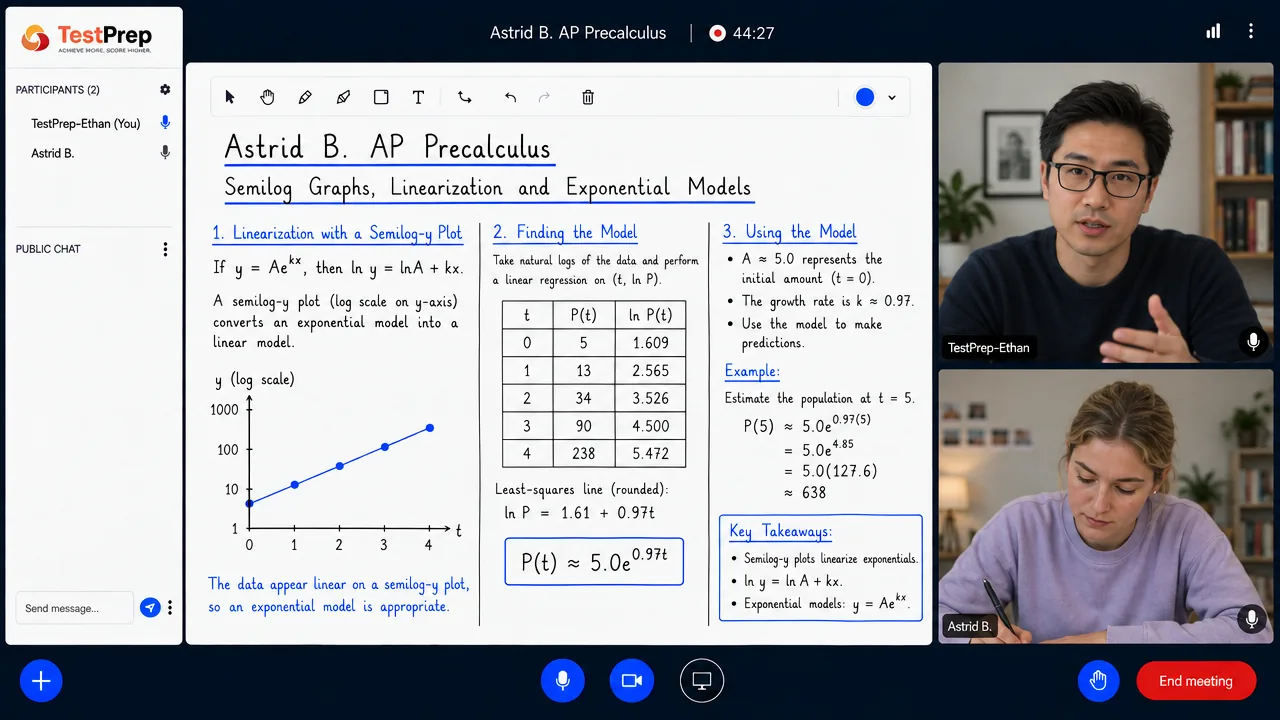
- Modeling data sets with exponential functions
- Composing functions and finding inverses
- Modeling scenarios with logarithmic functions
- Validating a function model using a residual plot
3Unit 3: Trigonometric and Polar Functions
30–35%
- Relating right triangle trigonometry to the sine, cosine, and tangent functions
- Modeling data and scenarios with sinusoidal functions
- Using inverse trigonometric functions to solve trigonometric equations
- Graphing functions using polar coordinates
- Describing how angles and radii change with respect to each other in a polar graph
4Unit 4: Functions Involving Parameters, Vectors, and Matrices
Not on the AP Exam
- Describing how quantities change with respect to each other in a parametric function
- Graphing conic sections using implicitly defined functions and parametric functions
- Using vectors to describe motion of an object
- Describing the impact of a transformation matrix on a graphical object
- Modeling change in a context using matrices
Approach
How we teach AP Precalculus
Study plan
- 1
Phase 1 — Polynomial and rational (Unit 1)
End behaviour, zeros, asymptotes, transformations
- End-behaviour reasoning from leading term
- Vertical / horizontal / slant asymptotes from rational forms
- 2
Phase 2 — Exponential and logarithmic (Unit 2)
Inverses, log laws, modelling with exp / log
- Solving exponential equations algebraically
- Half-life and growth-rate modelling FRQs
- 3
Phase 3 — Trigonometric and polar (Unit 3)
Unit circle, identities, polar functions
- Unit-circle fluency in radians and degrees
- Identity-based simplification practice
- Polar curves and conversions
- 4
Phase 4 — Functions, vectors, matrices (Unit 4, not assessed on the AP Exam) + mock
Parametric, vector, matrix functions
- Vector arithmetic and dot product
- 2x2 matrix transformations
- Released FRQs to rubric
How lessons work
Function families compared in parallel
Polynomial, rational, exponential, log and trig functions are taught in a comparison grid (domain, range, end behaviour, asymptotes, key transformations) so students recognise the family from the prompt.
Modelling FRQs as a script
Modelling tasks have a fixed shape: read scenario, identify the function family, write the function, answer the question, interpret in context. We drill this script until it's automatic.
Calculator vs no-calculator separated
The two sections reward different skills (algebraic manipulation vs efficient calculator use). We drill them as different exams and tune calculator workflow.
Advice
AP Precalculus: common mistakes and study tips
MistakeConfusing rate of change with average rate of change.
FixAverage rate uses two endpoints; instantaneous rate uses a limit. Be explicit about which the question asks for.
MistakeDropping domain restrictions on rational and log functions.
FixState the domain explicitly before solving; cancelled factors leave holes, not 'simplifications'.
MistakeWrong sign or direction on log / exponent problems.
FixPractise log laws on small numerical examples first, then move to symbolic manipulation.
MistakeTrig identity errors under time pressure.
FixKeep a small priority list — Pythagorean, sum and difference, double-angle — and rehearse choosing the right identity, not deriving on the spot.
MistakePolar plotting with the wrong angle convention.
FixConfirm whether the question uses radians or degrees; calculator-mode mismatches are common.
MistakeModelling FRQs that skip interpretation.
FixEvery modelling FRQ ends with 'interpret the meaning'. Always answer in the units of the original scenario.
Study tips
- Memorise the unit circle cold — it is the foundation for every trigonometric question on the exam.
- Practise hand-sketching every function family so you can recognise behaviour without a calculator.
- Visualise transformations (shift, stretch, reflect) by graphing each step rather than guessing the final picture.
- If you are heading to AP Calculus, build the intuitive idea of a limit here so the AB jump feels natural.
Ready to raise your AP Precalculus score?
You can start one-to-one AP Precalculus lessons with a single lesson. Every package and price is on one page.
- Live one-to-one lessons online
- No package needed — book a single lesson
- Lesson times that fit your school week
You can also write to us through our contact page.
Other subjects
Related and other AP subjects
Often taken alongside this subject
- AP Calculus ABStandard next step — AP Precalculus is explicitly designed as Calculus AB preparation.
- AP Calculus BCStronger students often skip from AP Precalculus directly into BC.
- AP StatisticsFunction modelling and graph interpretation transfer between Precalculus and Statistics.
All AP subjects
- AP Calculus AB
- AP Calculus BC
- AP Statistics
- AP Computer Science A
- AP Computer Science Principles
- AP Physics 1
- AP Physics 2
- AP Physics C: Mechanics
- AP Physics C: Electricity & Magnetism
- AP Chemistry
- AP Biology
- AP Environmental Science
- AP English Language & Composition
- AP English Literature & Composition
- AP US History (APUSH)
- AP World History: Modern
- AP European History
- AP US Government & Politics
- AP Comparative Government & Politics
- AP Human Geography
- AP Microeconomics
- AP Macroeconomics
- AP Psychology
- AP Art History
- AP Music Theory
- AP Spanish Language & Culture
- AP French Language & Culture
- AP Chinese Language & Culture
- AP Business with Personal Finance
- AP Cybersecurity
- AP African American Studies
AP Precalculus Prep — Frequently Asked Questions
The questions students ask most about AP Precalculus preparation.