HomeAPU.S. History
PopularDBQ Essay

AP U.S. History Tutoring & Prep Course

Short answer

The AP US History (APUSH) group course is live online: 50 lessons, 90 minutes each, 75 hours in all.

Group lessons are taught in classes of at most 6 students.

The current group's lessons began on 26 September 2026. The group course fee is €1,573 in one payment.

Try the free AP US History (APUSH) practice test

AP US History (APUSH) tutoring across the nine College Board periods, with DBQ, LEQ and short-answer writing strategy for a score of 5.

One-to-one and small groups · Live online · College Board curriculum

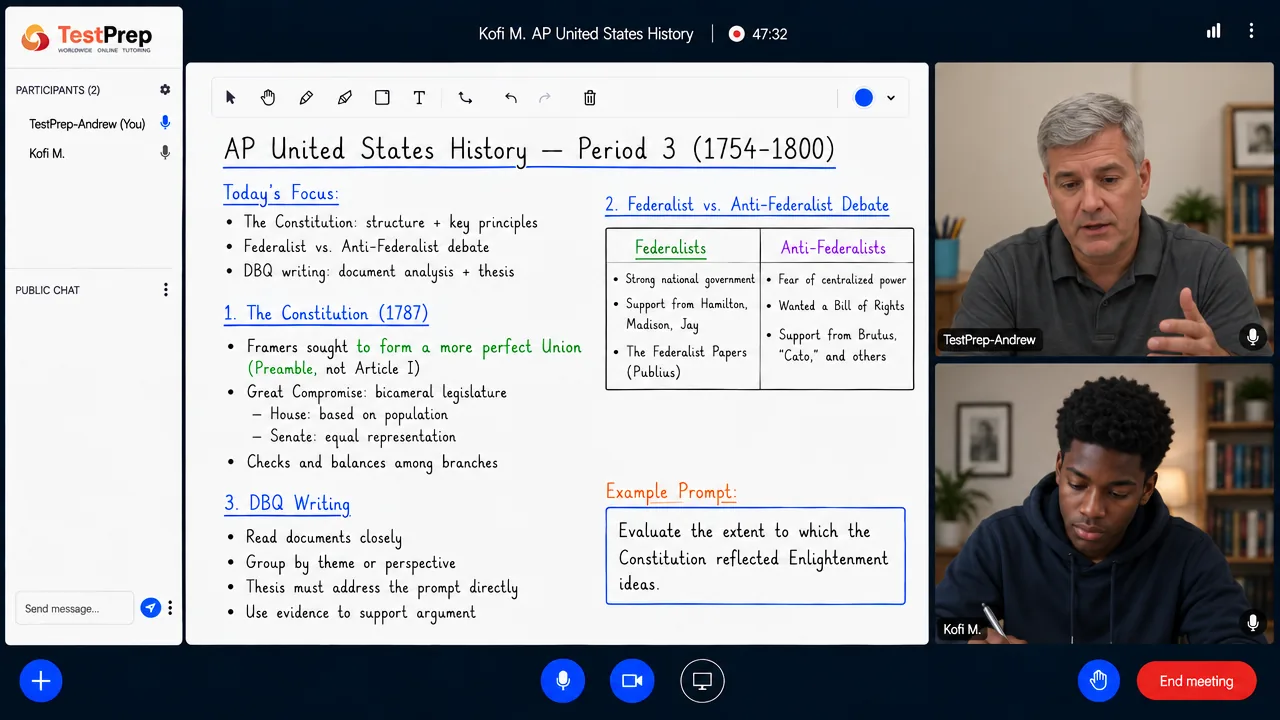
From a TestPrep AP United States History private lesson

100% live online lessons

About the subject

AP US History (APUSH): what it covers and who it suits

AP US History (APUSH) tutoring at TestPrep Europe drills the four FRQ types — DBQ, LEQ, SAQ short-answer, and the MCQ stimulus questions — built around the College Board's nine periods and eight course themes. The exam rewards historical argument with sourced evidence and contextualisation, not narrative retelling.

  • Nine periods (1491–present) covered with theme-based connections
  • DBQ, LEQ, SAQ and stimulus MCQs each drilled as a separate genre
  • Document sourcing (HIPP — historical situation, intended audience, purpose, point of view) as a fixed routine
Read more

AP US History (APUSH) is a comprehensive course on American history from the colonial period to the present. For students applying to US universities, it provides the historical context to engage seriously with American academic life, and the document-based writing it teaches is directly applicable to the writing-intensive courses every US undergraduate takes.

AP US History (APUSH) divides American history from 1491 to the present into nine periods and trains students in the AP historical thinking skills: causation, comparison, continuity and change over time, and contextualisation. The exam's signature feature is the Document-Based Question, which gives students seven primary sources and asks them to synthesise the evidence into a defensible historical argument. Our programme works through every period chronologically, builds thematic comparison tables alongside the timeline and provides weekly DBQ and LEQ writing practice with rubric-aligned feedback.

One-to-one AP US History (APUSH) tutoring

Our one-to-one AP tutoring is built entirely around the student's current level and target score. Each lesson works on your specific weak topics, drills exam-format questions and teaches free-response and essay technique with the College Board's scoring guidelines in front of us. Our tutors follow every revision of the Course and Exam Description, so the work you put in matches what is rewarded in May.

AP US History (APUSH) small-group course

Our small-group AP courses (no more than 6 students per class) give you a structured weekly programme alongside students aiming for the same score. The syllabus follows the College Board's Course and Exam Description unit by unit, and every lesson is taught live online.

Exam

AP US History (APUSH) exam format

The College Board runs the AP US History (APUSH) exam every May. Sections, timing and weighting:

  • Section I-A: Multiple Choice

    40%

    55 stimulus-based questions in 55 minutes.

  • Section I-B: Short Answer

    20%

    3 required short-answer questions in 40 minutes. From May 2027 there is no choice, and each question is built on a source: secondary text, primary text, and a non-text source such as an image, map or graph. Each question covers a different period.

  • Section II: Free Response

    40%

    1 hour 40 minutes: 1 Document-Based Question (DBQ: seven documents, 60 minutes including a 15-minute reading period, 25%) and 1 required Long Essay Question (LEQ: 40 minutes, 15%). From May 2027 there is no choice of LEQ prompts. The whole exam is digital in Bluebook.

One-to-one AP tutoring

AP US History (APUSH) Private Tutoring

Private AP lessons planned around you: the units you find hardest, your school's pace and the score you are aiming for. Every lesson is live and online, with a tutor who teaches this subject.

  • A lesson plan built around your target score
  • Every unit of the College Board course, in the order you need it
  • Multiple-choice and free-response technique, checked against College Board scoring guidelines
  • Lesson times that fit around your school week

How it works

  1. 1

    Tell us your goal

    We start from your school syllabus, your exam date and the result you are aiming for.

  2. 2

    Your own plan

    We map out the lessons you need, unit by unit.

  3. 3

    Live one-to-one lessons

    Meet your tutor online at times that suit your week.

  4. 4

    Regular progress checks

    Homework and a short check after each lesson show how you are getting on.

Start one-to-one AP US History (APUSH)

Per lesson in a package

From €58

Single lesson €63

See all prices

Right for you if you want a plan built entirely around you, flexible lesson times and a tutor's full attention.

Book one-to-one lessons

Before choosing a package, you can book one paid lesson.

Our AP tutors began teaching in 2018 or earlier.

Group course calendar

AP United States History Group Course Calendar

50 lessons in total (40 topic lessons + 10 past-paper lessons). Topic lessons on Saturday and Sunday, 10:30–12:00; past-paper lessons on Saturday, 10:30–12:00 (Türkiye time). Lessons are taught in English.

2027-28 classes

First lesson

25 September 2027

Last lesson

29 April 2028

Enrolment deadline

22 September 2027

AP exam

5 May 2028 (estimated)

Course fee

€1,573single payment

or 3 instalments of €524

Enrol now
  • 50 lessons in total
  • 40 topic lessons
  • 10 past-paper lessons
  • Lesson recordings available for 14 days

Lesson-by-lesson calendar

Topic lessonPast-paper lesson
Lesson-by-lesson calendar
DateTopic
25 Sep 2027Sat10:30–12:00Period 1: 1491–1607 (1/2)
26 Sep 2027Sun10:30–12:00Period 1: 1491–1607 (2/2)
2 Oct 2027Sat10:30–12:00Period 2: 1607–1754 (1/3)
3 Oct 2027Sun10:30–12:00Period 2: 1607–1754 (2/3)
9 Oct 2027Sat10:30–12:00Period 2: 1607–1754 (3/3)
10 Oct 2027Sun10:30–12:00Period 3: 1754–1800 (1/6)
16 Oct 2027Sat10:30–12:00Period 3: 1754–1800 (2/6)
17 Oct 2027Sun10:30–12:00Period 3: 1754–1800 (3/6)
23 Oct 2027Sat10:30–12:00Period 3: 1754–1800 (4/6)
24 Oct 2027Sun10:30–12:00Period 3: 1754–1800 (5/6)

Good to know

  • College Board has not yet published the May 2028 AP exam schedule, so the exam date is estimated from the 2027 schedule. Once it is confirmed, we will adjust the programme to match.
  • 100% First-Lesson Money-Back Guarantee

    Not satisfied? Full refund, no questions asked.

    We do not offer free trial lessons. Payment is required before your first lesson.

  • Secure Payments

    Powered by Stripe with 256-bit encryption.

    Stripe
  • Flexible Billing

    Local cards welcome, instalments available.

Lessons cancelled less than 3 hours before the start count as taken. Full terms

Practice test · Question bank · TestPrep AI Tutor

Practise AP US History (APUSH) on your own

Three ways to practise between lessons. Each one is a separate product.

  • Coming soon

    AP US History (APUSH) Question Bank

    The AP US History (APUSH) question bank is on its way. Until then, you can explore the other AP subjects in the question bank.

    Explore the AP question bank
  • AP US History (APUSH) Practice Test

    A full-length test in the real exam format, with a detailed score report. Two attempts per test, and 12 months to use them.

    Go to the practice test
  • TestPrep AI Tutor

    Talks you through the questions you got wrong on a practice test, out loud. Your first 2 mistakes are free.

    How TestPrep AI Tutor works

Syllabus

AP US History (APUSH) topics

Unit and topic names are the College Board's own. Percentages are each unit's share of the exam score, as the College Board publishes them.

1

Unit 1: Period 1: 1491–1607

4–6%
  • Native American societies before European contact
  • European exploration in the New World
  • The Columbian Exchange
  • Labor, slavery, and caste in the Spanish colonial system
  • Cultural interactions between Europeans, Native Americans, and Africans
2

Unit 2: Period 2: 1607–1754

6–8%
  • How different European colonies developed and expanded
  • Transatlantic trade
  • Interactions between American Indians and Europeans
  • Slavery in the British colonies
  • Colonial society and culture
3

Unit 3: Period 3: 1754–1800

10–17%
  • The Seven Years' War
  • The American Revolution
  • The Articles of Confederation
  • The creation and ratification of the Constitution
  • Developing an American identity
  • Immigration to and migration within America
4

Unit 4: Period 4: 1800–1848

10–17%
  • The rise of political parties
  • American foreign policy
  • Innovations in technology, agriculture, and business
  • Debates about federal power
  • The Second Great Awakening
  • Reform movements
  • The experience of African Americans
5

Unit 5: Period 5: 1844–1877

10–17%
  • Manifest Destiny
  • The Mexican–American War
  • Attempts to resolve conflicts over the spread of slavery
  • The election of 1860 and Southern secession
  • The Civil War
  • Reconstruction
6

Unit 6: Period 6: 1865–1898

10–17%
  • The settlement of the West
  • The "New South"
  • The rise of industrial capitalism
  • Immigration and migration
  • Reform movements
  • Debates about the role of government
7

Unit 7: Period 7: 1890–1945

10–17%
  • Debates over imperialism
  • The Progressive movement
  • World War I
  • Innovations in communications and technology in the 1920s
  • The Great Depression and the New Deal
  • World War II
  • Postwar diplomacy
8

Unit 8: Period 8: 1945–1980

10–17%
  • The Cold War and the Red Scare
  • America as a world power
  • The Vietnam War
  • The Great Society
  • The African American civil rights movement
  • Youth culture of the 1960s
9

Unit 9: Period 9: 1980–Present

4–6%
  • Reagan and conservatism
  • The end of the Cold War
  • Shifts in the economy
  • Migration and immigration
  • Challenges of the 21st century

Approach

How we teach AP US History (APUSH)

Study plan

  1. 1

    Phase 1 — Periods 1–4 (1491–1848)

    Colonisation, Revolution, Constitution, early republic, antebellum

    • Anchor events and one-page timelines per period
    • SAQ drills on causation and comparison
  2. 2

    Phase 2 — Periods 5–6 (1844–1898)

    Civil War, Reconstruction, industrialisation, Gilded Age

    • DBQ structure with HIPP
    • LEQ thesis-and-evidence routine
  3. 3

    Phase 3 — Periods 7–8 (1890–1980)

    Progressive era, World Wars, Cold War, civil rights

    • Continuity and change essays
    • Stimulus MCQ practice on visual / textual sources
  4. 4

    Phase 4 — Period 9 + thematic review + mock

    Late 20th century to present, theme-based connections

    • Theme-based timelines (NAT, WOR, ARC, etc.)
    • Released DBQ + LEQ to rubric
    • Full-length timed practice exam

How lessons work

  • HIPP as a reflex

    Document sourcing is taught as a four-step checklist — historical situation, intended audience, purpose, point of view — and rehearsed until students apply it without thinking.

  • Theme-based revision over chronology

    Late-stage review pivots from period-by-period to theme-by-theme (NAT, WOR, ARC, MIG, etc.), because the single required LEQ gives a broad prompt spanning about half the course, and themes are what connect evidence across that span.

  • Specific evidence banks

    Each student keeps a bank of named events, laws and figures by period, so essay evidence is precise rather than vague.

Advice

AP US History (APUSH): common mistakes and study tips

  • MistakeNarrative storytelling instead of historical argument.

    FixOpen every essay with a defensible thesis that makes a claim, then defend it with evidence — never retell events.

  • MistakeQuoting documents without sourcing them.

    FixDo HIPP on at least two documents in every DBQ (the rubric's minimum for the sourcing point) and practise three for a margin of safety; a document used without sourcing earns evidence credit but not that point.

  • MistakeVague evidence ('many people opposed the war').

    FixUse specific names, laws, dates, court cases. Specificity is what separates a 4 from a 5 on the rubric's evidence row.

  • MistakeWeak contextualisation ('this was during the Cold War').

    FixContextualisation must be a paragraph of historical situation that ties to the prompt — not a one-line label.

  • MistakeChronology errors that undermine the argument.

    FixBuild a one-page timeline of the nine periods with five anchor events each; revisit it weekly so dates don't slip.

  • MistakeRunning out of time on the LEQ.

    FixUse a fixed split (DBQ 60 min / LEQ 40 min / SAQs 40 min) and protect the LEQ block strictly.

Study tips

  • On the DBQ, use at least 4 of the 7 documents and tie each to its historical context.
  • Use the HAPPY (Historical context, Audience, Purpose, Point of view, whY) framework on every document.
  • Learn thematic links — causation, comparison, continuity and change — alongside the timeline.
  • On the LEQ, build a tight thesis and defend it in 2–3 evidence-rich body paragraphs; depth beats breadth.

Ready to raise your AP US History (APUSH) score?

You can start one-to-one AP US History (APUSH) lessons with a single lesson. Every package and price is on one page.

  • Live one-to-one lessons online
  • No package needed — book a single lesson
  • Lesson times that fit your school week
FAQ

AP US History (APUSH) Prep — Frequently Asked Questions

The questions students ask most about AP US History (APUSH) preparation.

The DBQ is the highest-weighted single FRQ on the exam. Students who treat it as 'just another essay' usually under-score; we drill it as the centrepiece.

Knowing major presidencies and their signature policies matters; memorising every cabinet does not. We focus on which figures and laws are useful as evidence.

Different — APUSH is narrower and deeper; APWH is broader. The skills are identical, but APUSH rewards specific US-focused evidence while APWH rewards comparison across regions.

Yes, when they treat it as an argument-and-evidence exam rather than a memorisation contest. The skills transfer from any humanities background.

The money-back guarantee covers live lessons. If you are not satisfied after your first private lesson, we refund your payment in full. The question bank and practice tests are not part of it. We do not offer free trial lessons. Payment is required before your first lesson.

Practice tests, question banks and TestPrep AI Tutor time are digital content. You can ask for a refund of a digital product you have not used within 14 days of the payment date. A product counts as used once any practice test in the pack has been started, any question in a paid section of the question bank has been opened, or any second of TestPrep AI Tutor time has been used; a used product is not refunded.

You can cancel a lesson package at any time. Lessons already given are charged at the single-lesson price and the rest is refunded. The first-lesson guarantee applies on top.

Lessons cancelled less than 3 hours before the start count as taken and are not refunded. A lesson that has not been paid for 3 hours before it starts is cancelled automatically.

AP US History (APUSH) reviews

Be the first to review this programme.

Share your experience

Your comment will appear after approval.

Your rating

All TestPrep Europe reviews