AP Physics 2 Tutoring & Prep Course
Short answer
The AP Physics 2 group course is live online: 50 lessons, 90 minutes each, 75 hours in all.
Group lessons are taught in classes of at most 6 students.
The current group's lessons began on 26 September 2026. The group course fee is €1,573 in one payment.
Try the free AP Physics 2 practice test
AP Physics 2 tutoring covering thermodynamics, electricity, magnetism, optics, waves and modern physics for a score of 5.
One-to-one and small groups · Live online · College Board curriculum
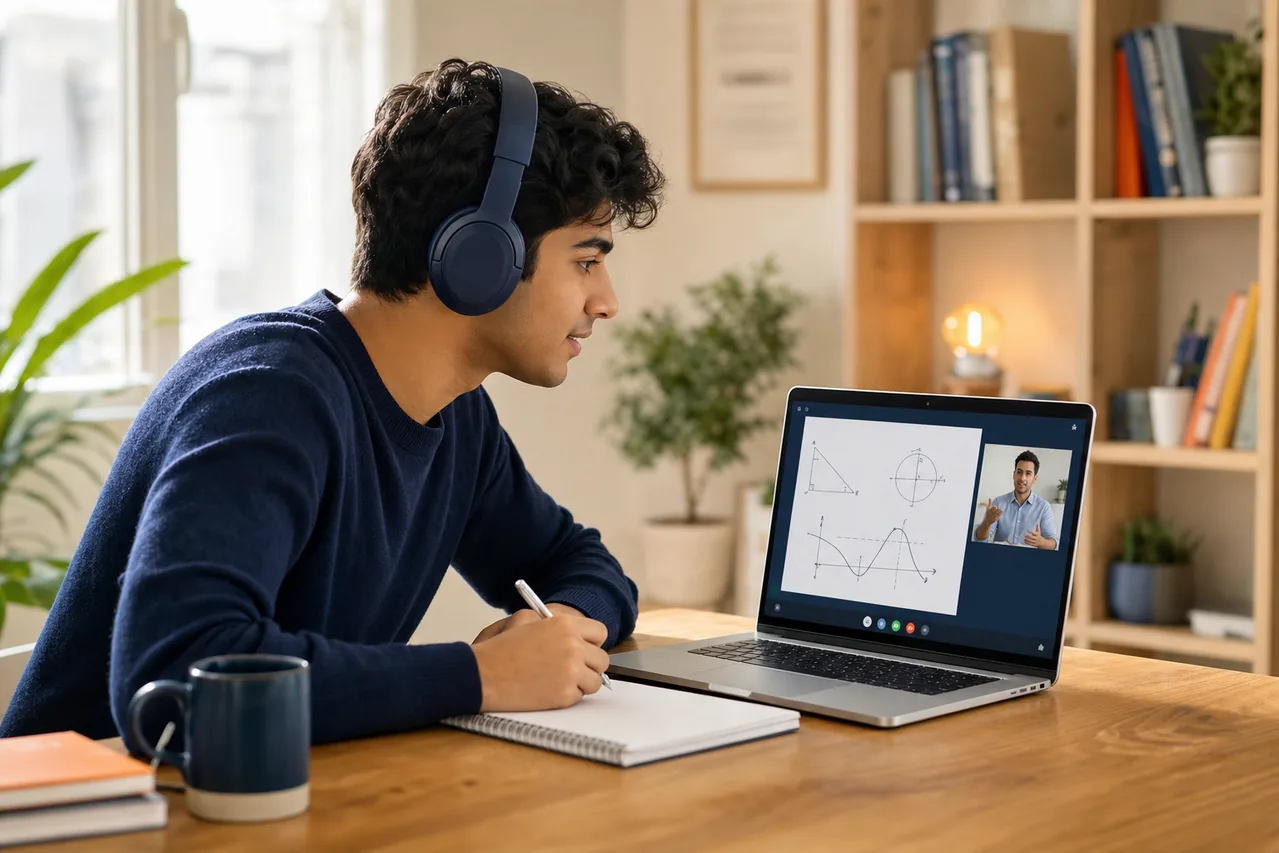
100% live online lessons
About the subject
AP Physics 2: what it covers and who it suits
AP Physics 2 tutoring at TestPrep Europe covers thermodynamics, electric force, fields and circuits, magnetism, optics, waves and modern physics in the MCQ + FRQ format used on the May exam. Physics 2 is algebra-based but heavily conceptual — the FRQ rubric rewards diagrams, sign conventions and proportional reasoning more than algebraic gymnastics.
Your lessons are taught by Ali Ertan, who teach AP Physics 2.
- Seven content units, Unit 9: Thermodynamics through Unit 15: Modern Physics
- Sign conventions and free-body / circuit diagrams drilled into reflex
- Proportional reasoning and 'what happens if you double …' practised explicitly
Read more
AP Physics 2 is the algebra-based continuation of AP Physics 1 and is useful for pre-medical, biomedical-engineering and environmental-science applicants. It covers thermodynamics, electric force, fields and circuits, magnetism and electromagnetism, geometric and physical optics, waves and sound, and modern physics. Fluids moved to AP Physics 1 in 2024-25. A strong score signals to admissions committees that a student can handle two consecutive years of college-level physics.
AP Physics 2 picks up the topics AP Physics 1 leaves behind. Students start with thermodynamics — heat, temperature, entropy and the gas laws — then move to electric force, field and potential, electric circuits, magnetism and electromagnetism, geometric optics, waves, sound and physical optics, and a closing unit on modern physics. Although fewer students take it than Physics 1, AP Physics 2 carries real value for biomedical, environmental and architecture applicants, all of whom need solid intuition about fields, circuits and waves. Our programme reinforces the AP Physics 1 mechanics base where needed and then drills the new content systematically, with circuit-analysis and optics workshops that mirror the FRQ scoring rubric.
One-to-one AP Physics 2 tutoring
Our one-to-one AP tutoring is built entirely around the student's current level and target score. Each lesson works on your specific weak topics, drills exam-format questions and teaches free-response and essay technique with the College Board's scoring guidelines in front of us. Our tutors follow every revision of the Course and Exam Description, so the work you put in matches what is rewarded in May.
AP Physics 2 small-group course
Our small-group AP courses (no more than 6 students per class) give you a structured weekly programme alongside students aiming for the same score. The syllabus follows the College Board's Course and Exam Description unit by unit, and every lesson is taught live online.
Exam
AP Physics 2 exam format
The College Board runs the AP Physics 2 exam every May. Sections, timing and weighting:
Section I: Multiple Choice
50%42 questions in 1 hour 25 minutes. Updated effective with the May 2027 exam. Calculators permitted.
Section II: Free Response
50%4 questions in 1 hour 35 minutes covering mathematical routines, translation between representations, experimental design and analysis, and qualitative/quantitative translation.
Exam delivery
Hybrid digitalMultiple choice is answered in Bluebook; free-response answers are handwritten.
One-to-one AP tutoring
AP Physics 2 Private Tutoring
Private AP lessons planned around you: the units you find hardest, your school's pace and the score you are aiming for. Every lesson is live and online, with a tutor who teaches this subject.
- A lesson plan built around your target score
- Every unit of the College Board course, in the order you need it
- Multiple-choice and free-response technique, checked against College Board scoring guidelines
- Lesson times that fit around your school week
How it works
- 1
Tell us your goal
We start from your school syllabus, your exam date and the result you are aiming for.
- 2
Your own plan
We map out the lessons you need, unit by unit.
- 3
Live one-to-one lessons
Meet your tutor online at times that suit your week.
- 4
Regular progress checks
Homework and a short check after each lesson show how you are getting on.
Start one-to-one AP Physics 2
Right for you if you want a plan built entirely around you, flexible lesson times and a tutor's full attention.
Book one-to-one lessonsBefore choosing a package, you can book one paid lesson.
Our AP tutors began teaching in 2018 or earlier.
No group is open right now
Group course
A Private Group for This Subject
There is no open group timetable for this subject in 2026–27. If 3 or more of you sign up together, we open a private group course for you — at the same price as the open group course. Lessons are taught in English.
Course fee
€1,573the same as an open group course
At least 3 students · you set the weekly timetable together
Each student buys their own place online, and we let you know as soon as your group is ready.
or 3 instalments of €524Questions first? Get in touch- Classes of no more than 6 students
- Live online lessons you can watch again
- A lesson plan that follows the College Board course
- Not satisfied after the first week of your group course? Full (100%) refund. We do not offer free trial lessons. Payment is required before your first lesson.
100% First-Lesson Money-Back Guarantee
Not satisfied? Full refund, no questions asked.
We do not offer free trial lessons. Payment is required before your first lesson.
Secure Payments
Powered by Stripe with 256-bit encryption.

Flexible Billing
Local cards welcome, instalments available.
Lessons cancelled less than 3 hours before the start count as taken. Full terms
Practice test · Question bank · TestPrep AI Tutor
Practise AP Physics 2 on your own
Three ways to practise between lessons. Each one is a separate product.
- Coming soon
AP Physics 2 Question Bank
The AP Physics 2 question bank is on its way. Until then, you can explore the other AP subjects in the question bank.
Explore the AP question bank AP Physics 2 Practice Test
A full-length test in the real exam format, with a detailed score report. Two attempts per test, and 12 months to use them.
Go to the practice testTestPrep AI Tutor
Talks you through the questions you got wrong on a practice test, out loud. Your first 2 mistakes are free.
How TestPrep AI Tutor works
Syllabus
AP Physics 2 topics
Unit and topic names are the College Board's own. Percentages are each unit's share of the exam score, as the College Board publishes them.
1Unit 9: Thermodynamics
15–18%
- Thermodynamic systems
- Pressure, thermal equilibrium, and the Ideal Gas Law
- Thermodynamics and forces
- Heat and energy transfer
- Thermodynamics and collisions
- Probability, thermal equilibrium, and entropy
2Unit 10: Electric Force, Field, and Potential
15–18%
- Electric systems and charge
- Charge distribution: Friction, conduction, and induction
- Electric permittivity
- Electric forces and free-body diagrams
- Gravitational and electromagnetic forces
- Electric charges and fields
- Electric flux
- Conservation of electric energy
3Unit 11: Electric Circuits
15–18%
- Definition and conservation of electric charge
- Resistivity and resistance
- Resistance and capacitance
- Kirchhoff's loop rule
- Kirchhoff's junction rule and the conservation of electric charge
4Unit 12: Magnetism and Electromagnetism
12–15%
- Magnetic systems
- Magnetic permeability and magnetic dipole moment
- Vector and scalar fields
- Monopole and dipole fields
- Magnetic fields and forces
- Forces review
- Magnetic flux
5Unit 13: Geometric Optics
12–15%
- Refraction, reflection, and absorption
- Images from lenses and mirrors
6Unit 14: Waves, Sound, and Physical Optics
12–15%
- Periodic waves
- Electromagnetic waves
- Sound
- Doppler Effect
- Interference and diffraction
7Unit 15: Modern Physics
12–15%
- Radioactive decay
- Energy in modern physics (energy in radioactive decay and E = mc²)
- Mass–energy equivalence
- Blackbody radiation
- Properties of waves and particles
- Photoelectric effect
Approach
How we teach AP Physics 2
Study plan
- 1
Phase 1 — Unit 9: Thermodynamics
Thermodynamic systems, the Ideal Gas Law, heat transfer, entropy
- PV diagrams and first-law accounting
- Microscopic-to-macroscopic reasoning
- 2
Phase 2 — Unit 10: Electric Force, Field, and Potential and Unit 11: Electric Circuits
Charge, fields, potential, resistance, capacitance, Kirchhoff's rules
- Field vs potential reasoning
- Capacitors in circuits
- Mixed series-parallel circuit reduction
- 3
Phase 3 — Unit 12: Magnetism and Electromagnetism and Unit 13: Geometric Optics
Magnetic fields and forces, magnetic flux, mirrors and lenses
- Force on moving charges and current-carrying wires
- Mirror and lens equations with sign conventions
- 4
Phase 4 — Unit 14: Waves, Sound, and Physical Optics and Unit 15: Modern Physics + mock
Waves, interference and diffraction, photons, radioactive decay
- Single- and double-slit calculations
- Photoelectric effect and blackbody radiation
- Released FRQ set under timed conditions
How lessons work
Diagrams before equations
Free-body, ray, and circuit diagrams are drawn before any equation is written — the rubric awards points for the diagram, and the diagram fixes most sign errors before they happen.
Proportional reasoning as a separate skill
AP Physics 2 FRQs constantly ask 'what happens if X doubles?'. We drill these as ratios rather than by re-running the calculation, so students answer them in seconds.
Lab FRQs as a structured genre
Experimental-design FRQs follow a fixed template: variables, control, procedure, expected data, falsification. Students rehearse the template rather than improvising under time pressure.
Advice
AP Physics 2: common mistakes and study tips
MistakeTreating electric field and electric potential as the same thing — assuming the potential is zero wherever the field is.
FixWrite down first whether the question wants a vector (field) or a scalar (potential); add fields as vectors and potentials with their signs.
MistakeConfusing series and parallel rules in mixed circuits.
FixRe-draw the circuit as nested blocks and reduce step by step rather than trying to read the original diagram.
MistakeWrong sign on charges and currents in magnetic-force problems.
FixUse the right-hand rule explicitly each time; sketch the vectors with labels rather than visualising in your head.
MistakeTreating optics ray diagrams as decoration.
FixDraw the principal rays first, then read object/image distances and orientation from the diagram — the rubric awards diagram points.
MistakeSloppy units in thermodynamics ('joules' for power).
FixCarry units through every calculation; W vs J vs W·s distinguishes correct from rubric-failing answers.
MistakeWeak experimental explanations on lab FRQs.
FixAlways state the variables, the control, and how the data would falsify the hypothesis — exactly the language the rubric expects.
Study tips
- Tie the laws of thermodynamics to everyday devices (refrigerators, heat engines) so the abstractions become concrete.
- Approach circuit problems systematically: simplify the network first, then apply Kirchhoff's laws.
- Always draw ray diagrams on optics questions — the picture is half the answer.
- Modern physics is more conceptual than computational; understand photon energy, wave–particle duality and quantised energy levels.
Ready to raise your AP Physics 2 score?
You can start one-to-one AP Physics 2 lessons with a single lesson. Every package and price is on one page.
- Live one-to-one lessons online
- No package needed — book a single lesson
- Lesson times that fit your school week
You can also write to us through our contact page.
Other subjects
Related and other AP subjects
Often taken alongside this subject
- AP Physics 1Algebra-based foundation; Physics 1 mechanics is assumed background for Physics 2.
- AP Physics C: MechanicsCalculus-based mechanics for engineering / physics applications.
- AP Calculus ABStrengthens the proportional and rate reasoning Physics 2 leans on.
All AP subjects
- AP Calculus AB
- AP Calculus BC
- AP Statistics
- AP Precalculus
- AP Computer Science A
- AP Computer Science Principles
- AP Physics 1
- AP Physics C: Mechanics
- AP Physics C: Electricity & Magnetism
- AP Chemistry
- AP Biology
- AP Environmental Science
- AP English Language & Composition
- AP English Literature & Composition
- AP US History (APUSH)
- AP World History: Modern
- AP European History
- AP US Government & Politics
- AP Comparative Government & Politics
- AP Human Geography
- AP Microeconomics
- AP Macroeconomics
- AP Psychology
- AP Art History
- AP Music Theory
- AP Spanish Language & Culture
- AP French Language & Culture
- AP Chinese Language & Culture
- AP Business with Personal Finance
- AP Cybersecurity
- AP African American Studies
AP Physics 2 Prep — Frequently Asked Questions
The questions students ask most about AP Physics 2 preparation.