AP Chinese Language and Culture Tutoring & Prep Course
Short answer
The AP Chinese Language & Culture course is one-to-one tutoring, taught live online: every lesson is 90 minutes.
A private group is for 3 or more friends who sign up together; there are no published start dates, and we agree the start date and lesson times with you.
In one-to-one tutoring, packages are from €58 a lesson.
Try the free AP Chinese Language & Culture practice test
AP Chinese Language and Culture tutoring with listening, speaking and writing strategy for a score of 5.
One-to-one and small groups · Live online · College Board curriculum
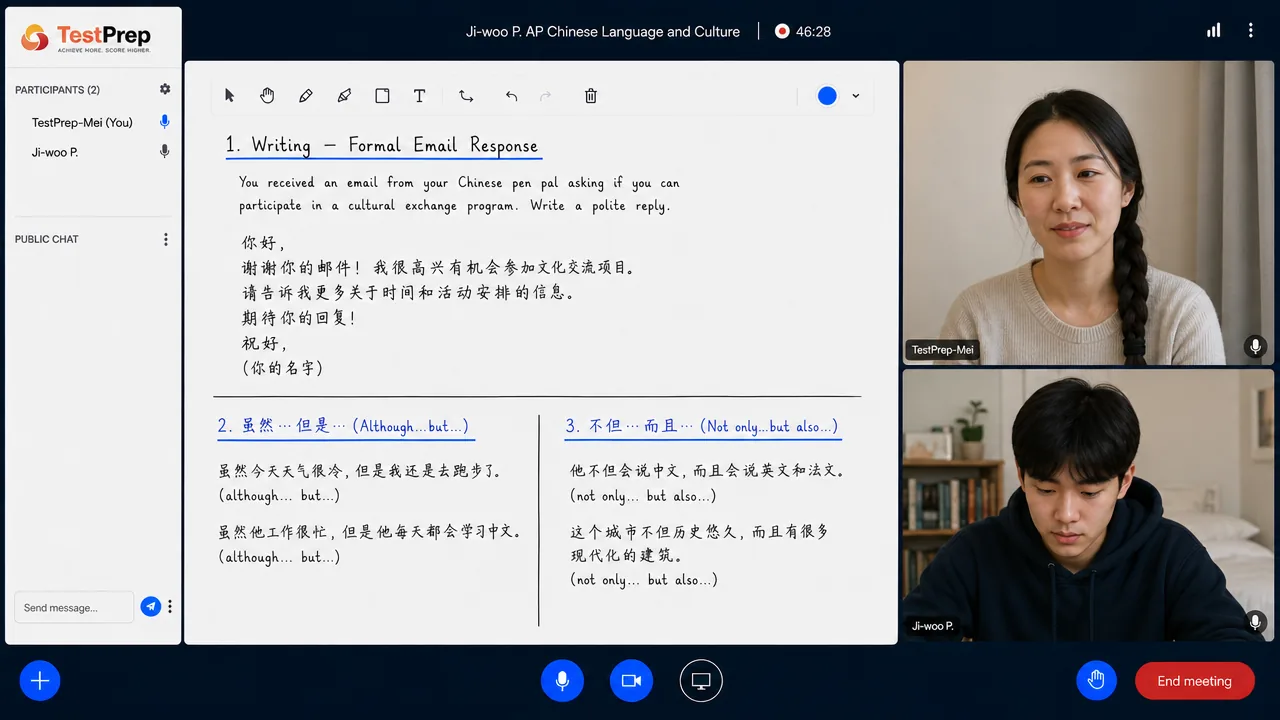
100% live online lessons
About the subject
AP Chinese Language & Culture: what it covers and who it suits
AP Chinese Language and Culture tutoring at TestPrep Europe builds proficiency across listening, reading, speaking and writing at the Intermediate-Mid to Intermediate-High level. The exam runs in Bluebook, with on-screen text in simplified or traditional characters and typed answers in Pinyin or Bopomofo. Since the 2026-27 revision, a course project prepares the Project Presentation and Project Q&A; the written tasks are story narration and an email response.
- Bluebook format with simplified or traditional characters and Pinyin / Bopomofo input
- Project Presentation, Project Q&A, story narration and email response drilled separately
- Pinyin / character input fluency built up explicitly for the writing tasks
Read more
AP Chinese Language and Culture develops advanced Mandarin reading, writing, listening and speaking. As the world's second-largest economy, China makes Mandarin increasingly valuable in international business, diplomacy and cultural exchange. The exam runs in Bluebook, where on-screen text can be shown in simplified or traditional characters and answers are typed with Pinyin or Bopomofo.
AP Chinese Language and Culture is an advanced Mandarin course covering both simplified and traditional characters and integrating reading, writing, listening and speaking. Since the 2026-27 revision, a year-long course project prepares the Project Presentation and Project Q&A on exam day; the written tasks are story narration (a four-image picture sequence) and an email response, followed by listening and reading multiple choice, all in Bluebook. Our programme adapts to each student's starting level: heritage speakers focus on academic Chinese and exam strategy, while non-heritage speakers build core language skills up to exam standard.
One-to-one AP Chinese Language & Culture tutoring
Our one-to-one AP tutoring is built entirely around the student's current level and target score. Each lesson works on your specific weak topics, drills exam-format questions and teaches free-response and essay technique with the College Board's scoring guidelines in front of us. Our tutors follow every revision of the Course and Exam Description, so the work you put in matches what is rewarded in May.
AP Chinese Language & Culture small-group course
Our small-group AP courses (no more than 6 students per class) give you a structured weekly programme alongside students aiming for the same score. The syllabus follows the College Board's Course and Exam Description unit by unit, and every lesson is taught live online.
Exam
AP Chinese Language & Culture exam format
The College Board runs the AP Chinese Language & Culture exam every May. Sections, timing and weighting:
Section I: Free Response
50%4 tasks in 40-45 minutes: project presentation (3 minutes prep, 3 minutes presenting, 20%), project Q&A (4 questions, 40 seconds each, 15%), story narration (7.5%) and email response (7.5%) — the last two share 30 minutes.
Section II: Multiple Choice
50%55 questions in 1 hour 5 minutes: Part A listening (25 questions, 25 minutes, 25%) and Part B reading (30 questions, 40 minutes, 25%).
Exam delivery
Fully digitalRevised for 2026-27: the exam runs in Bluebook and paper exams are discontinued. The Personalized Project Reference is submitted through the AP Digital Portfolio by April 30.
How do I register for the exam?
- The course project materials open in the AP Digital Portfolio in January, and you submit your Personalized Project Reference by 30 April. The two speaking questions on exam day (Project Presentation and Project Q&A) are about your project.
One-to-one AP tutoring
AP Chinese Language & Culture Private Tutoring
Private AP lessons planned around you: the units you find hardest, your school's pace and the score you are aiming for. Every lesson is live and online, with a tutor who teaches this subject.
- A lesson plan built around your target score
- Every unit of the College Board course, in the order you need it
- Multiple-choice and free-response technique, checked against College Board scoring guidelines
- Lesson times that fit around your school week
How it works
- 1
Tell us your goal
We start from your school syllabus, your exam date and the result you are aiming for.
- 2
Your own plan
We map out the lessons you need, unit by unit.
- 3
Live one-to-one lessons
Meet your tutor online at times that suit your week.
- 4
Regular progress checks
Homework and a short check after each lesson show how you are getting on.
Start one-to-one AP Chinese Language & Culture
Right for you if you want a plan built entirely around you, flexible lesson times and a tutor's full attention.
Book one-to-one lessonsBefore choosing a package, you can book one paid lesson.
Our AP tutors began teaching in 2018 or earlier.
Group course
A Private Group for This Subject
There is no open group timetable for this subject in 2026–27. If 3 or more of you sign up together, we open a private group course for you — at the same price as the open group course. Lessons are taught in English.
Course fee
€1,573the same as an open group course
At least 3 students · you set the weekly timetable together
Each student buys their own place online, and we let you know as soon as your group is ready.
or 3 instalments of €524Questions first? Get in touch- Classes of no more than 6 students
- Live online lessons you can watch again
- A lesson plan that follows the College Board course
- Not satisfied after the first week of your group course? Full (100%) refund. We do not offer free trial lessons. Payment is required before your first lesson.
100% First-Lesson Money-Back Guarantee
Not satisfied? Full refund, no questions asked.
We do not offer free trial lessons. Payment is required before your first lesson.
Secure Payments
Powered by Stripe with 256-bit encryption.

Flexible Billing
Local cards welcome, instalments available.
Lessons cancelled less than 3 hours before the start count as taken. Full terms
Practice test · Question bank · TestPrep AI Tutor
Practise AP Chinese Language & Culture on your own
Three ways to practise between lessons. Each one is a separate product.
- Coming soon
AP Chinese Language & Culture Question Bank
The AP Chinese Language & Culture question bank is on its way. Until then, you can explore the other AP subjects in the question bank.
Explore the AP question bank AP Chinese Language & Culture Practice Test
A full-length test in the real exam format, with a detailed score report. Two attempts per test, and 12 months to use them.
Go to the practice testTestPrep AI Tutor
Talks you through the questions you got wrong on a practice test, out loud. Your first 2 mistakes are free.
How TestPrep AI Tutor works
Syllabus
AP Chinese Language & Culture topics
Unit and topic names are the College Board's own.
1Unit 1: Families and Communities
- Explore how families shape values and traditions, as well as personal beliefs and interests
- Examine the experiences faced by families in modern society
- Consider the evolving role of the community in contemporary societies
2Unit 2: Language and Culture
- Explore how developments in science and technology impact language and the ways in which people communicate
- Examine how social media affects others
- Consider the role of entertainment and advertising as integral parts of culture
- Explore how a community's values are reflected in its art and customs
3Unit 3: Art and Creativity
- Explore how art and creativity influence the quality of life and values in a community
- Consider the role and importance of art in Chinese-speaking communities
- Discover how the arts capture and reflect the history of a community
- Investigate how the concepts of art and creativity are defined within a culture
- Explore how art challenges and reflects cultural perspectives
4Unit 4: Science and Technology
- Explore how developments in science can both create and resolve challenges in contemporary society
- Investigate how technology creates new ways to connect with others and how it impacts and shapes language and culture
5Unit 5: Contemporary Life
- Investigate how cultural perspectives and traditions relate to contemporary life
- Consider how a community's culture affects public life
- Explore how popular culture influences contemporary life
6Unit 6: Global Contexts
- Investigate how global phenomena affect individual families and communities
- Explore how individuals can influence the world around them
- Suggest possible solutions that address contemporary global challenges
Approach
How we teach AP Chinese Language & Culture
Study plan
- 1
Phase 1 — Foundation
High-frequency characters and grammar
- Top 1,000 characters with examples
- Aspect markers, measure words, sentence patterns
- 2
Phase 2 — Interpretive mode
Listening and reading
- Audio comprehension with note-taking
- Reading practice with character-decoding under time pressure
- 3
Phase 3 — Writing tasks
Story narration and email response
- Pinyin / character input speed drills
- Narrative-writing structure practice
- Email-response template practice
- 4
Phase 4 — Course project + mock
Project Presentation and Project Q&A
- Personalized Project Reference drafted and submitted by 30 April
- Timed presentation and 40-second Q&A rehearsal
- Full practice exam in Bluebook format
How lessons work
Input speed as a core skill
AP Chinese is computer-delivered. We drill IME input speed and accuracy until it stops being a bottleneck on the writing tasks.
Cultural content as named evidence
Students keep a small bank of named festivals, regional foods, artists and historical figures, ready to deploy in the project presentation and Q&A.
Writing tasks as templates
Story narration and the email response have predictable structures. We practise the templates until automatic, leaving cognitive room for content.
Advice
AP Chinese Language & Culture: common mistakes and study tips
MistakeSlow pinyin / character input under timed writing.
FixDrill input speed on the delivery method (Microsoft IME or similar) until 30+ characters per minute is comfortable. Slow input alone can sink the writing score.
MistakeMixing simplified and traditional characters.
FixChoose one set at the start of the year and stay consistent across all tasks. Switching mid-essay reads as inconsistency.
MistakeEmail reply without required register and structure.
FixEmail reply has expected greetings, closings and formal register. Practise the template until automatic.
MistakeProject presentation answered with general claims.
FixUse specific material from your project sources (a song, an artist, a festival, a regional tradition) and explain its cultural significance. Generic answers under-score.
MistakeConfusing measure words and aspect markers (了 / 过 / 着).
FixDrill aspect markers in context, not as isolated grammar points. Errors here are common and visible to the rubric.
MistakeReading answers based on guessing characters.
FixUse the surrounding context and known characters before guessing; on AP Chinese, decoding by context is a tested skill.
Study tips
- Learn at least 30 new characters daily and use them in original sentences.
- Use CCTV, Mandarin podcasts and Chinese music for listening practice.
- On story narration, link the four images into a coherent chronological story rather than describing them in isolation.
- In the Project Presentation and Project Q&A, support claims with concrete examples from your project sources rather than generalisations.
Ready to raise your AP Chinese Language & Culture score?
You can start one-to-one AP Chinese Language & Culture lessons with a single lesson. Every package and price is on one page.
- Live one-to-one lessons online
- No package needed — book a single lesson
- Lesson times that fit your school week
You can also write to us through our contact page.
Other subjects
Related and other AP subjects
Often taken alongside this subject
- AP Spanish LanguageOther AP world-language exam — comparable preparation discipline.
- AP French LanguageOther AP world-language exam — comparable preparation discipline.
- AP World HistoryHistorical context for greater China supports cultural-presentation depth.
All AP subjects
- AP Calculus AB
- AP Calculus BC
- AP Statistics
- AP Precalculus
- AP Computer Science A
- AP Computer Science Principles
- AP Physics 1
- AP Physics 2
- AP Physics C: Mechanics
- AP Physics C: Electricity & Magnetism
- AP Chemistry
- AP Biology
- AP Environmental Science
- AP English Language & Composition
- AP English Literature & Composition
- AP US History (APUSH)
- AP World History: Modern
- AP European History
- AP US Government & Politics
- AP Comparative Government & Politics
- AP Human Geography
- AP Microeconomics
- AP Macroeconomics
- AP Psychology
- AP Art History
- AP Music Theory
- AP Spanish Language & Culture
- AP French Language & Culture
- AP Business with Personal Finance
- AP Cybersecurity
- AP African American Studies
AP Chinese Language & Culture Prep — Frequently Asked Questions
The questions students ask most about AP Chinese Language & Culture preparation.