HomeAPMicroeconomics
PopularSupply and Demand

AP Microeconomics Tutoring & Prep Course

Short answer

The AP Microeconomics group course is live online: 50 lessons, 90 minutes each, 75 hours in all.

Group lessons are taught in classes of at most 6 students.

The current group's lessons began on 26 September 2026. The group course fee is €1,573 in one payment.

Try the free AP Microeconomics practice test

AP Microeconomics tutoring covering supply and demand, market structures and welfare analysis. FRQ graphing strategy for a score of 5.

One-to-one and small groups · Live online · College Board curriculum

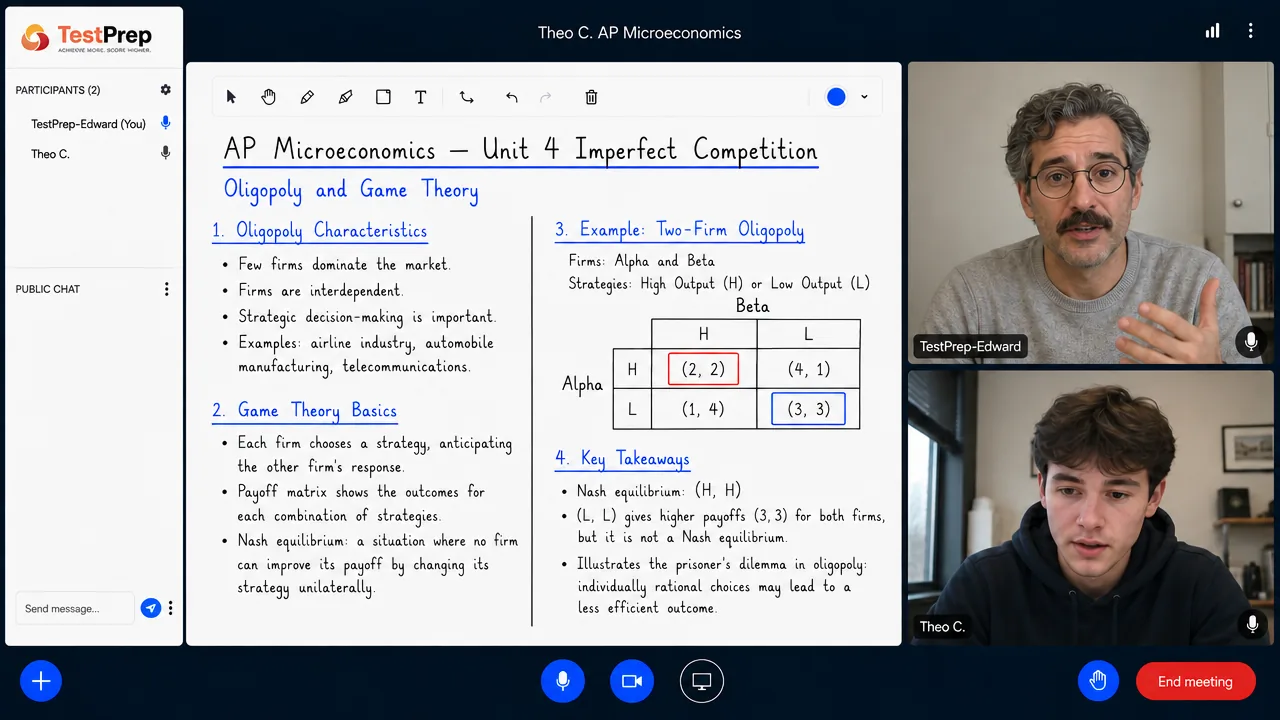
From a TestPrep AP Microeconomics private lesson

100% live online lessons

About the subject

AP Microeconomics: what it covers and who it suits

AP Microeconomics tutoring at TestPrep Europe drills the six College Board units — basic concepts, supply and demand, production, market structures, factor markets, market failure — across MCQ and FRQ formats. The exam rewards labelled cost-curve diagrams and clear MR = MC reasoning across the four market structures.

Your lessons are taught by Selin Yıldız, who teach AP Microeconomics.

  • All 6 units, basic concepts through market failure
  • Cost-curve diagrams (ATC, AVC, MC) drilled to reflex
  • Four market structures (PC, monopoly, oligopoly, monopolistic competition) compared in parallel
Read more

AP Microeconomics builds the toolkit for analysing individual decisions, markets and firm behaviour. It is essential preparation for university economics, business and finance programmes, and increasingly relevant for computer science and policy programmes that draw on market design and game theory.

AP Microeconomics is a one-semester university-level course covering the behaviour of individuals and firms in markets. It begins with the fundamental concepts of scarcity and opportunity cost, then moves through supply and demand, elasticity, costs of production, the four market structures (perfect competition, monopolistic competition, oligopoly and monopoly), factor markets, and the role of government in correcting market failures. The exam is graph-heavy: a typical FRQ asks students to draw a labelled diagram and use it to support a multi-step analytical argument. Our AP Micro programme drills graph-drawing fluency, vocabulary precision and FRQ structure; many students take Micro and Macro together and we build the curriculum to capitalise on the overlap.

One-to-one AP Microeconomics tutoring

Our one-to-one AP tutoring is built entirely around the student's current level and target score. Each lesson works on your specific weak topics, drills exam-format questions and teaches free-response and essay technique with the College Board's scoring guidelines in front of us. Our tutors follow every revision of the Course and Exam Description, so the work you put in matches what is rewarded in May.

AP Microeconomics small-group course

Our small-group AP courses (no more than 6 students per class) give you a structured weekly programme alongside students aiming for the same score. The syllabus follows the College Board's Course and Exam Description unit by unit, and every lesson is taught live online.

Exam

AP Microeconomics exam format

The College Board runs the AP Microeconomics exam every May. Sections, timing and weighting:

  • Section I: Multiple Choice

    66%

    60 questions in 1 hour 10 minutes. Calculator permitted.

  • Section II: Free Response

    33%

    3 questions (1 long + 2 short) in 1 hour, including a 10-minute reading period. Heavy emphasis on graph-based analysis.

  • Exam format

    Hybrid digital

    Multiple-choice questions are answered in the Bluebook app; free-response questions are shown in Bluebook and answered by hand in a paper booklet. A four-function calculator is allowed on both sections. 2027 exam date: 4 May 2027.

One-to-one AP tutoring

AP Microeconomics Private Tutoring

Private AP lessons planned around you: the units you find hardest, your school's pace and the score you are aiming for. Every lesson is live and online, with a tutor who teaches this subject.

  • A lesson plan built around your target score
  • Every unit of the College Board course, in the order you need it
  • Multiple-choice and free-response technique, checked against College Board scoring guidelines
  • Lesson times that fit around your school week

How it works

  1. 1

    Tell us your goal

    We start from your school syllabus, your exam date and the result you are aiming for.

  2. 2

    Your own plan

    We map out the lessons you need, unit by unit.

  3. 3

    Live one-to-one lessons

    Meet your tutor online at times that suit your week.

  4. 4

    Regular progress checks

    Homework and a short check after each lesson show how you are getting on.

Start one-to-one AP Microeconomics

Per lesson in a package

From €58

Single lesson €63

See all prices

Right for you if you want a plan built entirely around you, flexible lesson times and a tutor's full attention.

Book one-to-one lessons

Before choosing a package, you can book one paid lesson.

Our AP tutors began teaching in 2018 or earlier.

Group course calendar

AP Microeconomics Group Course Calendar

50 lessons in total (40 topic lessons + 10 past-paper lessons). Topic lessons on Saturday and Sunday, 16:00–17:30; past-paper lessons on Saturday, 16:00–17:30 (Türkiye time). Lessons are taught in English.

2027-28 classes

First lesson

25 September 2027

Last lesson

29 April 2028

Enrolment deadline

22 September 2027

AP exam

2 May 2028 (estimated)

Course fee

€1,573single payment

or 3 instalments of €524

Enrol now
  • 50 lessons in total
  • 40 topic lessons
  • 10 past-paper lessons
  • Lesson recordings available for 14 days

Lesson-by-lesson calendar

Topic lessonPast-paper lesson
Lesson-by-lesson calendar
DateTopic
25 Sep 2027Sat16:00–17:30Unit 1: Basic Economic Concepts (1/6)
26 Sep 2027Sun16:00–17:30Unit 1: Basic Economic Concepts (2/6)
2 Oct 2027Sat16:00–17:30Unit 1: Basic Economic Concepts (3/6)
3 Oct 2027Sun16:00–17:30Unit 1: Basic Economic Concepts (4/6)
9 Oct 2027Sat16:00–17:30Unit 1: Basic Economic Concepts (5/6)
10 Oct 2027Sun16:00–17:30Unit 1: Basic Economic Concepts (6/6)
16 Oct 2027Sat16:00–17:30Unit 2: Supply and Demand (1/9)
17 Oct 2027Sun16:00–17:30Unit 2: Supply and Demand (2/9)
23 Oct 2027Sat16:00–17:30Unit 2: Supply and Demand (3/9)
24 Oct 2027Sun16:00–17:30Unit 2: Supply and Demand (4/9)

Good to know

  • College Board has not yet published the May 2028 AP exam schedule, so the exam date is estimated from the 2027 schedule. Once it is confirmed, we will adjust the programme to match.
  • 100% First-Lesson Money-Back Guarantee

    Not satisfied? Full refund, no questions asked.

    We do not offer free trial lessons. Payment is required before your first lesson.

  • Secure Payments

    Powered by Stripe with 256-bit encryption.

    Stripe
  • Flexible Billing

    Local cards welcome, instalments available.

Lessons cancelled less than 3 hours before the start count as taken. Full terms

Practice test · Question bank · TestPrep AI Tutor

Practise AP Microeconomics on your own

Three ways to practise between lessons. Each one is a separate product.

  • Coming soon

    AP Microeconomics Question Bank

    The AP Microeconomics question bank is on its way. Until then, you can explore the other AP subjects in the question bank.

    Explore the AP question bank
  • AP Microeconomics Practice Test

    A full-length test in the real exam format, with a detailed score report. Two attempts per test, and 12 months to use them.

    Go to the practice test
  • TestPrep AI Tutor

    Talks you through the questions you got wrong on a practice test, out loud. Your first 2 mistakes are free.

    How TestPrep AI Tutor works

Syllabus

AP Microeconomics topics

Unit and topic names are the College Board's own. Percentages are each unit's share of the exam score, as the College Board publishes them.

1

Unit 1: Basic Economic Concepts

12–15%
  • Scarcity
  • Resource allocation and economic systems
  • The Production Possibilities Curve
  • Comparative advantage and gains from trade
  • Cost-benefit analysis
  • Marginal analysis and consumer choice
2

Unit 2: Supply and Demand

20–25%
  • Demand
  • Supply
  • Elasticity
  • Market equilibrium, disequilibrium, and changes in equilibrium
  • The effects of government intervention in markets
  • International trade and public policy
3

Unit 3: Production, Cost, and the Perfect Competition Model

22–25%
  • The production function
  • Short- and long-run production costs
  • Types of profit
  • Profit maximization
  • Perfect competition
4

Unit 4: Imperfect Competition

15–22%
  • Monopoly
  • Price discrimination
  • Monopolistic competition
  • Oligopoly and game theory
5

Unit 5: Factor Markets

10–13%
  • Introduction to factor markets
  • Changes in factor demand and factor supply
  • Profit-maximizing behavior in perfectly competitive factor markets
  • Monopsonistic markets
6

Unit 6: Market Failure and the Role of Government

8–13%
  • Socially efficient and inefficient market outcomes
  • Externalities
  • Public and private goods
  • The effects of government intervention in different market structures
  • Income and wealth inequality

Approach

How we teach AP Microeconomics

Study plan

  1. 1

    Phase 1 — Basic concepts + supply and demand (Units 1–2)

    Scarcity, PPC, market equilibrium, surplus, elasticity

    • Consumer and producer surplus on every diagram
    • PED / YED / XED / PES with calculation
    • Tax incidence and deadweight loss
  2. 2

    Phase 2 — Production and costs (Unit 3)

    Production functions, short-run vs long-run cost curves

    • Total / marginal / average product
    • ATC, AVC, MC relationships
    • Long-run cost curve and economies of scale
  3. 3

    Phase 3 — Market structures (Unit 4)

    PC, monopoly, oligopoly, monopolistic competition

    • MR = MC profit-maximisation across all four
    • Short-run vs long-run equilibrium contrasts
    • Game theory and dominant-strategy reasoning
  4. 4

    Phase 4 — Factor markets + market failure (Units 5–6) + mock

    Labour markets, externalities, public goods, redistribution

    • MRP and labour-market diagrams
    • Pigouvian taxes and subsidies on externalities
    • Released FRQs to rubric

How lessons work

  • Diagram-first answers

    Each FRQ opens with a fully labelled diagram before prose. The diagram earns rubric points and the explanation flows from it.

  • Four market structures in parallel

    PC, monopoly, oligopoly and monopolistic competition are taught side by side using a comparison grid, so students never mix up the demand curves under time pressure.

  • Externalities and tax incidence as fixed routines

    These are core Unit 6 FRQ topics. We drill them as scripted templates rather than improvising on exam day.

Advice

AP Microeconomics: common mistakes and study tips

  • MistakeProfit-maximisation answers without MR = MC.

    FixEvery market-structure FRQ pivots on MR = MC. State the rule and find the quantity, then read the price off the demand curve.

  • MistakeConfusing perfect competition firm vs market diagrams.

    FixAlways draw both side by side: market sets price, firm takes price. Label which is which before writing prose.

  • MistakeTreating monopoly demand as horizontal.

    FixMonopoly faces the market demand curve, which is downward sloping. MR is below D and twice as steep.

  • MistakeWrong shutdown vs exit logic.

    FixShutdown in the short run if P < AVC; exit in the long run if P < ATC. Use the right comparison for the time frame.

  • MistakeVague externality answers ('there's a negative effect').

    FixShow the divergence between MSC and MPC (or MSB and MPB) on a diagram, identify the deadweight loss, and propose a Pigouvian remedy.

  • MistakeIgnoring elasticity in tax-incidence questions.

    FixWhoever is more inelastic bears more of the tax. Draw the elasticity ratios before assigning incidence.

Study tips

  • Graphs are the language of AP Micro FRQs — practise drawing every standard diagram (S/D, MC/MR, externality, game-theory matrix) under time pressure.
  • Always label every axis, curve and equilibrium point; unlabelled diagrams lose points even when the shape is correct.
  • Memorise the comparative properties of the four market structures cold: efficiency, profit, price-setting power, ease of entry.
  • On welfare-analysis questions, identify producer surplus, consumer surplus and deadweight loss explicitly — AP rubrics reward exact terminology.

Ready to raise your AP Microeconomics score?

You can start one-to-one AP Microeconomics lessons with a single lesson. Every package and price is on one page.

  • Live one-to-one lessons online
  • No package needed — book a single lesson
  • Lesson times that fit your school week
FAQ

AP Microeconomics Prep — Frequently Asked Questions

The questions students ask most about AP Microeconomics preparation.

Slightly, for most students — Micro has more diagrams (cost curves, four market structures) and more nuanced rules (shutdown vs exit, PC vs monopoly). The maths is the same.

Either order works; many universities prefer Micro first because supply-and-demand and elasticity feed directly into Macro's AD-AS. We support either order.

No. The exam stays at algebra and proportional reasoning. Comfort with reading and shifting graphs matters more than maths fluency.

Students new to economics usually book 30–50 hours; students with prior IB Economics SL or similar often book less.

The money-back guarantee covers live lessons. If you are not satisfied after your first private lesson, we refund your payment in full. The question bank and practice tests are not part of it. We do not offer free trial lessons. Payment is required before your first lesson.

Practice tests, question banks and TestPrep AI Tutor time are digital content. You can ask for a refund of a digital product you have not used within 14 days of the payment date. A product counts as used once any practice test in the pack has been started, any question in a paid section of the question bank has been opened, or any second of TestPrep AI Tutor time has been used; a used product is not refunded.

You can cancel a lesson package at any time. Lessons already given are charged at the single-lesson price and the rest is refunded. The first-lesson guarantee applies on top.

Lessons cancelled less than 3 hours before the start count as taken and are not refunded. A lesson that has not been paid for 3 hours before it starts is cancelled automatically.

AP Microeconomics reviews

Be the first to review this programme.

Share your experience

Your comment will appear after approval.

Your rating

All TestPrep Europe reviews