AP Calculus AB Tutoring & Prep Course
Short answer
The AP Calculus AB group course is live online: 50 lessons, 90 minutes each, 75 hours in all.
Group lessons are taught in classes of at most 6 students.
The current group's lessons began on 28 September 2026. The group course fee is €1,573 in one payment.
Try the free AP Calculus AB practice test
AP Calculus AB tutoring across all eight College Board units, from Limits and Continuity to Applications of Integration, with FRQ practice for a 5.
One-to-one and small groups · Live online · College Board curriculum
100% live online lessons
About the subject
AP Calculus AB: what it covers and who it suits
AP Calculus AB tutoring at TestPrep Europe is a one-to-one online programme that walks through the eight College Board units — Limits & Continuity through Applications of Integration — in the exact MCQ + FRQ format used on the May exam. Calculator-active and no-calculator sections are practised separately so the student is fluent in both.
Some of the teachers who teach AP Calculus AB: Burak Kara, Deniz Arslan, Eda Karataş and Gökhan İnce.
- All 8 units covered in order, Unit 1: Limits and Continuity through Unit 8: Applications of Integration
- MCQ + FRQ practice and error analysis after every unit
- Calculator-active and no-calculator strategy drilled separately
Read more
AP Calculus AB is the foundation for university success in engineering, physics, economics and computer science. Students who score a 4 or 5 typically place out of first-semester calculus, saving tuition and fast-tracking into upper-division STEM coursework. Beyond the credit, the limit, derivative and integral concepts that anchor the course are the working language of optimisation, motion analysis and area/volume modelling across every quantitative discipline.
AP Calculus AB covers roughly the first semester of college-level calculus and is administered by the College Board every May. The course progresses from limits and continuity to differentiation as a tool for analysing rate of change, and finally to integration as a tool for accumulating change. The Fundamental Theorem of Calculus ties differentiation and integration together and is one of the most heavily tested ideas on the exam. Beyond formula recall, the AP exam tests conceptual understanding and problem-solving: Free Response questions ask students to interpret graphs, draw conclusions from tabular data and construct mathematical arguments. Our AP Calculus AB programme builds a personalised study plan against the College Board CED around each student's weakest sub-units, and dedicates significant time to FRQ-writing strategy, aiming at the full 9 points on each free-response problem.
One-to-one AP Calculus AB tutoring
Our one-to-one AP tutoring is built entirely around the student's current level and target score. Each lesson works on your specific weak topics, drills exam-format questions and teaches free-response and essay technique with the College Board's scoring guidelines in front of us. Our tutors follow every revision of the Course and Exam Description, so the work you put in matches what is rewarded in May.
AP Calculus AB small-group course
Our small-group AP courses (no more than 6 students per class) give you a structured weekly programme alongside students aiming for the same score. The syllabus follows the College Board's Course and Exam Description unit by unit, and every lesson is taught live online.
Exam
AP Calculus AB exam format
The College Board runs the AP Calculus AB exam every May. Sections, timing and weighting:
Section I: Multiple Choice
50%42 questions in 1 hour 40 minutes. Part A (29 questions, 62 minutes, no calculator) and Part B (13 questions, 38 minutes, graphing calculator). Question count and timing were updated effective with the May 2027 exam.
Section II: Free Response
50%6 questions in 1 hour 30 minutes. Part A (2 questions, 30 minutes, calculator) and Part B (4 questions, 60 minutes, no calculator).
Exam delivery
Hybrid digitalMultiple-choice questions are answered in the Bluebook app; free-response questions are viewed in Bluebook and answered by hand in a paper booklet.
One-to-one AP tutoring
AP Calculus AB Private Tutoring
Private AP lessons planned around you: the units you find hardest, your school's pace and the score you are aiming for. Every lesson is live and online, with a tutor who teaches this subject.
- A lesson plan built around your target score
- Every unit of the College Board course, in the order you need it
- Multiple-choice and free-response technique, checked against College Board scoring guidelines
- Lesson times that fit around your school week
How it works
- 1
Tell us your goal
We start from your school syllabus, your exam date and the result you are aiming for.
- 2
Your own plan
We map out the lessons you need, unit by unit.
- 3
Live one-to-one lessons
Meet your tutor online at times that suit your week.
- 4
Regular progress checks
Homework and a short check after each lesson show how you are getting on.
Start one-to-one AP Calculus AB
Right for you if you want a plan built entirely around you, flexible lesson times and a tutor's full attention.
Book one-to-one lessonsBefore choosing a package, you can book one paid lesson.
Our AP tutors began teaching in 2018 or earlier.
No group is open right now
Group course
A Private Group for This Subject
There is no open group timetable for this subject in 2026–27. If 3 or more of you sign up together, we open a private group course for you — at the same price as the open group course. Lessons are taught in English.
Course fee
€1,573the same as an open group course
At least 3 students · you set the weekly timetable together
Each student buys their own place online, and we let you know as soon as your group is ready.
or 3 instalments of €524Questions first? Get in touch- Classes of no more than 6 students
- Live online lessons you can watch again
- A lesson plan that follows the College Board course
- Not satisfied after the first week of your group course? Full (100%) refund. We do not offer free trial lessons. Payment is required before your first lesson.
100% First-Lesson Money-Back Guarantee
Not satisfied? Full refund, no questions asked.
We do not offer free trial lessons. Payment is required before your first lesson.
Secure Payments
Powered by Stripe with 256-bit encryption.

Flexible Billing
Local cards welcome, instalments available.
Lessons cancelled less than 3 hours before the start count as taken. Full terms
Practice test · Question bank · TestPrep AI Tutor
Practise AP Calculus AB on your own
Three ways to practise between lessons. Each one is a separate product.
- Coming soon
AP Calculus AB Question Bank
The AP Calculus AB question bank is on its way. Until then, you can explore the other AP subjects in the question bank.
Explore the AP question bank AP Calculus AB Practice Test
A full-length test in the real exam format, with a detailed score report. Two attempts per test, and 12 months to use them.
Go to the practice testTestPrep AI Tutor
Talks you through the questions you got wrong on a practice test, out loud. Your first 2 mistakes are free.
How TestPrep AI Tutor works
Syllabus
AP Calculus AB topics
Unit and topic names are the College Board's own. Percentages are each unit's share of the exam score, as the College Board publishes them.
1Unit 1: Limits and Continuity
10–15%
- How limits help us to handle change at an instant
- Definition and properties of limits in various representations
- Definitions of continuity of a function at a point and over a domain
- Asymptotes and limits at infinity
- Reasoning using the Squeeze theorem and the Intermediate Value Theorem
2Unit 2: Differentiation: Definition and Fundamental Properties
10–15%
- Defining the derivative of a function at a point and as a function
- Connecting differentiability and continuity
- Determining derivatives for elementary functions
- Applying differentiation rules
3Unit 3: Differentiation: Composite, Implicit, and Inverse Functions
5–10%
- The chain rule for differentiating composite functions
- Implicit differentiation
- Differentiation of general and particular inverse functions
- Determining higher-order derivatives of functions
4Unit 4: Contextual Applications of Differentiation
10–15%
- Identifying relevant mathematical information in verbal representations of real-world problems involving rates of change
- Applying understandings of differentiation to problems involving motion
- Generalizing understandings of motion problems to other situations involving rates of change
- Solving related rates problems
- Local linearity and approximation
- L'Hospital's rule
5Unit 5: Analytical Applications of Differentiation
15–20%
- Mean Value Theorem and Extreme Value Theorem
- Derivatives and properties of functions
- How to use the first derivative test, second derivative test, and candidates test
- Sketching graphs of functions and their derivatives
- How to solve optimization problems
- Behaviors of Implicit relations
6Unit 6: Integration and Accumulation of Change
15–20%
- Using definite integrals to determine accumulated change over an interval
- Approximating integrals using Riemann Sums
- Accumulation functions, the Fundamental Theorem of Calculus, and definite integrals
- Antiderivatives and indefinite integrals
- Properties of integrals and integration techniques
7Unit 7: Differential Equations
5–10%
- Interpreting verbal descriptions of change as separable differential equations
- Sketching slope fields and families of solution curves
- Solving separable differential equations to find general and particular solutions
- Deriving and applying a model for exponential growth and decay
8Unit 8: Applications of Integration
10–15%
- Determining the average value of a function using definite integrals
- Modeling particle motion
- Solving accumulation problems
- Finding the area between curves
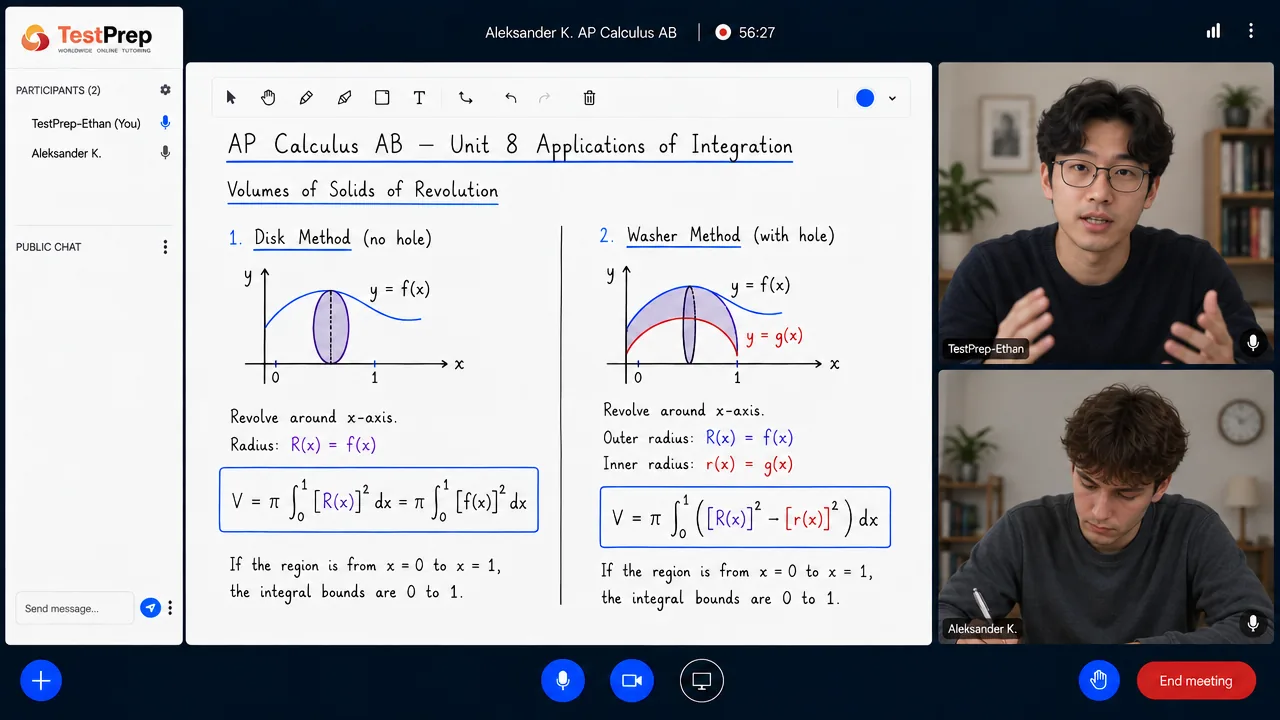
- Determining volume with cross-sections, the disc method, and the washer method
Approach
How we teach AP Calculus AB
Study plan
- 1
Phase 1 — Foundation (Units 1–3)
Limits, continuity, definition of the derivative
- Algebraic, graphical and one-sided limits
- Continuity and the Intermediate Value Theorem
- Derivative definition and rules, the chain rule and implicit differentiation
- 2
Phase 2 — Applications of the derivative (Units 4–5)
Optimization, related rates, MVT
- Related rates, local linearity and L'Hospital's rule
- Motion problems
- Mean Value Theorem, Extreme Value Theorem and curve analysis
- Optimization in FRQ format
- 3
Phase 3 — Integrals (Units 6–7)
Antiderivatives, definite integrals, FTC
- u-substitution
- Riemann sums and the definite integral
- FTC Parts 1 and 2
- Separable differential equations + slope fields
- 4
Phase 4 — Applications + mock exam (Unit 8 + review)
Area, volume, FRQ technique
- Area between curves; volumes by cross-sections, discs and washers
- Timed released FRQ sets
- Calculator-active vs no-calculator practice
- Full-length mock with score estimate
How lessons work
Calculator-active and no-calculator drilled apart
Most students under-prepare the no-calculator half. Each unit closes with separate sessions for both formats so timing reflexes match the real paper.
FRQ rubric coaching
Released FRQs are scored against the official rubric so the student sees exactly which step earns which point — and never falls into the 'right answer, missing justification' trap.
Notational discipline
Leibniz, Lagrange and Newton notation are taught explicitly; consistency inside a single response is treated as a habit, not a stylistic choice.
Advice
AP Calculus AB: common mistakes and study tips
MistakeMixing notation (dy/dx, f′(x), Df) inside the same FRQ.
FixPick one notation per question and keep it consistent — the FRQ rubric rewards notational discipline.
MistakeForgetting the inner derivative when applying the chain rule, especially inside ln, sin or e^u.
FixAlways rewrite as u = …, then d/dx = (outer derivative)·(du/dx) so the chain step is explicit.
MistakeJustifying with 'because it is increasing' instead of citing the sign of f′.
FixTie every justification to a derivative sign: 'f′(x) > 0 on (a,b), so f is increasing on (a,b).'
MistakeDropping units in applied integral problems.
FixDecide whether the question gives a rate or an amount before setting up the integral, and write units before integrating.
MistakeConfusing the graphs of f, f′ and f″.
FixIf the graph isn't labelled, annotate first: extrema → f′ = 0; inflection points → f″ = 0.
MistakeRounding to two decimals on calculator-active questions.
FixAP rubrics demand three decimals or more on calculator-active items; rounding too early loses the point.
Study tips
- Show every step on FRQs — the AP rubric awards points for the solution path, not just the final answer.
- Master the calculator for numerical integration, root finding and graph analysis; Part B questions assume calculator fluency.
- After each unit, attempt the released College Board FRQs and self-grade against the official scoring guidelines.
- Build conceptual links between limit, derivative and integral instead of memorising rules in isolation.
Ready to raise your AP Calculus AB score?
You can start one-to-one AP Calculus AB lessons with a single lesson. Every package and price is on one page.
- Live one-to-one lessons online
- No package needed — book a single lesson
- Lesson times that fit your school week
You can also write to us through our contact page.
Other subjects
Related and other AP subjects
Often taken alongside this subject
- AP Calculus BCBC is a strict superset of AB; series and parametric/polar are added on top.
- AP Physics 1Many AB students take Physics 1 in the same year for the STEM signal.
- AP StatisticsCommon math-AP pairing for non-calculus-heavy university applications.
All AP subjects
- AP Calculus BC
- AP Statistics
- AP Precalculus
- AP Computer Science A
- AP Computer Science Principles
- AP Physics 1
- AP Physics 2
- AP Physics C: Mechanics
- AP Physics C: Electricity & Magnetism
- AP Chemistry
- AP Biology
- AP Environmental Science
- AP English Language & Composition
- AP English Literature & Composition
- AP US History (APUSH)
- AP World History: Modern
- AP European History
- AP US Government & Politics
- AP Comparative Government & Politics
- AP Human Geography
- AP Microeconomics
- AP Macroeconomics
- AP Psychology
- AP Art History
- AP Music Theory
- AP Spanish Language & Culture
- AP French Language & Culture
- AP Chinese Language & Culture
- AP Business with Personal Finance
- AP Cybersecurity
- AP African American Studies
AP Calculus AB Prep — Frequently Asked Questions
The questions students ask most about AP Calculus AB preparation.