AP Chemistry Tutoring & Prep Course
Targeted AP Chemistry preparation with one-to-one tutoring, full past-paper support and personalized study plans tailored to your target grade.
Since 2008, TestPrep Europe has taught Chemistry through one-to-one tutoring and small-group courses on its own online learning platform. The programme combines the AP syllabus with subject teaching, problem solving and past-paper practice.
100% live online lessons
Explore this page
Go straight to what you need
Why is AP Kimya important?
Whether you choose 1:1 tutoring or our small-group AP courses, our experienced AP instructors map the path to a 5. Targeted AP Kimya preparation built around your starting point and your target score.
AP Chemistry is a rigorous course that builds the chemical reasoning required for medicine, pharmacy, biochemistry, chemical engineering and materials science. The exam tests deep conceptual understanding, multi-step quantitative problem solving and laboratory data interpretation in roughly equal measure.
TestPrep Europe's AP tutoring program is fully personalised: every lesson focuses on your specific weak topics, FRQ/essay technique, and exam-day strategy. Our instructors track the College Board's current curriculum and scoring rubrics closely so the work you do with us mirrors what is rewarded on the actual exam. Group cohorts (max 6 students) keep weekly accountability high while preserving individual attention.
AP Kimya exam structure
Review the section-by-section breakdown of the AP Kimya exam, administered worldwide by the College Board every May. Each section is drilled separately in our 1:1 and small-group programs so you build strategy for the parts of the test that matter most to your score.
Section I: Multiple Choice
50%60 questions in 1 hour 30 minutes. Calculator NOT permitted.
Section II: Free Response
50%7 questions (3 long + 4 short) in 1 hour 45 minutes. Calculator and formula sheet provided.
AP Kimya curriculum coverage
Unit-by-unit summary of the topics we cover, mapped to the College Board's official Course and Exam Description (CED). In our 1:1 lessons each unit is paced and weighted to the individual student.
AP Kimya study strategies
Strategies our AP instructors recommend for top-scoring AP Kimya preparation. We integrate these techniques directly into 1:1 sessions and small-group practice rounds.
The MC section has no calculator — drill mental arithmetic and order-of-magnitude estimation until they are automatic.
On lab-based FRQs, structure your answer around experimental design, sources of error and data interpretation rather than rote calculation.
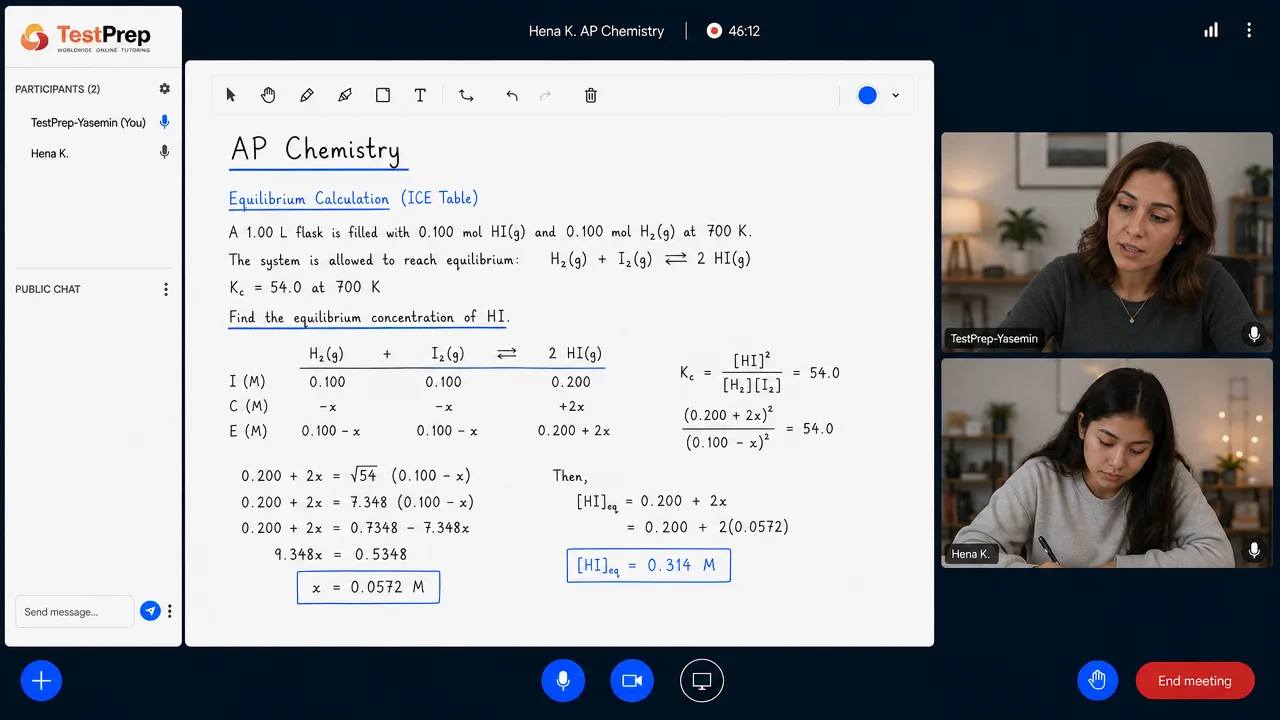
Use ICE tables systematically for every equilibrium problem; the discipline pays off when problems get multi-step.
Connect the thermodynamic quantities (ΔH, ΔS, ΔG) conceptually rather than treating them as three unrelated formulas.
About AP Kimya
AP Chemistry is equivalent to a first-year university general chemistry course. It begins with atomic structure, then proceeds through periodic trends, bonding, intermolecular forces, reaction types, stoichiometry, kinetics, thermodynamics, equilibrium, acids and bases, and electrochemistry. Sixteen recommended inquiry-based laboratory investigations support the curriculum and are explicitly tested on the FRQ section. Our programme begins with a diagnostic to identify weak units, then balances quantitative problem solving with FRQ-writing strategy and explicit lab-question practice — the lab-style FRQs are the most predictable source of points for students willing to learn the conventions.
1:1 AP tutoring — personalised support
Our 1:1 AP tutoring is built entirely around the student's current knowledge level and target score. Each session focuses on your specific weak topics, drills exam-format practice questions, and teaches FRQ / essay technique with the College Board's scoring rubric in front of us. Our instructors stay current with every CED revision so the work you put in mirrors what gets rewarded in May.
Small-group AP courses — structured cohorts
Our small-group AP courses (max 6 students) give you a structured weekly programme alongside students chasing the same target. The syllabus tracks the College Board CED unit-by-unit and includes weekly quizzes plus full-length mock exams to benchmark progress. All cohorts are delivered live online, so students can join from anywhere in Europe.
What is AP Chemistry tutoring?
AP Chemistry tutoring at TestPrep Europe walks through all nine units — atomic structure through equilibrium and acid-base — in the MCQ + FRQ format used on the May exam. Sessions emphasise particle-level reasoning and quantitative work side by side, because the FRQ rubric rewards both algebraic answers and the explanations that justify them.
- All 9 College Board units, atomic structure through equilibrium and thermodynamics
- Particle-level diagrams practised alongside every quantitative topic
- Released FRQs scored against the official rubric, including data-table interpretation
- Lab-based questions and experimental reasoning practised across units
Common AP Chemistry mistakes
HataDropping units in stoichiometry and dimensional-analysis problems.
DüzeltmeCarry units through every step — the FRQ rubric awards points for unit consistency, not just the final number.
HataIgnoring significant figures on calculator-active questions.
DüzeltmeMatch sig-figs to the least precise measurement in the data; rounding too early or too late both lose points.
HataSetting up equilibrium expressions from total moles instead of equilibrium concentrations.
DüzeltmeAlways build an ICE table first, then translate the equilibrium row into Kc/Kp — never skip the table.
HataVague particle-level explanations ('the particles move faster').
DüzeltmeTie every explanation to a named interaction — IMFs, bond polarity, ion size, electron arrangement — so the answer earns the explanation point.
HataConfusing strong / weak acid behaviour at the equivalence point.
DüzeltmeStrong + strong → pH 7; strong + weak → pH determined by the conjugate. Practise the four titration shapes until they're reflex.
HataTreating thermodynamic spontaneity as a Gibbs sign rule only.
DüzeltmeAlways check ΔH and ΔS qualitatively before computing ΔG, so temperature dependence is part of the explanation.
AP Chemistry study plan
- 1
Phase 1 — Foundations (Units 1–3)
Atomic structure, periodic trends, bonding, IMFs
- Coulombic attraction reasoning for periodic trends
- Lewis structures, formal charge, VSEPR
- IMF ranking with boiling-point data
- 2
Phase 2 — Quantitative chemistry (Units 4–5)
Reactions, stoichiometry, kinetics
- Net ionic equations and reaction prediction
- Limiting reagent FRQs with percent yield
- Rate laws from initial-rate data and integrated forms
- 3
Phase 3 — Energetics and equilibrium (Units 6–7)
Thermochemistry, ΔG, Kc/Kp, Le Chatelier
- Hess's law and bond enthalpy calculations
- ICE tables with quadratic and approximation
- Q vs K reasoning for direction of shift
- 4
Phase 4 — Acid-base + electrochemistry (Units 8–9) + mock
Buffers, titration curves, redox, FRQ technique
- Henderson-Hasselbalch and buffer design
- Strong/weak titration curves end-to-end
- Standard reduction potentials and electrolysis
- Full released FRQ set under timed conditions
How TestPrep Europe teaches AP Chemistry
Particle-level diagrams alongside maths
Every quantitative topic is paired with a particle-level explanation, because the FRQ rubric splits points between the calculation and the reasoning that justifies it.
Data-table FRQs as a separate skill
AP Chemistry FRQs increasingly hand the student a data table and ask for graphing, slope interpretation, and uncertainty discussion — we drill this as its own technique, not as part of the topic itself.
Released FRQs scored to rubric
Students score their own answers against the official rubric so the gap between 'right idea' and 'right wording for the point' becomes visible after every unit.
Sıkça sorulan sorular
Is AP Chemistry harder than AP Biology?
AP Chemistry is more quantitative and unforgiving on units and significant figures; AP Biology is denser in vocabulary and command-term writing. Students aiming at engineering or chemical sciences benefit more from Chemistry; students aiming at health sciences often pair both.
Do I need a specific calculator?
AP Chemistry permits a non-graphing scientific calculator on most sections; the College Board publishes the current list each year. We make sure students are fluent in their chosen model before the exam.
How many hours of tutoring are typical?
Students with a one-year IGCSE / GCSE chemistry background usually book 40–60 hours; students starting from a weaker base or aiming to move from a 3 to a 5 often book more. We start with a free diagnostic.
How much of the exam is the FRQ?
The FRQ section is half the score. Students who only practise MCQs almost always under-score, because the rubric rewards explanation steps that MCQs never test.
What Sets Our Chemistry Tutoring Apart
Reach your Chemistry goals with our team of expert tutors.
Expert Tutors
Teachers with deep experience in AP Chemistry
Goal-Oriented
Personalized program built around your a 5 / 5 score target
Comprehensive Materials
Past-paper archive, topic notes and practice questions
Proven Results
High success rate and verified student references
What You'll Learn in Chemistry
Exam-focused, end-to-end program fully aligned with the AP syllabus.
Topic-by-topic deep analysis and explanations
Past-paper walkthroughs with mark-scheme breakdowns
Exam techniques and time-management strategies
Fast and effective problem-solving methods
Regular mock exams with performance tracking
One-on-One Tutoring
PopularSeçtiğiniz AP dersine özel
- All AP subjects mevcut
- Okul müfredatı ile entegre
- FRQ practice sessions
Subject-Based Courses
Popüler AP subjects için grup
- AP Calculus, Physics, Chemistry
- 10 haftalık programlar
- Lab sessions dahil
Reinforce your lessons with the Chemistry Question Bank
The Chemistry Question Bank is the perfect companion to your private tutoring or course. Reinforce what you learn in class with thousands of targeted questions.
Explore Chemistry Pricing & Packages
Compare our private tutoring and group course options. Start risk-free with our first-lesson refund guarantee.
Chemistry Student Achievements
Real outcomes from students who studied Chemistry with us
“Organic chemistry isn't a nightmare anymore. I finally understand reaction mechanisms.”
Zeynep A.
AP student
“I started from zero on mole calculations and they're now my strongest area.”
Berk M.
AP student
“The support I got on lab reports and during the IA process was invaluable.”
Elif S.
AP student
Other AP Subjects
Browse the other subject options available in our AP program.
Calculus AB
Targeted AP Calculus AB preparation with one-to-one tutoring, full past-paper support and personalized study plans tailored to your target grade.
Calculus BC
Targeted AP Calculus BC preparation with one-to-one tutoring, full past-paper support and personalized study plans tailored to your target grade.
Statistics
Targeted AP Statistics preparation with one-to-one tutoring, full past-paper support and personalized study plans tailored to your target grade.
Precalculus
Targeted AP Precalculus preparation with one-to-one tutoring, full past-paper support and personalized study plans tailored to your target grade.
Computer Science A
Targeted AP Computer Science A preparation with one-to-one tutoring, full past-paper support and personalized study plans tailored to your target grade.
Computer Science Principles
Targeted AP Computer Science Principles preparation with one-to-one tutoring, full past-paper support and personalized study plans tailored to your target grade.
Physics 1
Targeted AP Physics 1 preparation with one-to-one tutoring, full past-paper support and personalized study plans tailored to your target grade.
Physics 2
Targeted AP Physics 2 preparation with one-to-one tutoring, full past-paper support and personalized study plans tailored to your target grade.
Start Your Chemistry Lessons Today
Book a free consultation, define your goals and we'll build a program tailored to you.