HomeAPPsychology
PopularCognition

AP Psychology Tutoring & Prep Course

Short answer

The AP Psychology group course is live online: 50 lessons, 90 minutes each, 75 hours in all.

Group lessons are taught in classes of at most 6 students.

The current group's lessons began on 26 September 2026. The group course fee is €1,573 in one payment.

Try the free AP Psychology practice test

AP Psychology tutoring covering biological bases, learning, cognition, development and disorders for a score of 5.

One-to-one and small groups · Live online · College Board curriculum

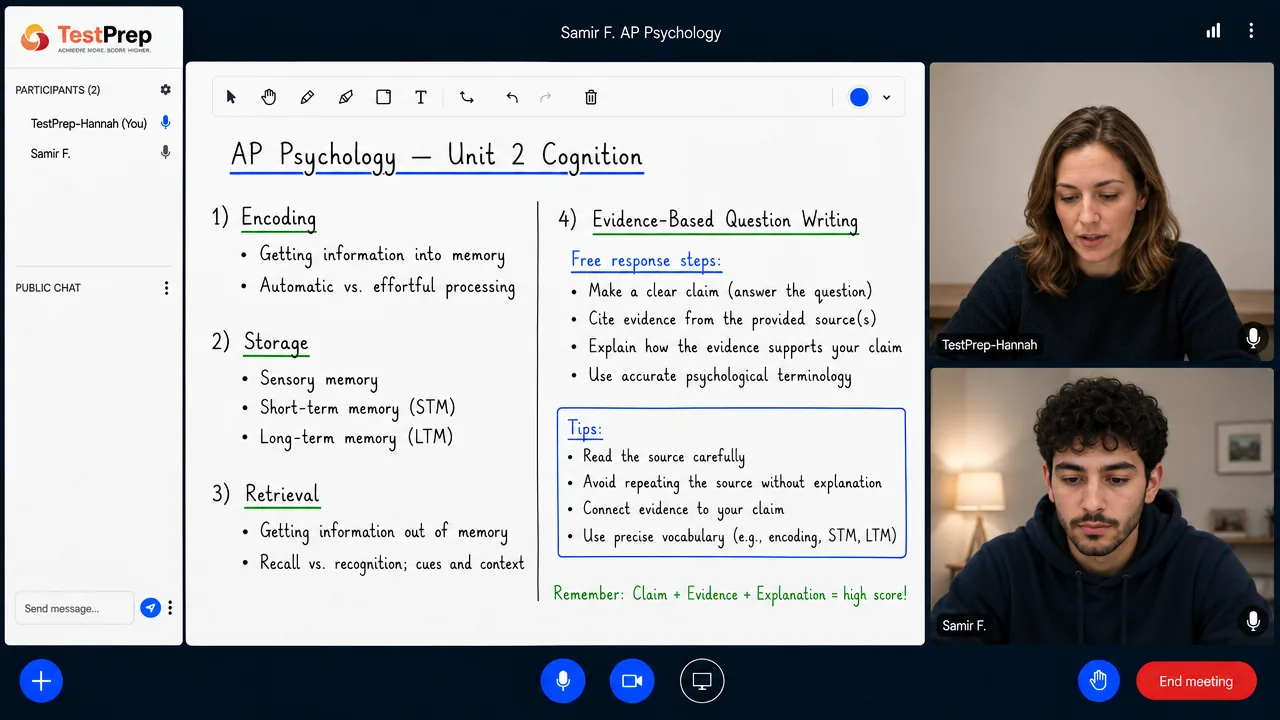
From a TestPrep AP Psychology private lesson

100% live online lessons

About the subject

AP Psychology: what it covers and who it suits

AP Psychology tutoring at TestPrep Europe covers the College Board's five units — Biological Bases of Behavior, Cognition, Development and Learning, Social Psychology and Personality, and Mental and Physical Health — alongside the multiple-choice section and the two FRQs, the Article Analysis Question and the Evidence-Based Question. The exam rewards specific application: name the concept, define it, then tie it to the study or evidence in front of you.

  • Full coverage of all five units, from Biological Bases of Behavior to Mental and Physical Health
  • MCQ stimulus practice with research-design and statistics interpretation
  • FRQ application drills using the 'name + define + apply' template
Read more

AP Psychology surveys the scientific study of behaviour and mental processes. It builds the foundation for psychology, neuroscience, psychiatry, education, marketing and human resources, and is one of the more accessible AP exams for students new to the social sciences.

AP Psychology is a survey course, revised in 2024-25 into five units: Biological Bases of Behavior (the nervous system, the brain, sleep, sensation), Cognition (perception, thinking, memory, intelligence), Development and Learning, Social Psychology and Personality (including motivation and emotion), and Mental and Physical Health (health psychology, disorders and treatment). Research methods run through every unit as a science practice rather than standing alone. Each unit introduces canonical psychologists and their theories. The exam tests both terminology and the ability to apply concepts to research summaries and real-life scenarios. Our programme moves AP Psychology beyond rote vocabulary into application-driven study, with flashcard systems, scenario-based FRQ practice and regular quizzes.

One-to-one AP Psychology tutoring

Our one-to-one AP tutoring is built entirely around the student's current level and target score. Each lesson works on your specific weak topics, drills exam-format questions and teaches free-response and essay technique with the College Board's scoring guidelines in front of us. Our tutors follow every revision of the Course and Exam Description, so the work you put in matches what is rewarded in May.

AP Psychology small-group course

Our small-group AP courses (no more than 6 students per class) give you a structured weekly programme alongside students aiming for the same score. The syllabus follows the College Board's Course and Exam Description unit by unit, and every lesson is taught live online.

Exam

AP Psychology exam format

The College Board runs the AP Psychology exam every May. Sections, timing and weighting:

  • Section I: Multiple Choice

    66.7%

    75 questions in 1 hour 30 minutes.

  • Section II: Free Response

    33.3%

    2 questions in 1 hour 10 minutes: an Article Analysis Question (7 points) and an Evidence-Based Question (7 points).

  • Exam delivery

    Fully digital

    The entire exam is completed in the Bluebook app.

One-to-one AP tutoring

AP Psychology Private Tutoring

Private AP lessons planned around you: the units you find hardest, your school's pace and the score you are aiming for. Every lesson is live and online, with a tutor who teaches this subject.

  • A lesson plan built around your target score
  • Every unit of the College Board course, in the order you need it
  • Multiple-choice and free-response technique, checked against College Board scoring guidelines
  • Lesson times that fit around your school week

How it works

  1. 1

    Tell us your goal

    We start from your school syllabus, your exam date and the result you are aiming for.

  2. 2

    Your own plan

    We map out the lessons you need, unit by unit.

  3. 3

    Live one-to-one lessons

    Meet your tutor online at times that suit your week.

  4. 4

    Regular progress checks

    Homework and a short check after each lesson show how you are getting on.

Start one-to-one AP Psychology

Per lesson in a package

From €58

Single lesson €63

See all prices

Right for you if you want a plan built entirely around you, flexible lesson times and a tutor's full attention.

Book one-to-one lessons

Before choosing a package, you can book one paid lesson.

Our AP tutors began teaching in 2018 or earlier.

Group course calendar

AP Psychology Group Course Calendar

50 lessons in total (40 topic lessons + 10 past-paper lessons). Topic lessons on Saturday and Sunday, 09:00–10:30; past-paper lessons on Saturday, 09:00–10:30 (Türkiye time). Lessons are taught in English.

2027-28 classes

First lesson

25 September 2027

Last lesson

29 April 2028

Enrolment deadline

22 September 2027

AP exam

12 May 2028 (estimated)

Course fee

€1,573single payment

or 3 instalments of €524

Enrol now
  • 50 lessons in total
  • 40 topic lessons
  • 10 past-paper lessons
  • Lesson recordings available for 14 days

Lesson-by-lesson calendar

Topic lessonPast-paper lesson
Lesson-by-lesson calendar
DateTopic
25 Sep 2027Sat09:00–10:30Unit 1: Biological Bases of Behavior (1/8)
26 Sep 2027Sun09:00–10:30Unit 1: Biological Bases of Behavior (2/8)
2 Oct 2027Sat09:00–10:30Unit 1: Biological Bases of Behavior (3/8)
3 Oct 2027Sun09:00–10:30Unit 1: Biological Bases of Behavior (4/8)
9 Oct 2027Sat09:00–10:30Unit 1: Biological Bases of Behavior (5/8)
10 Oct 2027Sun09:00–10:30Unit 1: Biological Bases of Behavior (6/8)
16 Oct 2027Sat09:00–10:30Unit 1: Biological Bases of Behavior (7/8)
17 Oct 2027Sun09:00–10:30Unit 1: Biological Bases of Behavior (8/8)
23 Oct 2027Sat09:00–10:30Unit 2: Cognition (1/8)
24 Oct 2027Sun09:00–10:30Unit 2: Cognition (2/8)

Good to know

  • College Board has not yet published the May 2028 AP exam schedule, so the exam date is estimated from the 2027 schedule. Once it is confirmed, we will adjust the programme to match.
  • 100% First-Lesson Money-Back Guarantee

    Not satisfied? Full refund, no questions asked.

    We do not offer free trial lessons. Payment is required before your first lesson.

  • Secure Payments

    Powered by Stripe with 256-bit encryption.

    Stripe
  • Flexible Billing

    Local cards welcome, instalments available.

Lessons cancelled less than 3 hours before the start count as taken. Full terms

Practice test · Question bank · TestPrep AI Tutor

Practise AP Psychology on your own

Three ways to practise between lessons. Each one is a separate product.

  • Coming soon

    AP Psychology Question Bank

    The AP Psychology question bank is on its way. Until then, you can explore the other AP subjects in the question bank.

    Explore the AP question bank
  • AP Psychology Practice Test

    A full-length test in the real exam format, with a detailed score report. Two attempts per test, and 12 months to use them.

    Go to the practice test
  • TestPrep AI Tutor

    Talks you through the questions you got wrong on a practice test, out loud. Your first 2 mistakes are free.

    How TestPrep AI Tutor works

Syllabus

AP Psychology topics

Unit and topic names are the College Board's own. Percentages are each unit's share of the exam score, as the College Board publishes them.

1

Unit 1: Biological Bases of Behavior

15–25%
  • The interaction of inherited traits, environment, and evolution in shaping behavior
  • Structures and functions of nervous systems
  • Neural firing and the influence of psychoactive substances
  • The study of the brain, including its structures and functions
  • Sleep
  • Sensation
2

Unit 2: Cognition

15–25%
  • Perception
  • Biases and errors in thinking, creative thinking, and problem-solving strategies
  • The cognitive and physiological processes that make up memory
  • Forgetting and typical memory errors
  • Defining and measuring intelligence and achievement
3

Unit 3: Development and Learning

15–25%
  • Research methods used in developmental psychology
  • Physical, cognitive, and social-emotional development across the lifespan
  • Gender and sexual orientation
4

Unit 4: Social Psychology and Personality

15–25%
  • Attribution theory and person perception
  • Attitude formation and change
  • The psychology of social situations
  • Psychodynamic, humanistic, social cognitive, and trait theories of personality
  • Motivation
  • Emotion
5

Unit 5: Mental and Physical Health

15–25%
  • An introduction to health and positive psychology
  • Standards for diagnosing and approaches to explaining psychological disorders
  • Neurodevelopmental and schizophrenic spectrum disorders
  • Bipolar, depressive, anxiety, and obsessive-compulsive disorders
  • Dissociative and trauma- and stress-related disorders
  • Eating disorders and personality disorders
  • Historical developments in psychological treatment
  • Modern treatment options and methods

Approach

How we teach AP Psychology

Study plan

  1. 1

    Phase 1 — Unit 1: Biological Bases of Behavior

    Research methods as science practices, the nervous system, the brain, sleep, sensation

    • IV/DV, control, sampling vocabulary
    • Major brain regions with functions and studies
    • Neurotransmitters and neural firing
  2. 2

    Phase 2 — Unit 2: Cognition

    Perception, thinking, memory, intelligence

    • Memory: encoding, storage, retrieval, forgetting
    • Heuristics and decision-making
    • Intelligence and testing concepts
  3. 3

    Phase 3 — Unit 3: Development and Learning and Unit 4: Social Psychology and Personality

    Lifespan development, learning, social psychology, personality, motivation and emotion

    • Piaget, Erikson, Kohlberg, Vygotsky
    • Classical vs operant conditioning drills
    • Attribution, conformity, obedience
  4. 4

    Phase 4 — Unit 5: Mental and Physical Health + mock

    Health psychology, disorders, treatment

    • Disorders with diagnostic features
    • Treatments paired with their theoretical approach
    • Article Analysis and Evidence-Based questions scored to the rubric

How lessons work

  • Name + define + apply template

    Every FRQ paragraph follows the same structure: name the concept, define it briefly, apply it to the prompt's scenario. The rubric awards points for application, not for definition.

  • Comparison tables for confusable terms

    Pairs like classical/operant, positive/negative reinforcement, assimilation/accommodation are taught as comparison tables, not as separate cards.

  • Research methods integrated, not siloed

    Research-design vocabulary is reinforced in every unit's MCQ practice, because stimulus questions on any topic can ask about IV/DV, sampling or ethics.

Advice

AP Psychology: common mistakes and study tips

  • MistakeDefining a term without applying it to the scenario.

    FixDefinitions alone earn nothing on the current FRQs: the Evidence-Based Question wants the concept tied to evidence from the sources, and the Article Analysis Question wants the study's own details.

  • MistakeConfusing similar concepts (classical vs operant conditioning, etc.).

    FixBuild small comparison tables for confusable pairs and rehearse the distinguishing feature, not just the names.

  • MistakeWrong research design vocabulary on stimulus questions.

    FixIndependent variable, dependent variable, control group, random assignment vs random sampling — these terms are tested directly on every paper.

  • MistakeTreating biological bases as 'just brain regions'.

    FixPair every region with its function and a study or behavioural example. Memorising names alone won't earn FRQ application points.

  • MistakePop-psychology answers ('she is using her ego').

    FixUse the technical term as defined in the syllabus, even when everyday usage differs (e.g., 'reinforcement' has a precise behaviourist meaning).

  • MistakeSkipping the ethics terms (informed consent, debriefing).

    FixResearch-methods FRQs reward explicit ethics language. Practise the standard checklist.

Study tips

  • Memorise the canonical psychologists (Freud, Piaget, Skinner, Bandura, Maslow) and their contributions on flashcards.
  • Know the major neurotransmitters (serotonin, dopamine, GABA, acetylcholine) and their functions.
  • On FRQs, define the term and apply it to the scenario — definition alone caps your score.
  • There is no separate research-methods unit any more, but the Research Methods and Design practice drives about a quarter of the multiple-choice questions and the whole Article Analysis Question — be solid on independent/dependent variables, control groups, sampling and ethics.

Ready to raise your AP Psychology score?

You can start one-to-one AP Psychology lessons with a single lesson. Every package and price is on one page.

  • Live one-to-one lessons online
  • No package needed — book a single lesson
  • Lesson times that fit your school week
FAQ

AP Psychology Prep — Frequently Asked Questions

The questions students ask most about AP Psychology preparation.

Yes — it has a clear unit structure, manageable maths content, and FRQ writing that transfers to other social-science APs. Many students take it in 11th grade.

Not heavily. Students should be comfortable reading bar graphs, scatterplots and basic descriptive statistics; no calculation beyond mean/median is required.

Substantial — major theorists, terms, brain regions and studies all need to be available for application. We organise them into themed banks rather than long flat lists.

Students new to psychology usually book 25–45 hours; students aiming to move from a 3 to a 5 typically book more.

The money-back guarantee covers live lessons. If you are not satisfied after your first private lesson, we refund your payment in full. The question bank and practice tests are not part of it. We do not offer free trial lessons. Payment is required before your first lesson.

Practice tests, question banks and TestPrep AI Tutor time are digital content. You can ask for a refund of a digital product you have not used within 14 days of the payment date. A product counts as used once any practice test in the pack has been started, any question in a paid section of the question bank has been opened, or any second of TestPrep AI Tutor time has been used; a used product is not refunded.

You can cancel a lesson package at any time. Lessons already given are charged at the single-lesson price and the rest is refunded. The first-lesson guarantee applies on top.

Lessons cancelled less than 3 hours before the start count as taken and are not refunded. A lesson that has not been paid for 3 hours before it starts is cancelled automatically.

AP Psychology reviews

Be the first to review this programme.

Share your experience

Your comment will appear after approval.

Your rating

All TestPrep Europe reviews