HomeAPBiology
PopularHeredity

AP Biology Tutoring & Prep Course

One-to-one AP Biology tutoring, with full past-paper practice and a personalised study plan built around your target grade.

Since 2008, TestPrep Europe has taught AP Biology through one-to-one tutoring and small-group courses on its own online learning platform. The programme combines the AP syllabus with subject teaching, problem solving and past-paper practice.

One-to-one and small groups · Live online · College Board curriculum

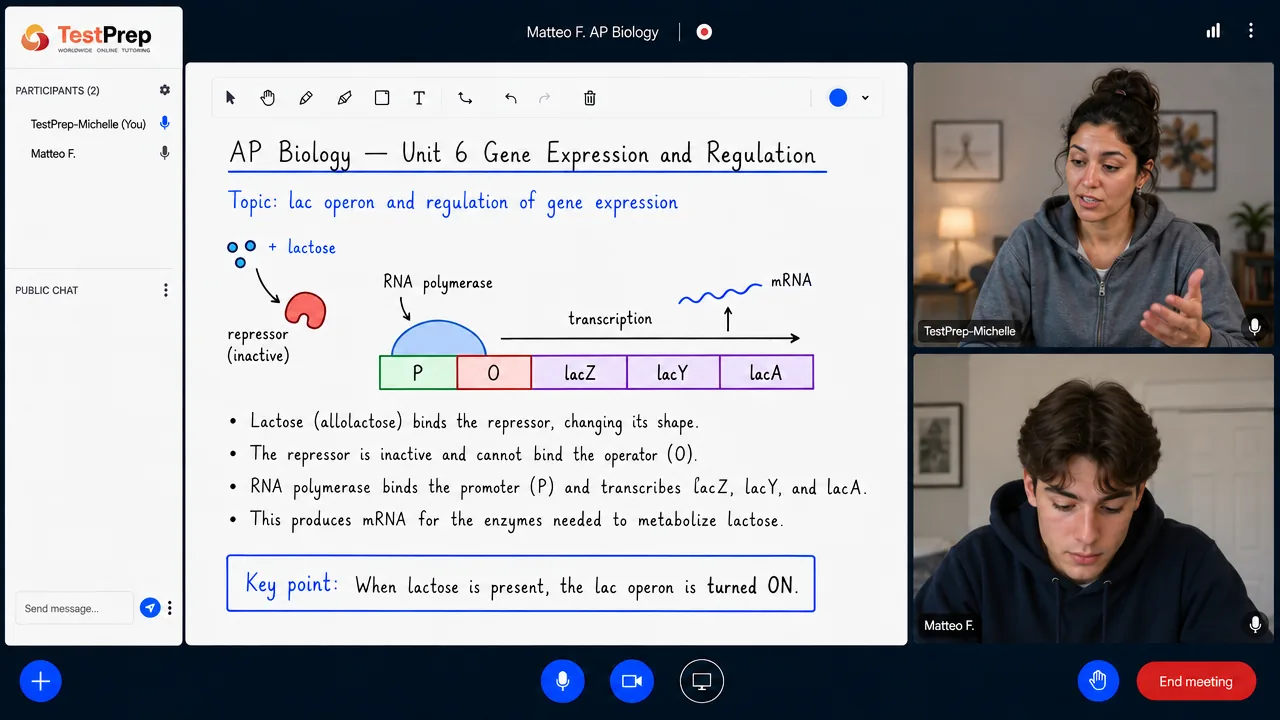
From a TestPrep AP Biology private lesson

100% live online lessons

About the subject

AP Biology: what it covers and who it suits

AP Biology tutoring at TestPrep Europe covers all eight College Board units — chemistry of life through ecology — with a heavy focus on data-based questions and experimental design, which together drive the FRQ rubric. Command terms (justify, explain, predict) are practised explicitly because they decide whether a correct biology fact earns a point.

  • All 8 units, chemistry of life through ecology
  • Data-based and graph-interpretation FRQs drilled as a separate skill
  • Experimental design and controls practised in every unit
Read more

AP Biology examines living systems from the molecular scale to ecosystems and is foundational for medicine, dentistry, biotechnology, genetics and ecology. The exam emphasises conceptual understanding, data analysis and scientific argumentation rather than memorisation of facts.

AP Biology is equivalent to a two-semester introductory college biology course. The curriculum is built around four big ideas — Evolution, Energetics, Information Storage and Transmission, and Systems Interactions — across eight units from Chemistry of Life to Ecology. Our programme leans heavily on data analysis and FRQ writing — the two skills that distinguish a 5 from a 4 — and runs weekly timed FRQ practice with rubric-aligned feedback.

One-to-one AP Biology tutoring

Our one-to-one AP tutoring is built entirely around the student's current level and target score. Each lesson works on your specific weak topics, drills exam-format questions and teaches free-response and essay technique with the College Board's scoring guidelines in front of us. Our tutors follow every revision of the Course and Exam Description, so the work you put in matches what is rewarded in May.

AP Biology small-group course

Our small-group AP courses (no more than 6 students per class) give you a structured weekly programme alongside students aiming for the same score. The syllabus follows the College Board's Course and Exam Description unit by unit, and every lesson is taught live online.

Exam

AP Biology exam format

The College Board runs the AP Biology exam every May. Sections, timing and weighting:

  • Section I: Multiple Choice

    50%

    60 questions in 1 hour 30 minutes. Single-answer questions, many tied to short data sets or graphs. A four-function (with square root) or scientific calculator is allowed; graphing calculators are not.

  • Section II: Free Response

    50%

    6 questions (2 long + 4 short) in 1 hour 30 minutes. Includes data interpretation and experimental design.

How do I register for the exam?
  • You can take AP Exams without taking the AP course at your school, but you can't register on your own.
  • Find a school that runs AP Exams and ask its AP coordinator to place you in an "exam only" section; enter the join code in My AP as soon as you get it. In some countries, College Board also lists authorized AP test centers you can register with directly.
  • Schools place their exam orders by mid-November; late additions, up to about mid-March, cost extra. Contact schools by the end of October at the latest.
  • College Board's AP Course Ledger lists the schools that offer AP; search it by country and city.

AP Course LedgerAuthorized AP test centers outside the U.S.

One-to-one AP tutoring

AP Biology Private Tutoring

Private AP lessons planned around you: the units you find hardest, your school's pace and the score you are aiming for. Every lesson is live and online, with a tutor who teaches this subject.

  • A lesson plan built around your target score
  • Every unit of the College Board course, in the order you need it
  • Multiple-choice and free-response technique, checked against College Board scoring guidelines
  • Lesson times that fit around your school week

How it works

  1. 1

    Tell us your goal

    We start from your school syllabus, your exam date and the result you are aiming for.

  2. 2

    Your own plan

    We map out the lessons you need, unit by unit.

  3. 3

    Live one-to-one lessons

    Meet your tutor online at times that suit your week.

  4. 4

    Regular progress checks

    Homework and a short check after each lesson show how you are getting on.

Start one-to-one AP Biology

Per lesson in a package, from

€54

See all prices

Right for you if you want a plan built entirely around you, flexible lesson times and a tutor's full attention.

Book one-to-one lessons

No package needed — you can book a single lesson.

Even our newest AP tutor has been teaching AP prep since 2016.

Group course calendar

AP Biology Group Course Calendar

50 lessons in total (40 topic lessons + 10 past-paper lessons). Topic lessons on Saturday and Sunday, 14:30–16:00; past-paper lessons on Sunday, 14:30–16:00 (Türkiye time). Lessons are taught in English.

2026-27 intake

Full

First lesson

10 October 2026

Last lesson

2 May 2027

Enrolment deadline

7 October 2026

AP exam

3 May 2027

Course fee

€1,566single payment

or 3 instalments of €522

  • 50 lessons in total
  • 40 topic lessons
  • 10 past-paper lessons
  • Lesson recordings available for 14 days

Every one of our 2026-27 AP group courses is full — thank you for the interest. The 2027-28 start dates are published on 1 November, and you can enrol now.

If three or more of you enrol together, you can have a group of your own at the same group course price. Each of you can buy a place online now, and we let you know as soon as your group is ready.

Buy a private group place

Lesson-by-lesson calendar

Topic lessonPast-paper lesson
Lesson-by-lesson calendar
DateTopic
10 Oct 2026Sat · 14:30–16:00Unit 1: Chemistry of Life (1/4)
11 Oct 2026Sun · 14:30–16:00Unit 1: Chemistry of Life (2/4)
17 Oct 2026Sat · 14:30–16:00Unit 1: Chemistry of Life (3/4)
18 Oct 2026Sun · 14:30–16:00Unit 1: Chemistry of Life (4/4)
24 Oct 2026Sat · 14:30–16:00Unit 2: Cells (1/5)
25 Oct 2026Sun · 14:30–16:00Unit 2: Cells (2/5)
31 Oct 2026Sat · 14:30–16:00Unit 2: Cells (3/5)
1 Nov 2026Sun · 14:30–16:00Unit 2: Cells (4/5)
7 Nov 2026Sat · 14:30–16:00Unit 2: Cells (5/5)
8 Nov 2026Sun · 14:30–16:00Unit 3: Cellular Energetics (1/6)

Good to know

  • 50 lessons in total: 40 teaching lessons and 10 exam walkthroughs.
  • Teaching phase: two lessons a week (Saturday and Sunday), 14:30–16:00.
  • Walkthrough phase: one lesson a week (Sunday), 14:30–16:00.
  • Unit 7: Natural Selection (13–20% of the exam) and Unit 3: Cellular Energetics (12–16%) get 6 lessons each.
  • Unit 2: Cells, Unit 4: Cell Communication and Cell Cycle, Unit 6: Gene Expression and Regulation and Unit 8: Ecology get 5 each.
  • Unit 1: Chemistry of Life and Unit 5: Heredity get 4 each.
  • Past exams are worked through from 2026 back to 2017. The 2020 exam was a shortened, free-response-only online exam, so a TestPrep practice test takes its place.
  • 100% First-Lesson Money-Back Guarantee

    Not satisfied? Full refund, no questions asked.

  • Secure Payments

    Powered by Stripe with 256-bit encryption.

    Stripe
  • Flexible Billing

    Pay in EUR — local cards welcome, instalments available.

Lessons cancelled less than 3 hours before the start count as taken. Full terms

Practice test · Question bank · AI Tutor

Practise AP Biology on your own

Three ways to practise between lessons. Each one is a separate product.

  • AP Biology Question Bank

    College Board-style questions unit by unit, with an explanation for every question. The first 30 questions are free.

    Try it free
  • AP Biology Practice Test

    A full-length test in the real exam format, with a detailed score report. Two attempts per test, and 12 months to use them.

    Go to the practice test
  • AI Tutor

    Talks you through the questions you got wrong on a practice test, out loud. Your first 2 mistakes are free.

    Meet the AI Tutor

Syllabus

AP Biology topics

Unit and topic names are the College Board's own. Percentages are each unit's share of the exam score, as the College Board publishes them.

1

Unit 1: Chemistry of Life

8–11%
  • Structure of water hydrogen bonding
  • Elements of life
  • Carbohydrates
  • Lipids
  • Nucleic acids
  • Proteins
2

Unit 2: Cells

10–13%
  • Cellular structure and functions
  • Cell size
  • Cellular interactions with its environment
  • Plasma membrane and membrane transport
  • Cell regulatory mechanisms (like osmosis and selective permeability)
  • Cellular compartmentalization
3

Unit 3: Cellular Energetics

12–16%
  • The structure and function of enzymes
  • Cellular energy
  • The processes of photosynthesis and cellular respiration
4

Unit 4: Cell Communication and Cell Cycle

10–15%
  • Cell communication
  • Signal transduction pathways
  • Feedback
  • Cell cycle and regulation
5

Unit 5: Heredity

8–11%
  • Meiosis and genetic diversity
  • Mendelian genetics
  • Non-mendelian Inheritance
  • Environmental effects on phenotype
6

Unit 6: Gene Expression and Regulation

12–16%
  • DNA and RNA structure
  • DNA replication
  • Transcription and RNA processing
  • Translation
  • Regulation of gene expression
  • Gene expression and cell specialization
  • Mutations
  • Biotechnology
7

Unit 7: Natural Selection

13–20%
  • Natural and artificial selection
  • Population genetics
  • Evidence of evolution and common ancestry
  • Phylogeny
  • Speciation and variations in populations
  • Origin of life on Earth
8

Unit 8: Ecology

10–15%
  • Responses to the environment
  • Energy flow through ecosystems
  • Population ecology and population density
  • Community ecology
  • Biodiversity
  • Disruptions in ecosystems

Approach

How we teach AP Biology

Study plan

  1. 1

    Phase 1 — Chemistry of life and cells (Units 1–2)

    Biomolecules, membranes, organelles, transport

    • Water properties and IMF logic
    • Membrane structure with osmosis problems
    • Compartmentalisation and the endomembrane system
  2. 2

    Phase 2 — Energetics and information (Units 3, 4 and 6)

    Cell energetics, communication, division, gene expression

    • Photosynthesis and respiration in parallel
    • Signal transduction cascades
    • Mitosis / meiosis / cancer link
    • DNA replication, transcription, translation, mutation effects
  3. 3

    Phase 3 — Heredity and natural selection (Units 5 and 7)

    Mendelian and population genetics, evolution

    • Pedigrees and dihybrid crosses
    • Hardy-Weinberg setup and interpretation
    • Phylogenetic tree reading and natural selection mechanisms
  4. 4

    Phase 4 — Ecology + mocks (Unit 8 + review)

    Population, community and ecosystem ecology

    • Population growth models with data
    • Food webs, trophic levels, energy transfer
    • Released FRQs with experimental design and graph analysis

How lessons work

  • Command terms taught as a vocabulary

    'Identify', 'describe', 'explain', 'justify' and 'predict' each have rubric implications. We rewrite the same answer in all five styles so students stop losing the explanation point.

  • Experimental design as a unit-agnostic skill

    Controls, replication, sample size and confounding variables are drilled as a checklist that gets applied to FRQs from every unit, not just to the lab unit.

  • Graph reading before content

    On data-based FRQs we read axes, units and trends out loud before touching biology — most lost points come from misreading the figure, not from misunderstanding the topic.

Advice

AP Biology: common mistakes and study tips

  • MistakeNaming a process instead of describing the mechanism.

    FixIf the prompt asks 'how' or 'why', describe the molecular or cellular event step by step — naming alone doesn't earn the point.

  • MistakeForgetting controls in experimental-design FRQs.

    FixAlways state the control group, the variable held constant, and the variable manipulated; missing one collapses the rubric.

  • MistakeTreating 'evolution' as a single explanation for any change.

    FixSpecify the mechanism — selection, drift, gene flow, mutation — and the source of variation each time.

  • MistakeMisreading graphs by ignoring axes and units.

    FixRead both axes out loud before answering; data-based FRQs penalise wrong direction or wrong scale even when the biology is correct.

  • MistakeConfusing genotype, phenotype and allele in genetics problems.

    FixAnnotate the cross with all three before answering — separate which the question is asking about.

  • MistakeVague ecology answers ('the population decreases').

    FixTie every prediction to a named driver — carrying capacity, density-dependent factor, trophic cascade — so the answer is mechanistic.

Study tips

  • Treat the data-analysis FRQs as core practice: they appear every year and reward students who can read graphs cleanly and write tight conclusions.
  • Practise statistical interpretation (chi-square, error bars, mean/median comparisons) — College Board explicitly tests these.
  • Build concept maps that link units; AP Biology rewards synthesis, especially the questions that bridge cellular and evolutionary scales.
  • Use the College Board's released FRQs and scoring guidelines to learn exactly what counts as a complete answer.

Ready to raise your AP Biology score?

You can start one-to-one AP Biology lessons with a single lesson. Every package and price is on one page.

  • Live one-to-one lessons online
  • No package needed — book a single lesson
  • Lesson times that fit your school week
FAQ

AP Biology Prep — Frequently Asked Questions

The questions students ask most about AP Biology preparation.

Less than students assume. The exam tests how well facts are applied to data and experiments, not how many facts are recalled. Students who only flashcard usually plateau around a 3.

Yes — chi-square appears on the equation sheet and shows up in genetics and ecology FRQs. We make sure students can both compute it and interpret the conclusion.

Both long questions ask you to interpret and evaluate experimental results (one of them with graphing), and one short question is a scientific investigation. They reward experimental setup language: independent / dependent variable, control, replication, and sample size. We treat them as a separate genre with their own template.

AP Biology is best after a solid IGCSE / GCSE Biology base; the topics overlap but AP demands more data work and explanatory writing.

A cohort takes 24 students, taught in classes of at most 6 because the cohort is split by level. Lessons are live and online, and every lesson is recorded; each recording stays available for 14 days from the lesson date.

The money-back guarantee covers live lessons. If you are not satisfied after your first private lesson, we refund your payment in full. On a group course, the same applies to the lessons held in the first week. The question bank and practice tests are not part of it.

No. They are digital products that open the moment you buy them, so they are not refundable. The one exception is the EU right of withdrawal: within 14 days of purchase, as long as you have not started a test or opened the question bank.

Lessons cancelled less than 3 hours before the start count as taken and are not refunded. A lesson that has not been paid for 3 hours before it starts is cancelled automatically.

AP Biology reviews

Be the first to review this programme.

Share your experience

Your comment will appear after approval.

Your rating

All TestPrep Europe reviews