AP Computer Science Principles Tutoring & Prep Course
Short answer
The AP Computer Science Principles course is one-to-one tutoring, taught live online: every lesson is 90 minutes.
A private group is for 3 or more friends who sign up together; there are no published start dates, and we agree the start date and lesson times with you.
In one-to-one tutoring, packages are from €58 a lesson.
Try the free AP Computer Science Principles practice test
AP Computer Science Principles tutoring covering computational thinking, data, the internet, and the Create Performance Task for a score of 5.
One-to-one and small groups · Live online · College Board curriculum
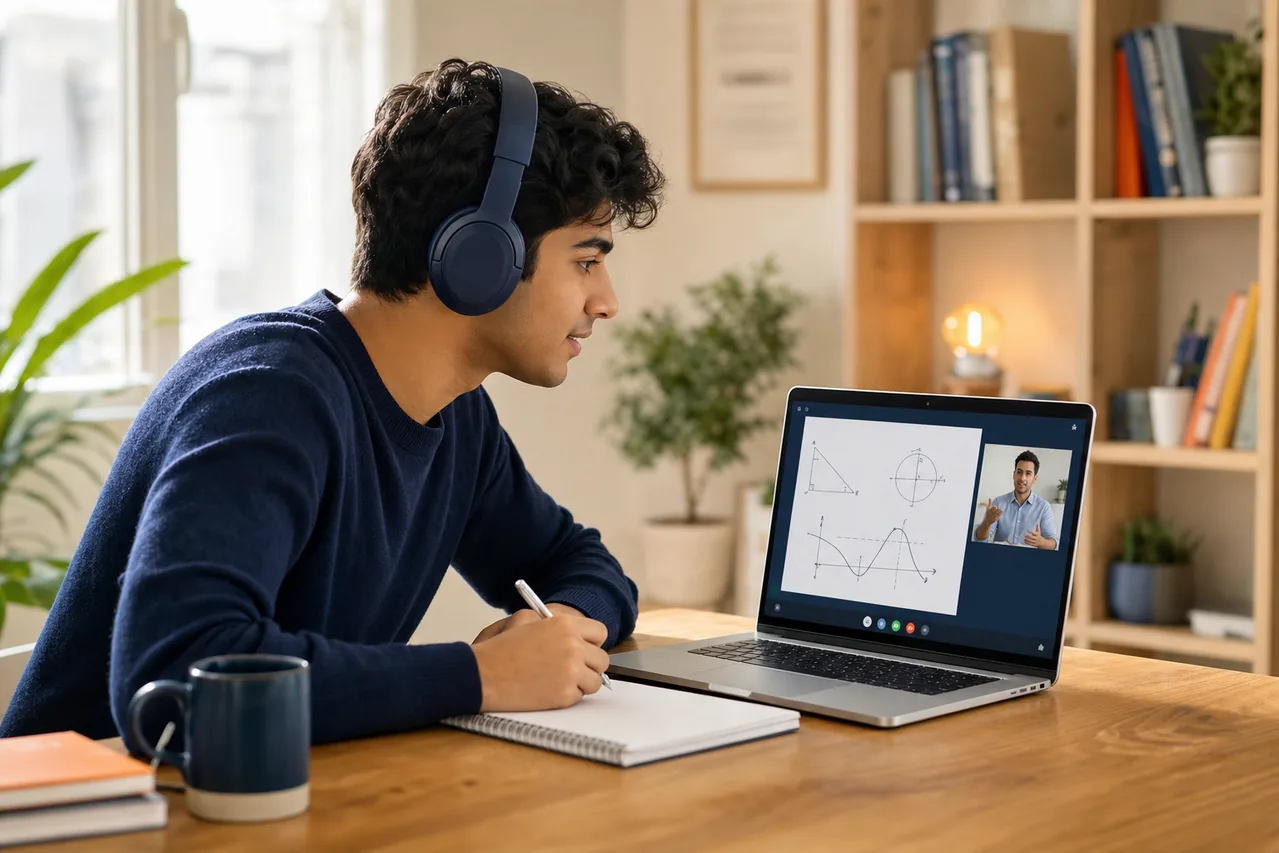
100% live online lessons
About the subject
AP Computer Science Principles: what it covers and who it suits
AP Computer Science Principles (CSP) tutoring at TestPrep Europe covers the five Big Ideas — creative development, data, algorithms and programming, computer systems and networks, impact of computing — alongside the Create performance task and the End-of-Course exam. The exam is conceptual and pseudocode-based; students don't need a single specific language but must reason fluently with iteration, lists and procedures.
- All 5 Big Ideas covered with the College Board reference pseudocode
- Algorithm tracing, list manipulation and procedure design drilled to reflex
- Data, networks and computing impact taught as exam content, not as background
Read more
AP Computer Science Principles (CSP) is a broad, programming-light introduction to computing. It covers how the internet works, how data is collected and analysed, how algorithms are designed, and how computing affects society — alongside enough programming to complete the Create Performance Task. CSP is ideal for students who want a foundational AP in technology without the steep Java curve of AP Computer Science A.
AP Computer Science Principles takes a deliberately wide view of computing: it teaches enough programming to build something meaningful while spending equal time on data, networks, security and the social consequences of technology. The Create Performance Task is the heart of the course — students build their own program, document the abstractions and algorithms inside it, and defend their design choices in writing. Our CSP programme keeps Python as the default teaching language (it is the easiest path to a strong Create Task for most students), but also supports JavaScript or Scratch where students prefer. We pair weekly multiple-choice drills with continuous Create Task development so the project is polished long before the College Board deadline.
One-to-one AP Computer Science Principles tutoring
Our one-to-one AP tutoring is built entirely around the student's current level and target score. Each lesson works on your specific weak topics, drills exam-format questions and teaches free-response and essay technique with the College Board's scoring guidelines in front of us. Our tutors follow every revision of the Course and Exam Description, so the work you put in matches what is rewarded in May.
AP Computer Science Principles small-group course
Our small-group AP courses (no more than 6 students per class) give you a structured weekly programme alongside students aiming for the same score. The syllabus follows the College Board's Course and Exam Description unit by unit, and every lesson is taught live online.
Exam
AP Computer Science Principles exam format
The College Board runs the AP Computer Science Principles exam every May. Sections, timing and weighting:
Create Performance Task
30%Program code, a video of up to one minute and a Personalized Project Reference, built in 9 hours of class time and submitted by 30 April 2027. Two written-response questions about that code are answered on exam day (60 minutes), with the Personalized Project Reference to hand.
End-of-Course Exam
70%70 multiple-choice questions in 2 hours covering data, algorithms, programming and the impact of computing.
The College Board will publish a revised course framework in spring 2027 for the 2027-28 school year, so the May 2028 exam will follow the new framework.
How do I register for the exam?
- You complete the Create performance task on your own and submit it as final in the AP Digital Portfolio by 30 April; with the written-response questions on exam day it makes up 30% of your score.
One-to-one AP tutoring
AP Computer Science Principles Private Tutoring
Private AP lessons planned around you: the units you find hardest, your school's pace and the score you are aiming for. Every lesson is live and online, with a tutor who teaches this subject.
- A lesson plan built around your target score
- Every unit of the College Board course, in the order you need it
- Multiple-choice and free-response technique, checked against College Board scoring guidelines
- Lesson times that fit around your school week
How it works
- 1
Tell us your goal
We start from your school syllabus, your exam date and the result you are aiming for.
- 2
Your own plan
We map out the lessons you need, unit by unit.
- 3
Live one-to-one lessons
Meet your tutor online at times that suit your week.
- 4
Regular progress checks
Homework and a short check after each lesson show how you are getting on.
Start one-to-one AP Computer Science Principles
Right for you if you want a plan built entirely around you, flexible lesson times and a tutor's full attention.
Book one-to-one lessonsBefore choosing a package, you can book one paid lesson.
Our AP tutors began teaching in 2018 or earlier.
Group course
A Private Group for This Subject
There is no open group timetable for this subject in 2026–27. If 3 or more of you sign up together, we open a private group course for you — at the same price as the open group course. Lessons are taught in English.
Course fee
€1,572the same as an open group course
At least 3 students · you set the weekly timetable together
Each student buys their own place online, and we let you know as soon as your group is ready.
or 3 instalments of €524Questions first? Get in touch- Classes of no more than 6 students
- Live online lessons you can watch again
- A lesson plan that follows the College Board course
- Not satisfied after the first week of your group course? Full (100%) refund. We do not offer free trial lessons. Payment is required before your first lesson.
100% First-Lesson Money-Back Guarantee
Not satisfied? Full refund, no questions asked.
We do not offer free trial lessons. Payment is required before your first lesson.
Secure Payments
Powered by Stripe with 256-bit encryption.

Flexible Billing
Local cards welcome, instalments available.
Lessons cancelled less than 3 hours before the start count as taken. Full terms
Practice test · Question bank · TestPrep AI Tutor
Practise AP Computer Science Principles on your own
Three ways to practise between lessons. Each one is a separate product.
- Coming soon
AP Computer Science Principles Question Bank
The AP Computer Science Principles question bank is on its way. Until then, you can explore the other AP subjects in the question bank.
Explore the AP question bank AP Computer Science Principles Practice Test
A full-length test in the real exam format, with a detailed score report. Two attempts per test, and 12 months to use them.
Go to the practice testTestPrep AI Tutor
Talks you through the questions you got wrong on a practice test, out loud. Your first 2 mistakes are free.
How TestPrep AI Tutor works
Syllabus
AP Computer Science Principles topics
Unit and topic names are the College Board's own. Percentages are each unit's share of the exam score, as the College Board publishes them.
1Big Idea 1: Creative Development
10–13%
- Collaboration
- Program design and development
2Big Idea 2: Data
17–22%
- Data compression
- Extracting information from data
3Big Idea 3: Algorithms and Programming
30–35%
- Developing algorithms
- Simulations
- Algorithmic efficiency
4Big Idea 4: Computer Systems and Networks
11–15%
- The Internet
- Parallel and distributed computing
5Big Idea 5: Impact of Computing
21–26%
- The digital divide
- Computing bias
- Safe computing
Approach
How we teach AP Computer Science Principles
Study plan
- 1
Phase 1 — Big Idea 1 + 2
Creative development and data
- Iterative development cycle
- Binary, hex, sampling and lossy compression
- Data filtering and aggregation
- 2
Phase 2 — Big Idea 3 (Programming)
Variables, lists, iteration, conditionals, procedures
- Reference pseudocode fluency
- List traversal and modification
- Procedure design with parameters and return values
- 3
Phase 3 — Big Ideas 4 + 5
Computer systems / networks and impact of computing
- Internet protocols, packets, fault tolerance
- Cybersecurity basics — encryption, multifactor auth
- Digital divide, bias, intellectual property
- 4
Phase 4 — Mocks
End-of-Course MCQ practice
- Released MCQs scored with explanations
- Pseudocode tracing under timed conditions
How lessons work
Reference pseudocode literacy
We focus on the College Board reference statements rather than any one language, so the student matches what the test actually uses.
Tracing tables for iteration
Students draw out variable state and list contents row-by-row through every loop in early practice; speed comes later, after correctness is automatic.
Five Big Ideas weighted to the exam
Practice time is allocated to match exam weighting — programming is large but not the whole picture.
Advice
AP Computer Science Principles: common mistakes and study tips
MistakeTreating CSP as 'just programming'.
FixProgramming is one Big Idea out of five. Data, networks and impact each carry significant exam weight; students who only practise code under-score.
MistakeConfusing the reference pseudocode with Python or Java.
FixUse the College Board reference list of operations and statements — equivalent code in another language won't match the test items.
MistakeOff-by-one errors when tracing iteration.
FixWrite loop variables and the list state in a small table for each iteration; trace by hand, not by intuition.
MistakeVague 'impact' answers ('computers help people').
FixTie every impact claim to a specific population, benefit / harm, and a named technology or practice (encryption, open source, accessibility, etc.).
MistakeConfusing analog and digital data representations.
FixBe explicit about sampling, quantisation and the loss involved; binary representation questions reward precision.
MistakeSkipping abstraction in procedure-design questions.
FixWrap reusable logic in named procedures with parameters; the rubric and the MCQ both reward abstraction.
Study tips
- Start the Create Task early and iterate; leaving it to the last week leaves no time to fix problems.
- In your written responses, point explicitly to your abstractions and your algorithm; the rubric grades whether you named them, not just whether they exist.
- Train on College Board pseudocode rather than any one real language — the multiple-choice section is language-neutral.
- Tie every concept back to a real-world example (TCP/IP, public-key crypto, recommendation algorithms) so abstract ideas stick.
Ready to raise your AP Computer Science Principles score?
You can start one-to-one AP Computer Science Principles lessons with a single lesson. Every package and price is on one page.
- Live one-to-one lessons online
- No package needed — book a single lesson
- Lesson times that fit your school week
You can also write to us through our contact page.
Other subjects
Related and other AP subjects
Often taken alongside this subject
- AP Computer Science AJava-based companion AP for students continuing into CS at university.
- AP StatisticsData Big Idea overlaps with statistical thinking.
- AP Calculus ABUseful pairing for students aiming at CS or engineering.
All AP subjects
- AP Calculus AB
- AP Calculus BC
- AP Statistics
- AP Precalculus
- AP Computer Science A
- AP Physics 1
- AP Physics 2
- AP Physics C: Mechanics
- AP Physics C: Electricity & Magnetism
- AP Chemistry
- AP Biology
- AP Environmental Science
- AP English Language & Composition
- AP English Literature & Composition
- AP US History (APUSH)
- AP World History: Modern
- AP European History
- AP US Government & Politics
- AP Comparative Government & Politics
- AP Human Geography
- AP Microeconomics
- AP Macroeconomics
- AP Psychology
- AP Art History
- AP Music Theory
- AP Spanish Language & Culture
- AP French Language & Culture
- AP Chinese Language & Culture
- AP Business with Personal Finance
- AP Cybersecurity
- AP African American Studies
AP Computer Science Principles Prep — Frequently Asked Questions
The questions students ask most about AP Computer Science Principles preparation.