AP Calculus BC Tutoring & Prep Course
Short answer
The AP Calculus BC group course is live online: 50 lessons, 90 minutes each, 75 hours in all.
Group lessons are taught in classes of at most 6 students.
The current group's lessons began on 28 September 2026. The group course fee is €1,573 in one payment.
Try the free AP Calculus BC practice test
AP Calculus BC tutoring covering series, parametric equations and advanced analysis. Intensive FRQ practice and strategy for a score of 5.
One-to-one and small groups · Live online · College Board curriculum
100% live online lessons
About the subject
AP Calculus BC: what it covers and who it suits
AP Calculus BC tutoring at TestPrep Europe covers everything in AB plus the two BC-only units — Unit 9: Parametric Equations, Polar Coordinates, and Vector-Valued Functions and Unit 10: Infinite Sequences and Series — and the extra BC topics inside Units 6–8, such as integration by parts, partial fractions, improper integrals and logistic models. The exam returns both an AB subscore and a BC score, so the AB foundation has to be airtight before BC topics layer on top.
Some of the teachers who teach AP Calculus BC: Burak Kara, Deniz Arslan, Eda Karataş and Gökhan İnce.
- All 10 BC units covered, AB material reviewed first as the foundation
- Series convergence tests practised as a flowchart, not as memorisation
- Parametric, polar and vector calculus drilled with timed FRQs
Read more
AP Calculus BC suits students targeting mathematics, physics and engineering. It covers everything in AB plus infinite sequences and series, Taylor and Maclaurin series, parametric equations and polar coordinates. A successful score typically places students out of two semesters of university calculus, a major advantage for STEM applicants and a meaningful tuition saving at private universities.
AP Calculus BC covers the equivalent of two semesters of university calculus. It includes all of AB (limits, derivatives, integrals, differential equations) and adds parametric, polar and vector functions, plus infinite sequences and series. Taylor and Maclaurin series are particularly important: they let students approximate transcendental functions with polynomials and underpin huge swathes of physics and engineering. On exam day students receive both a BC score and an AB sub-score, giving universities flexibility in awarding credit. Our BC programme tailors the pacing to each student's incoming background — students arriving from IB Math AA HL, for instance, already have most of the parametric and series content, so we focus tutoring time on AP-specific FRQ formatting and the alternating series error bound.
One-to-one AP Calculus BC tutoring
Our one-to-one AP tutoring is built entirely around the student's current level and target score. Each lesson works on your specific weak topics, drills exam-format questions and teaches free-response and essay technique with the College Board's scoring guidelines in front of us. Our tutors follow every revision of the Course and Exam Description, so the work you put in matches what is rewarded in May.
AP Calculus BC small-group course
Our small-group AP courses (no more than 6 students per class) give you a structured weekly programme alongside students aiming for the same score. The syllabus follows the College Board's Course and Exam Description unit by unit, and every lesson is taught live online.
Exam
AP Calculus BC exam format
The College Board runs the AP Calculus BC exam every May. Sections, timing and weighting:
Section I: Multiple Choice
50%42 questions in 1 hour 40 minutes. Part A (29 questions, 62 minutes, no calculator) and Part B (13 questions, 38 minutes, graphing calculator). AB and BC share the same multiple-choice structure.
Section II: Free Response
50%6 questions in 1 hour 30 minutes. Part A (2 questions, 30 minutes, calculator) and Part B (4 questions, 60 minutes, no calculator).
Exam delivery
Hybrid digitalMultiple choice is answered in Bluebook; free-response answers are handwritten in a paper booklet.
One-to-one AP tutoring
AP Calculus BC Private Tutoring
Private AP lessons planned around you: the units you find hardest, your school's pace and the score you are aiming for. Every lesson is live and online, with a tutor who teaches this subject.
- A lesson plan built around your target score
- Every unit of the College Board course, in the order you need it
- Multiple-choice and free-response technique, checked against College Board scoring guidelines
- Lesson times that fit around your school week
How it works
- 1
Tell us your goal
We start from your school syllabus, your exam date and the result you are aiming for.
- 2
Your own plan
We map out the lessons you need, unit by unit.
- 3
Live one-to-one lessons
Meet your tutor online at times that suit your week.
- 4
Regular progress checks
Homework and a short check after each lesson show how you are getting on.
Start one-to-one AP Calculus BC
Right for you if you want a plan built entirely around you, flexible lesson times and a tutor's full attention.
Book one-to-one lessonsBefore choosing a package, you can book one paid lesson.
Our AP tutors began teaching in 2018 or earlier.
No group is open right now
Group course
A Private Group for This Subject
There is no open group timetable for this subject in 2026–27. If 3 or more of you sign up together, we open a private group course for you — at the same price as the open group course. Lessons are taught in English.
Course fee
€1,573the same as an open group course
At least 3 students · you set the weekly timetable together
Each student buys their own place online, and we let you know as soon as your group is ready.
or 3 instalments of €524Questions first? Get in touch- Classes of no more than 6 students
- Live online lessons you can watch again
- A lesson plan that follows the College Board course
- Not satisfied after the first week of your group course? Full (100%) refund. We do not offer free trial lessons. Payment is required before your first lesson.
100% First-Lesson Money-Back Guarantee
Not satisfied? Full refund, no questions asked.
We do not offer free trial lessons. Payment is required before your first lesson.
Secure Payments
Powered by Stripe with 256-bit encryption.

Flexible Billing
Local cards welcome, instalments available.
Lessons cancelled less than 3 hours before the start count as taken. Full terms
Practice test · Question bank · TestPrep AI Tutor
Practise AP Calculus BC on your own
Three ways to practise between lessons. Each one is a separate product.
- Coming soon
AP Calculus BC Question Bank
The AP Calculus BC question bank is on its way. Until then, you can explore the other AP subjects in the question bank.
Explore the AP question bank AP Calculus BC Practice Test
A full-length test in the real exam format, with a detailed score report. Two attempts per test, and 12 months to use them.
Go to the practice testTestPrep AI Tutor
Talks you through the questions you got wrong on a practice test, out loud. Your first 2 mistakes are free.
How TestPrep AI Tutor works
Syllabus
AP Calculus BC topics
Unit and topic names are the College Board's own. Percentages are each unit's share of the exam score, as the College Board publishes them.
1Unit 1: Limits and Continuity
5–10%
- How limits help us to handle change at an instant
- Definition and properties of limits in various representations
- Definitions of continuity of a function at a point and over a domain
- Asymptotes and limits at infinity
- Reasoning using the Squeeze theorem and the Intermediate Value Theorem
2Unit 2: Differentiation: Definition and Fundamental Properties
5–10%
- Defining the derivative of a function at a point and as a function
- Connecting differentiability and continuity
- Determining derivatives for elementary functions
- Applying differentiation rules
3Unit 3: Differentiation: Composite, Implicit, and Inverse Functions
5–10%
- The chain rule for differentiating composite functions
- Implicit differentiation
- Differentiation of general and particular inverse functions
- Determining higher-order derivatives of functions
4Unit 4: Contextual Applications of Differentiation
5–10%
- Identifying relevant mathematical information in verbal representations of real-world problems involving rates of change
- Applying understandings of differentiation to problems involving motion
- Generalizing understandings of motion problems to other situations involving rates of change
- Solving related rates problems
- Local linearity and approximation
- L'Hospital's rule
5Unit 5: Analytical Applications of Differentiation
10–15%
- Mean Value Theorem and Extreme Value Theorem
- Derivatives and properties of functions
- How to use the first derivative test, second derivative test, and candidates test
- Sketching graphs of functions and their derivatives
- How to solve optimization problems
- Behaviors of Implicit relations
6Unit 6: Integration and Accumulation of Change
15–20%
- Using definite integrals to determine accumulated change over an interval
- Approximating integrals with Riemann Sums
- Accumulation functions, the Fundamental Theorem of Calculus, and definite integrals
- Antiderivatives and indefinite integrals
- Properties of integrals and integration techniques, extended
- Determining improper integrals
7Unit 7: Differential Equations
5–10%
- Interpreting verbal descriptions of change as separable differential equations
- Sketching slope fields and families of solution curves
- Using Euler's method to approximate values on a particular solution curve
- Solving separable differential equations to find general and particular solutions
- Deriving and applying exponential and logistic models
8Unit 8: Applications of Integration
5–10%
- Determining the average value of a function using definite integrals
- Modeling particle motion
- Solving accumulation problems
- Finding the area between curves
- Determining volume with cross-sections, the disc method, and the washer method
- Determining the length of a planar curve using a definite integral
9Unit 9: Parametric Equations, Polar Coordinates, and Vector-Valued Functions
10–15%
- Finding derivatives of parametric functions and vector-valued functions
- Calculating the accumulation of change in length over an interval using a definite integral
- Determining the position of a particle moving in a plane
- Calculating velocity, speed, and acceleration of a particle moving along a curve
- Finding derivatives of functions written in polar coordinates
- Finding the area of regions bounded by polar curves
10Unit 10: Infinite Sequences and Series
15–20%
- Applying limits to understand convergence of infinite series
- Types of series: Geometric, harmonic, and p-series
- A test for divergence and several tests for convergence
- Approximating sums of convergent infinite series and associated error bounds
- Determining the radius and interval of convergence for a series
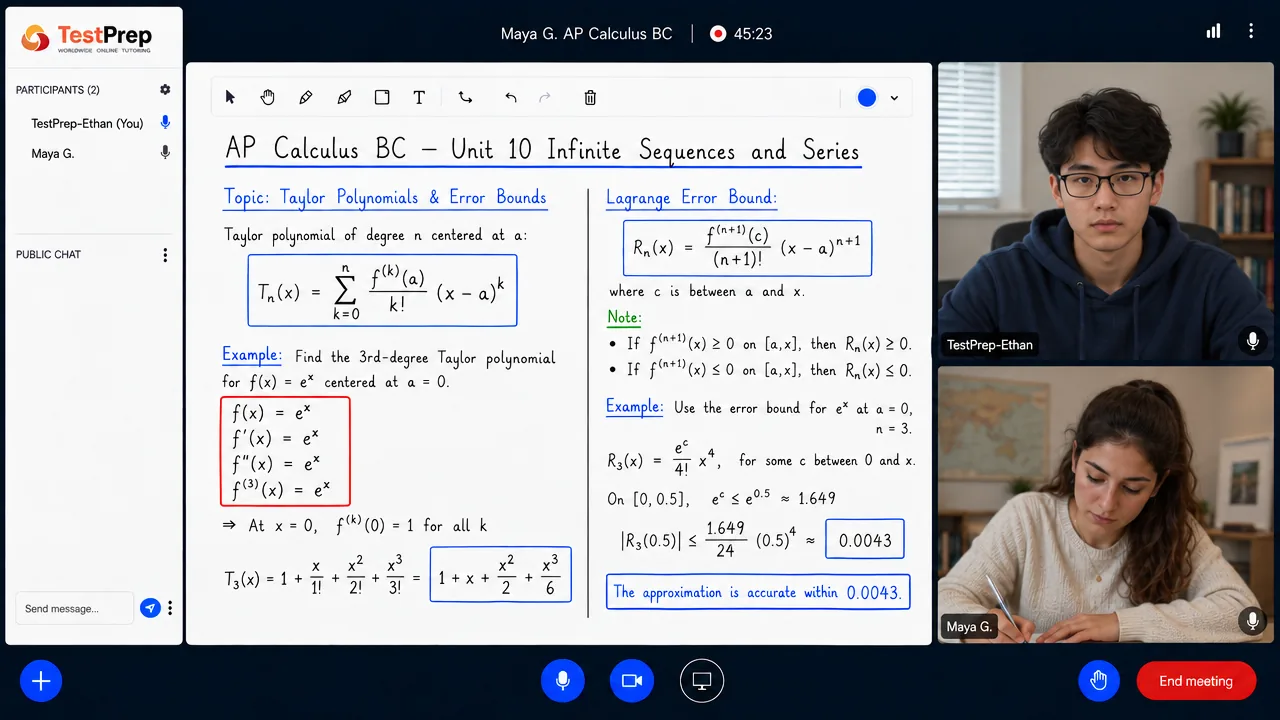
- Representing a function as a Taylor series or a Maclaurin series on an appropriate interval
Approach
How we teach AP Calculus BC
Study plan
- 1
Phase 1 — AB foundation review
Limits, derivatives, integrals
- Tighten AB rules
- Calculator-active reflexes
- 2
Phase 2 — Integration techniques
BC-only integration
- Integration by parts
- Partial fractions
- Improper integrals
- 3
Phase 3 — Parametric, polar, vector
Unit 9
- Parametric derivatives + arc length
- Polar area
- Vector-valued functions
- 4
Phase 4 — Series + mock
Unit 10 + full exam
- Convergence test flowchart
- Power series + radius of convergence
- Taylor/Maclaurin
- Full-length timed practice exam
How lessons work
Series as a decision tree
Convergence tests are taught as a routing problem — given the form of the series, which test runs fastest. Students stop guessing and start matching pattern to test.
Dual-track AB protection
Because BC also yields an AB subscore, every BC session keeps a small AB review block so the AB material doesn't decay.
Released FRQ scoring
Recent BC FRQs are scored against the official rubric in session; the student sees exactly where partial credit is gained or lost.
Advice
AP Calculus BC: common mistakes and study tips
MistakePicking the wrong convergence test under time pressure.
FixStart every series question with the divergence test, then route through ratio / integral / comparison / alternating-series tests via a fixed flowchart (the root test is not part of the AP course).
MistakeTreating polar area as Cartesian area.
FixPolar area is (1/2)∫r²dθ, never ∫y dx. Re-derive it once and the formula sticks.
MistakeConfusing parametric speed with parametric arc length.
FixSpeed is √((dx/dt)² + (dy/dt)²); arc length is the integral of speed over t. Different objects, different units.
MistakeDropping the +C in indefinite integrals on FRQs.
FixIndefinite integrals always carry +C — losing it costs the answer-mark and can cascade into later parts.
MistakeUsing a Taylor series centred at 0 when the question asks for a different centre.
FixRead the centre carefully; a Taylor series at x = a uses (x − a)^n, not x^n.
Study tips
- Learn the convergence tests as a systematic decision tree — know which test applies to which series shape.
- Memorise the Taylor/Maclaurin expansions for sin(x), cos(x), e^x, 1/(1-x) and ln(1+x).
- BC reports an AB sub-score, so build rock-solid AB fluency first, then layer the BC-only material on top.
- On parametric and polar problems, sketch the curve first to ground your intuition before doing the analytic work.
Student results
AP success stories
Results our AP students shared in their own reviews.
Ready to raise your AP Calculus BC score?
You can start one-to-one AP Calculus BC lessons with a single lesson. Every package and price is on one page.
- Live one-to-one lessons online
- No package needed — book a single lesson
- Lesson times that fit your school week
You can also write to us through our contact page.
Other subjects
Related and other AP subjects
Often taken alongside this subject
- AP Calculus ABAB is the foundation; BC layers on top.
- AP Physics C: MechanicsBC-level calculus is assumed in Physics C.
- AP StatisticsStrong second math AP for STEM-bound applicants.
All AP subjects
- AP Calculus AB
- AP Statistics
- AP Precalculus
- AP Computer Science A
- AP Computer Science Principles
- AP Physics 1
- AP Physics 2
- AP Physics C: Mechanics
- AP Physics C: Electricity & Magnetism
- AP Chemistry
- AP Biology
- AP Environmental Science
- AP English Language & Composition
- AP English Literature & Composition
- AP US History (APUSH)
- AP World History: Modern
- AP European History
- AP US Government & Politics
- AP Comparative Government & Politics
- AP Human Geography
- AP Microeconomics
- AP Macroeconomics
- AP Psychology
- AP Art History
- AP Music Theory
- AP Spanish Language & Culture
- AP French Language & Culture
- AP Chinese Language & Culture
- AP Business with Personal Finance
- AP Cybersecurity
- AP African American Studies
AP Calculus BC Prep — Frequently Asked Questions
The questions students ask most about AP Calculus BC preparation.