AP Computer Science A Tutoring & Prep Course
Short answer
The AP Computer Science A group course is live online: 50 lessons, 90 minutes each, 75 hours in all.
Group lessons are taught in classes of at most 6 students.
The current group's lessons began on 12 October 2026. The group course fee is €1,573 in one payment.
Try the free AP Computer Science A practice test
AP Computer Science A tutoring focused on Java programming, OOP and algorithms. FRQ coding strategy for a score of 5.
One-to-one and small groups · Live online · College Board curriculum
100% live online lessons
About the subject
AP Computer Science A: what it covers and who it suits
AP Computer Science A tutoring at TestPrep Europe covers Java fundamentals, object-oriented design, the classes listed in the Java Quick Reference, and the FRQ skills the College Board exam tests. Students leave able to read and write the kind of class-based Java the May exam demands.
- All 4 units covered: Using Objects and Methods through Data Collections
- The Java Quick Reference drilled until reflexive
- Class design FRQ practice with full rubric scoring
Read more
AP Computer Science A teaches object-oriented programming and algorithm design through Java. It is an excellent first formal programming credential for students aiming at software engineering, AI or data science, and a strong score typically grants placement out of CS101 at universities that accept AP credit.
AP Computer Science A introduces programming and algorithmic thinking through Java. Since the 2025-26 revision the course has four units — Using Objects and Methods, Selection and Iteration, Class Creation, and Data Collections — and inheritance is no longer part of it. Students design their own classes, work with arrays, ArrayLists, 2D arrays, text files and data sets, implement searching and sorting algorithms, and trace recursive methods. The exam tests both code tracing (reading existing code and predicting output) and code writing (producing correct Java that satisfies a specification). Our programme accommodates students at every starting point: complete beginners build from first principles, while students with prior Python or JavaScript exposure focus on Java idioms and the AP-specific FRQ rubric.
One-to-one AP Computer Science A tutoring
Our one-to-one AP tutoring is built entirely around the student's current level and target score. Each lesson works on your specific weak topics, drills exam-format questions and teaches free-response and essay technique with the College Board's scoring guidelines in front of us. Our tutors follow every revision of the Course and Exam Description, so the work you put in matches what is rewarded in May.
AP Computer Science A small-group course
Our small-group AP courses (no more than 6 students per class) give you a structured weekly programme alongside students aiming for the same score. The syllabus follows the College Board's Course and Exam Description unit by unit, and every lesson is taught live online.
Exam
AP Computer Science A exam format
The College Board runs the AP Computer Science A exam every May. Sections, timing and weighting:
Section I: Multiple Choice
55%42 questions in 1 hour 30 minutes. Code tracing, debugging and output prediction.
Section II: Free Response
45%4 questions in 1 hour 30 minutes, written in Java: one each of Methods and Control Structures, Class Design, Data Analysis with ArrayList, and 2D Array.
Exam delivery
Fully digitalThe entire exam is completed in the Bluebook app.
One-to-one AP tutoring
AP Computer Science A Private Tutoring
Private AP lessons planned around you: the units you find hardest, your school's pace and the score you are aiming for. Every lesson is live and online, with a tutor who teaches this subject.
- A lesson plan built around your target score
- Every unit of the College Board course, in the order you need it
- Multiple-choice and free-response technique, checked against College Board scoring guidelines
- Lesson times that fit around your school week
How it works
- 1
Tell us your goal
We start from your school syllabus, your exam date and the result you are aiming for.
- 2
Your own plan
We map out the lessons you need, unit by unit.
- 3
Live one-to-one lessons
Meet your tutor online at times that suit your week.
- 4
Regular progress checks
Homework and a short check after each lesson show how you are getting on.
Start one-to-one AP Computer Science A
Right for you if you want a plan built entirely around you, flexible lesson times and a tutor's full attention.
Book one-to-one lessonsBefore choosing a package, you can book one paid lesson.
Our AP tutors began teaching in 2018 or earlier.
No group is open right now
Group course
A Private Group for This Subject
There is no open group timetable for this subject in 2026–27. If 3 or more of you sign up together, we open a private group course for you — at the same price as the open group course. Lessons are taught in English.
Course fee
€1,573the same as an open group course
At least 3 students · you set the weekly timetable together
Each student buys their own place online, and we let you know as soon as your group is ready.
or 3 instalments of €524Questions first? Get in touch- Classes of no more than 6 students
- Live online lessons you can watch again
- A lesson plan that follows the College Board course
- Not satisfied after the first week of your group course? Full (100%) refund. We do not offer free trial lessons. Payment is required before your first lesson.
100% First-Lesson Money-Back Guarantee
Not satisfied? Full refund, no questions asked.
We do not offer free trial lessons. Payment is required before your first lesson.
Secure Payments
Powered by Stripe with 256-bit encryption.

Flexible Billing
Local cards welcome, instalments available.
Lessons cancelled less than 3 hours before the start count as taken. Full terms
Practice test · Question bank · TestPrep AI Tutor
Practise AP Computer Science A on your own
Three ways to practise between lessons. Each one is a separate product.
- Coming soon
AP Computer Science A Question Bank
The AP Computer Science A question bank is on its way. Until then, you can explore the other AP subjects in the question bank.
Explore the AP question bank AP Computer Science A Practice Test
A full-length test in the real exam format, with a detailed score report. Two attempts per test, and 12 months to use them.
Go to the practice testTestPrep AI Tutor
Talks you through the questions you got wrong on a practice test, out loud. Your first 2 mistakes are free.
How TestPrep AI Tutor works
Syllabus
AP Computer Science A topics
Unit and topic names are the College Board's own. Percentages are each unit's share of the exam score, as the College Board publishes them.
1Unit 1: Using Objects and Methods
15–25%
- Using primitive data types including int, double, and Boolean
- Evaluating arithmetic expressions in program code
- Using assignment operators to produce a value
- Knowing how variables and operators are sequenced and combined in an expression to create a result
- Using comments to describe the functionality of code
- Using objects and classes to describe instances, attributes, and behaviors
- Creating objects by calling constructors with and without parameters
- Defining an object's behavior using methods, including static and Math class
- Calling non-static void methods with and without parameters
- Using String objects and methods
- Using application program interfaces (APIs) and libraries
2Unit 2: Selection and Iteration
25–35%
- Finding Boolean values with expressions involving relational operators
- Using conditional statements to execute different statements based on input values
- Building on conditional statements to create multiple possible outcomes
- Creating the same value using equivalent Boolean expressions
- Creating a loop to run an expression repeatedly until certain conditions are met
- Implementing standard arithmetic-based and String-based algorithms
- Representing iterative processes in code using for and while loops
- Nesting loop and iteration statements
- Informally analyzing run-times
3Unit 3: Class Creation
10–18%
- Designing a class, including whether attributes are public or private
- Setting an object's attributes using constructors
- Defining behaviors of an object using non-void, void, and static methods
- Breaking problems into smaller parts by creating methods to solve individual subproblems
4Unit 4: Data Collections
30–40%
- Considering intellectual property and ethical concerns in programming
- Considering ethical issues around data collections
- Using data sets
- Representing multiple related items as array objects
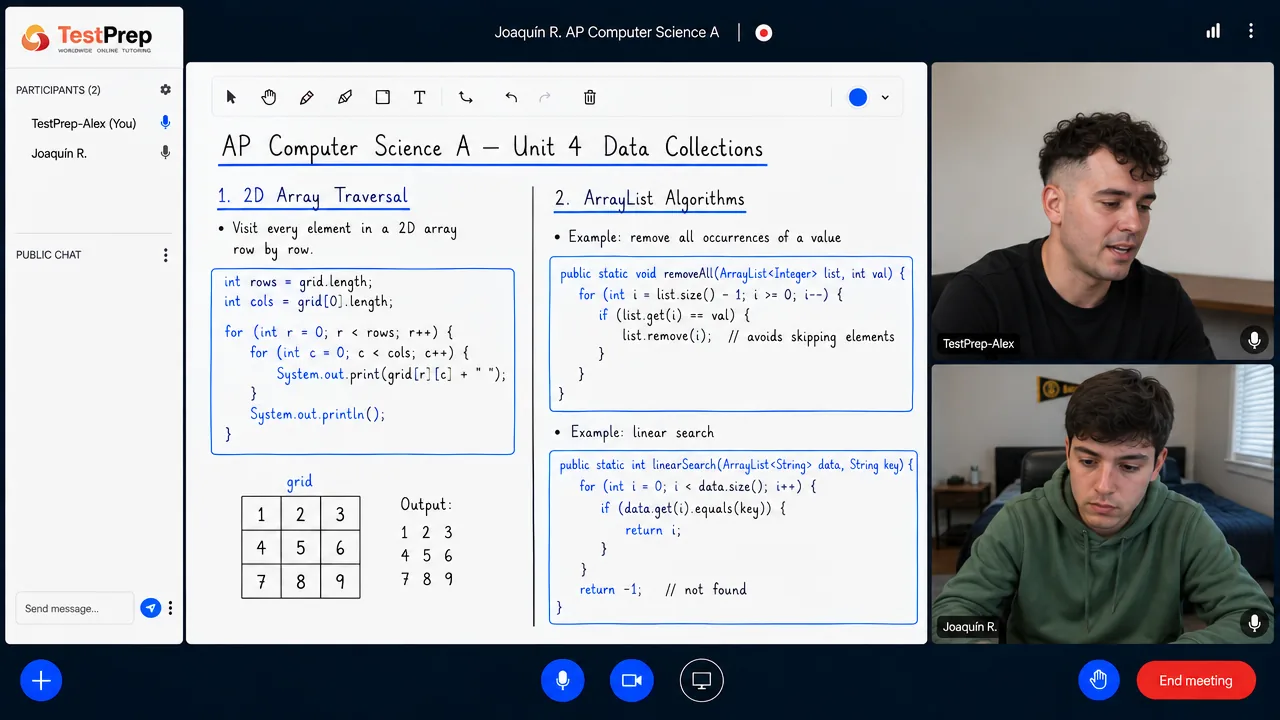
- Traversing an array by accessing the elements using iteration statements
- Implementing standard algorithms that utilize array traversals to perform functions
- Utilizing class libraries, including Integer and Double
- Representing collections of related object reference data using ArrayList objects
- Traversing an ArrayList by accessing the elements using iteration statements
- Implementing standard algorithms that utilize ArrayList traversals to perform functions
- Searching and sorting using standard algorithms
- Representing collections of data as arrays of arrays, or 2D arrays
- Traversing a 2D array by accessing the elements using nested iteration statements
- Executing recursive methods
- Searching and sorting using binary search and merge sort algorithms
Approach
How we teach AP Computer Science A
Study plan
- 1
Phase 1 — Unit 1: Using Objects and Methods
Java foundations
- Primitive types and expressions
- Objects, constructors and methods, including static methods and the Math class
- String objects and methods
- 2
Phase 2 — Unit 2: Selection and Iteration
Conditions and loops
- Boolean expressions and if/else
- for and while loops, nested loops
- Standard algorithms
- 3
Phase 3 — Unit 3: Class Creation
Class design
- Public and private attributes
- Constructors
- Void, non-void and static methods
- 4
Phase 4 — Unit 4: Data Collections + mock
Arrays, ArrayList, 2D arrays and the full exam
- Array and ArrayList traversals
- 2D arrays with nested loops
- Recursion, binary search and merge sort
- Full-length timed practice exam
How lessons work
Code without an IDE
The exam is taken in the Bluebook app with no compiler or autocomplete. Students drill writing syntactically valid Java without help — semicolons, braces, return types — until the IDE crutch is gone.
Java Quick Reference fluency
The Java Quick Reference, available in Bluebook, lists the classes and methods the exam expects. Students learn it cold so they don't reach for methods outside it.
FRQ rubric reading
Released class-design FRQs come with a rubric that lists each method requirement. Students learn to map the rubric directly to code structure.
Advice
AP Computer Science A: common mistakes and study tips
MistakeConfusing == with .equals() on String objects.
FixUse .equals() for object content; == only for primitives or reference identity. The FRQ rubric punishes the wrong choice.
MistakeOff-by-one bugs on for-loops over arrays / ArrayLists.
FixStop condition is i < arr.length, not i <= arr.length. Trace once on paper before writing.
MistakeForgetting that ArrayList.remove(int) shifts indices.
FixWhen removing during iteration, decrement the index or iterate backwards.
MistakeCalling a String method and expecting the original String to change.
FixStrings are immutable: s.toUpperCase() returns a new String. Assign the result (s = s.toUpperCase()) or the change is lost.
MistakeLosing track of calls when tracing a recursive method.
FixTrace recursion on paper as a stack: write the arguments of every call, stop at the base case, then pass return values back up in reverse order.
Study tips
- Code every day — at least 30 minutes of fresh Java. Reading code is not the same skill as writing it.
- FRQs are graded against strict Java syntax; small mistakes (missing semicolons, wrong return types) cost points.
- Know the distinction between Array and ArrayList cold, including when each is the right choice.
- Use CodingBat and the AP Classroom progress checks for spaced practice across the full curriculum.
Ready to raise your AP Computer Science A score?
You can start one-to-one AP Computer Science A lessons with a single lesson. Every package and price is on one page.
- Live one-to-one lessons online
- No package needed — book a single lesson
- Lesson times that fit your school week
You can also write to us through our contact page.
Other subjects
Related and other AP subjects
Often taken alongside this subject
- AP Calculus ABMost CS-bound applicants pair CSA with AB or BC.
- AP Physics 1Common STEM combination for CS / engineering applications.
- AP StatisticsUseful for data-science-leaning CS applicants.
All AP subjects
- AP Calculus AB
- AP Calculus BC
- AP Statistics
- AP Precalculus
- AP Computer Science Principles
- AP Physics 1
- AP Physics 2
- AP Physics C: Mechanics
- AP Physics C: Electricity & Magnetism
- AP Chemistry
- AP Biology
- AP Environmental Science
- AP English Language & Composition
- AP English Literature & Composition
- AP US History (APUSH)
- AP World History: Modern
- AP European History
- AP US Government & Politics
- AP Comparative Government & Politics
- AP Human Geography
- AP Microeconomics
- AP Macroeconomics
- AP Psychology
- AP Art History
- AP Music Theory
- AP Spanish Language & Culture
- AP French Language & Culture
- AP Chinese Language & Culture
- AP Business with Personal Finance
- AP Cybersecurity
- AP African American Studies
AP Computer Science A Prep — Frequently Asked Questions
The questions students ask most about AP Computer Science A preparation.