A-Level Computer Science Tutor & Online Tuition
Short answer
The A-Level Computer Science course is one-to-one tutoring, taught live online: every lesson is 90 minutes.
A private group is for 3 or more friends who sign up together (the group programme is 30 hours per subject); there are no published start dates, and we agree the start date and lesson times with you.
In one-to-one tutoring, packages are from €85 a lesson.
A-Level Computer Science tutoring for OCR H446, AQA 7517 and Cambridge 9618: computer systems, algorithms and programming, and the programming project.
One-to-one and small groups · Live online · AQA, OCR and Cambridge International specifications
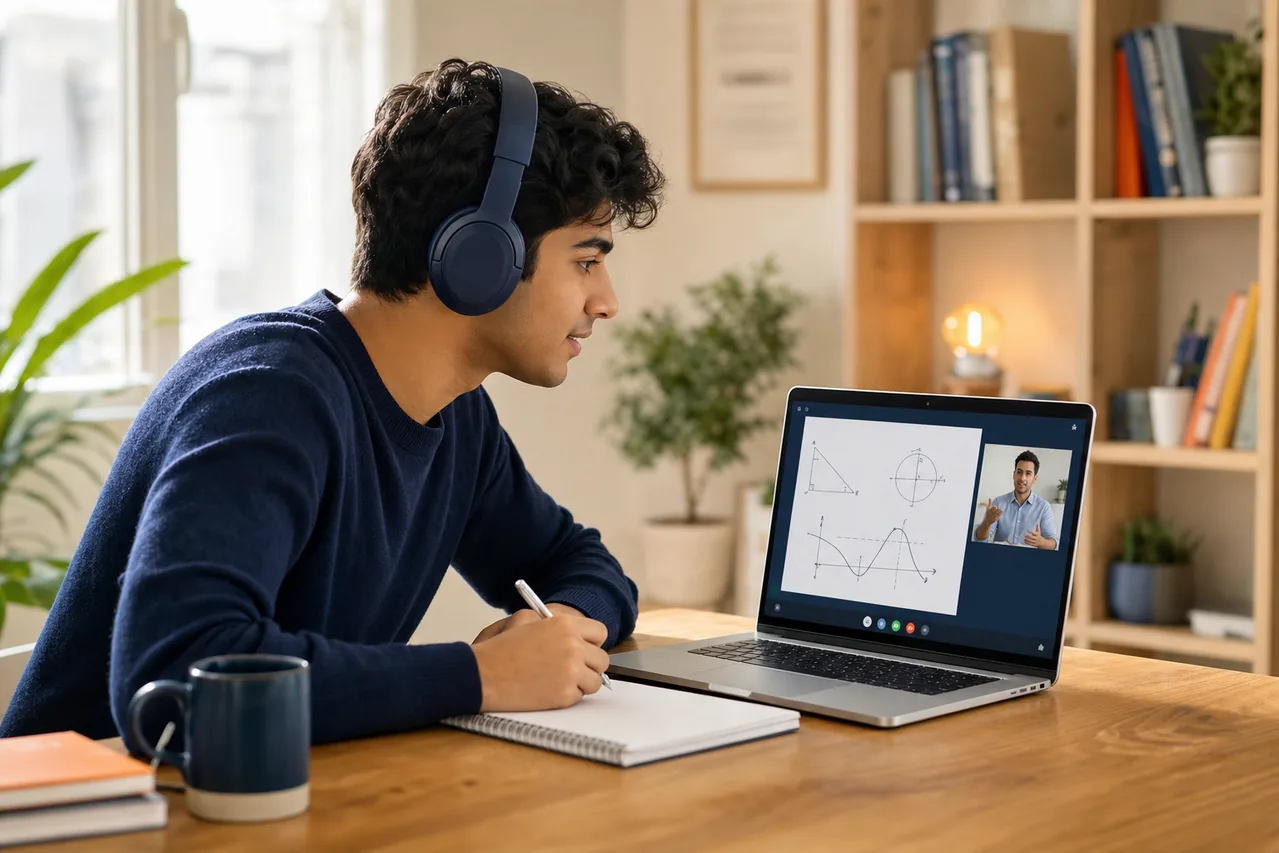
100% live online lessons
About the subject
A-Level Computer Science: what it covers and who it suits
A-Level Computer Science tutoring at TestPrep Europe works to the student's specification: OCR H446, AQA 7517 or Cambridge International 9618. On OCR H446 that means two written papers, Computer systems and Algorithms and programming (40% each), plus the programming project (non-exam assessment, 20%). Cambridge International 9618 has no NEA; programming is assessed in the Paper 4 Practical exam, taken on a computer.
- OCR, AQA and Cambridge International specifications mapped explicitly
- Pseudocode and language-specific code (Python / Java / VB / C#) practised side by side
- Algorithms and data structures drilled with code traces
Read more
A-Level Computer Science is strong preparation for university study in software engineering, AI, data science and cybersecurity. OCR H446 combines programming with the theory of computing: algorithms, data structures, Boolean algebra, computational thinking, processor architecture and networks.
A-Level Computer Science combines computing theory with practical programming. On OCR H446 students cover processor operation, network security, algorithm design and object-oriented software development. The programming project (non-exam assessment, 20% of the A-Level) requires students to analyse a real problem, design a software solution, develop and test it iteratively and evaluate it: a scaled-down version of a university software engineering project. Our programme builds programming fluency in the student's chosen language while drilling exam-format strategy and supporting the project.
One-to-one A-Level Computer Science tutoring
Our one-to-one A-Level tutoring is built around your current grade, your target grade and the exam board you are sitting. Each lesson works on your weak topics, drills AQA, OCR, CIE past-paper questions and walks through mark schemes, so you know exactly how marks are awarded.
A private group for A-Level Computer Science
There is no open group timetable for this subject. If 3 or more of you sign up together, we open a private group course for you. The price per student depends on how many subjects you take, with 30 hours of live lessons in each: 1 subject (30 hours) €1,031, 2 subjects (60 hours) €1,927, 3 subjects (90 hours) €2,689 and 4 subjects (120 hours) €3,496. Each student buys their own place online, and we let you know as soon as your group is ready.
Exam
A-Level Computer Science exam format
Exam boards: AQA, OCR, CIE
Computer systems (OCR H446/01)
40%2 hours 30 minutes, 140 marks, no calculator. 1.1–1.5: The characteristics of contemporary processors, input, output and storage devices; Software and software development; Exchanging data; Data types, data structures and algorithms; Legal, moral, cultural and ethical issues.
Algorithms and programming (OCR H446/02)
40%2 hours 30 minutes, 140 marks, no calculator. 2.1–2.3: Elements of computational thinking, Problem solving and programming, Algorithms. Section B opens with a scenario and asks mostly higher-tariff problem-solving questions.
Programming project (OCR H446/03 or 04)
20%Non-exam assessment, 70 marks. A programmed solution to a problem the student chooses, written up as a report: Analysis of the problem (10), Design of the solution (15), Developing the solution (25), Evaluation (20).
One-to-one A-Level tutoring
A-Level Computer Science Private Tutoring
Private A-Level lessons planned around your exam board's specification, your current grade and the grade you are aiming for. Every lesson is live and online, with a tutor who teaches this subject.
- A lesson plan built around your exam board and target grade
- Past-paper questions worked through with the board's mark schemes
- Exam technique for each paper, from command words to timing
- Lesson times that fit around your school week
How it works
- 1
Tell us your goal
We start from your school syllabus, your exam date and the result you are aiming for.
- 2
Your own plan
We map out the lessons you need, unit by unit.
- 3
Live one-to-one lessons
Meet your tutor online at times that suit your week.
- 4
Regular progress checks
Homework and a short check after each lesson show how you are getting on.
Start one-to-one A-Level Computer Science
Right for you if you want a plan built around your exam board, flexible lesson times and a tutor's full attention.
Book one-to-one lessonsBefore choosing a package, you can book one paid lesson.
Our A-Level tutors began teaching in 2018 or earlier.
100% First-Lesson Money-Back Guarantee
Not satisfied? Full refund, no questions asked.
We do not offer free trial lessons. Payment is required before your first lesson.
Secure Payments
Powered by Stripe with 256-bit encryption.

Flexible Billing
Local cards welcome, instalments available.
Lessons cancelled less than 3 hours before the start count as taken. Full terms
Included in lessons
Practice built into your A-Level Computer Science lessons
Every topic you cover in A-Level Computer Science is reinforced with question sets your tutor puts together for you. This programme has no separately sold question bank or practice test.
Mock exams included in the programme- Targeted questions on every topic
- Practice sets built around your weak areas
- Exam-style practice with past papers and mark schemes
- Worked solutions and feedback on every question
Syllabus
A-Level Computer Science topics
Topic names are those of the OCR H446 specification; other exam boards order and name them a little differently.
11.1 The characteristics of contemporary processors, input, output and storage devices
- Structure and function of the processor
- Types of processor
- Input, output and storage
21.2 Software and software development
- Systems Software
- Applications Generation
- Software Development
- Types of Programming Language
31.3 Exchanging data
- Compression, Encryption and Hashing
- Databases
- Networks
- Web Technologies
41.4 Data types, data structures and algorithms
- Data Types
- Data Structures
- Boolean Algebra
51.5 Legal, moral, cultural and ethical issues
- Computing related legislation
- Moral and ethical Issues
62.1 Elements of computational thinking
- Thinking abstractly
- Thinking ahead
- Thinking procedurally
- Thinking logically
- Thinking concurrently
72.2 Problem solving and programming
- Programming techniques
- Computational methods
82.3 Algorithms
- Algorithms
9Programming project (Component 03 or 04)
- Analysis of the problem
- Design of the solution
- Developing the solution
- Evaluation
Approach
How we teach A-Level Computer Science
Study plan
- 1
Phase 1 — Programming fundamentals
Languages, OOP, data types
- Procedural programming
- Object-oriented programming
- Data types and structures
- 2
Phase 2 — Algorithms + data structures
Standard algorithms
- Searching and sorting
- Trees, graphs, hash tables
- Recursion
- 3
Phase 3 — Theory + networks + databases
Wider theory
- Boolean algebra and Karnaugh maps
- Networks and security
- Databases and SQL
- 4
Phase 4 — NEA + mock
Project + papers
- NEA scoping, build, testing, evaluation
- Past-paper Paper 1 + Paper 2 timed mocks
How lessons work
Pseudocode + language in parallel
Pseudocode is the exam dialect; the chosen language (Python, Java, VB, C#) is the lab tool. We drill both so students don't confuse them.
Trace tables as habit
Trace tables turn iteration and recursion questions into careful step-by-step work. We make them automatic for any question that asks students to follow an algorithm.
NEA as engineering project
NEA is structured as a real software project — requirements, design, iterative build, real testing, evaluation. Final written work remains the student's own work.
Advice
A-Level Computer Science: common mistakes and study tips
MistakePseudocode that drifts into language-specific syntax.
FixOCR sets questions in its own pseudocode but accepts any clear style in answers; Cambridge 9618 expects answers in pseudocode following its own guide. Either way, a competent programmer must be able to follow the meaning.
MistakeAlgorithm answers without trace tables.
FixTrace tables make every step of a loop or recursion visible; build one whenever a question asks you to follow an algorithm.
MistakeBig-O analysis stated without justification.
FixAlways explain why an algorithm is O(n), O(n log n) or O(n²), not just state it.
MistakeNetworks answers conflating protocols at different layers.
FixTCP, IP, HTTP each have specific roles at specific layers. Layer confusion is a predictable mark loss.
MistakeNEA delivered without robust testing.
FixOn OCR, testing earns 15 of the 70 project marks (10 for testing to inform development, 5 for testing to inform evaluation) and is expected at every stage, so it cannot be added at the end without rework. Final written work remains the student's own work.
Study tips
- Start the programming project (NEA) early and meet your teacher regularly; OCR expects a well-defined problem for a real user and a non-trivial, substantial coded solution.
- Code the specification's standard algorithms yourself in your chosen language (for example Python, Java or C#): bubble, insertion, merge and quick sort, binary search, Dijkstra's shortest path algorithm and the A* algorithm, plus stack, queue, linked-list and tree operations.
- Drill binary and hexadecimal conversion, two's complement and floating point by hand under time pressure: calculators are not allowed in either OCR written paper.
- Practise writing pseudocode by hand. OCR sets questions in its own pseudocode but accepts any clear style in answers, as long as a competent programmer could follow it.
Ready to raise your A-Level Computer Science grade?
You can start one-to-one A-Level Computer Science lessons with a single lesson. Every package and price is on one page.
- Live one-to-one lessons online
- No package needed — book a single lesson
- Lesson times that fit your school week
You can also write to us through our contact page.
Other subjects
Related and other A-Level subjects
Often taken alongside this subject
- A-Level MathsDiscrete maths and proof support algorithmic reasoning.
- AP Computer Science AJava OOP focus complements A-Level CS.
- IB Computer ScienceComparable scope for IB students.
All A-Level subjects
- A-Level Biology
- A-Level Chemistry
- A-Level Physics
- A-Level Environmental Science
- A-Level Geology
- A-Level Mathematics
- A-Level Further Mathematics
- A-Level Design & Technology
- A-Level Psychology
- A-Level History
- A-Level Geography
- A-Level Philosophy
- A-Level Politics
- A-Level Ancient History
- A-Level Sociology
- A-Level Global Perspectives & Research
- A-Level Economics
- A-Level Business
- A-Level Accounting
- A-Level English Literature
- A-Level English Language
- A-Level English Language and Literature
A-Level Computer Science Prep — Frequently Asked Questions
The questions students ask most about A-Level Computer Science preparation.