A-Level English Language Tutor & Online Tuition
Short answer
The A-Level English Language course is one-to-one tutoring, taught live online: every lesson is 90 minutes.
A private group is for 3 or more friends who sign up together (the group programme is 30 hours per subject); there are no published start dates, and we agree the start date and lesson times with you.
In one-to-one tutoring, packages are from €85 a lesson.
A-Level English Language tutoring for AQA 7702 and OCR: language levels, language and society, diversity and change, and the Language in Action NEA.
One-to-one and small groups · Live online · AQA and OCR specifications
100% live online lessons
About the subject
A-Level English Language: what it covers and who it suits
A-Level English Language tutoring at TestPrep Europe is linguistics-led — we analyse language itself, not literature. The exam structure on this page follows AQA 7702, and we also work with students on the OCR specification. We cover the language levels (phonetics, phonology and prosodics, graphology, lexis and semantics, grammar, pragmatics, discourse), Textual variations and representations, Children's language development and Language diversity and change, and guide students through the NEA (Language in Action) within AQA's rules.
Your lessons are taught by Anna Thompson, Mark Stevens, Olivia Davies and Rebecca Clarke, who teach A-Level English Language.
- Paper 1 Language, the Individual and Society (40%): Textual Variations and Representations and Children's Language Development (0–11 years)
- Paper 2 Language Diversity and Change (40%): an evaluative essay on diversity or change, plus Language Discourses text analysis and directed writing
- NEA Language in Action (20%): a 2,000-word Language Investigation (excluding data) plus Original Writing and commentary (1,500 words in total)
Read more
A-Level English Language examines the structure, use and social function of language from a linguistic standpoint. It is ideal for journalism, media, advertising, speech therapy and education.
A-Level English Language examines English as a structural, social and historical phenomenon. AQA 7702 covers Textual variations and representations, Children's language development, Language diversity and change and Language discourses, and its NEA (Language in Action) develops both investigative and creative writing skills. Our programme combines text-analysis strategy, accurate linguistic terminology and NEA guidance that stays within AQA's rules.
One-to-one A-Level English Language tutoring
Our one-to-one A-Level tutoring is built around your current grade, your target grade and the exam board you are sitting. Each lesson works on your weak topics, drills AQA, OCR past-paper questions and walks through mark schemes, so you know exactly how marks are awarded.
A private group for A-Level English Language
There is no open group timetable for this subject. If 3 or more of you sign up together, we open a private group course for you. The price per student depends on how many subjects you take, with 30 hours of live lessons in each: 1 subject (30 hours) €1,031, 2 subjects (60 hours) €1,927, 3 subjects (90 hours) €2,689 and 4 subjects (120 hours) €3,495. Each student buys their own place online, and we let you know as soon as your group is ready.
Exam
A-Level English Language exam format
Exam boards: AQA, OCR
Paper 1: Language, the Individual and Society (AQA 7702)
40%2 hours 30 minutes, 100 marks. Section A, Textual Variations and Representations: two texts, one contemporary and one older, with an analysis of each (25 + 25 marks) and a comparison (20 marks). Section B, Children's Language Development (0–11 years): one discursive essay from a choice of two (30 marks).
Paper 2: Language Diversity and Change (AQA 7702)
40%2 hours 30 minutes, 100 marks. Section A: one evaluative essay on language diversity or on language change (30 marks). Section B, Language Discourses: analysis of two texts (40 marks) and a directed writing task on the same topic (30 marks).
NEA: Language in Action (AQA 7702)
20%3,500 words in total, 100 marks: a Language Investigation (2,000 words excluding data) and a piece of Original Writing with commentary (1,500 words in total).
One-to-one A-Level tutoring
A-Level English Language Private Tutoring
Private A-Level lessons planned around your exam board's specification, your current grade and the grade you are aiming for. Every lesson is live and online, with a tutor who teaches this subject.
- A lesson plan built around your exam board and target grade
- Past-paper questions worked through with the board's mark schemes
- Exam technique for each paper, from command words to timing
- Lesson times that fit around your school week
How it works
- 1
Tell us your goal
We start from your school syllabus, your exam date and the result you are aiming for.
- 2
Your own plan
We map out the lessons you need, unit by unit.
- 3
Live one-to-one lessons
Meet your tutor online at times that suit your week.
- 4
Regular progress checks
Homework and a short check after each lesson show how you are getting on.
Start one-to-one A-Level English Language
Right for you if you want a plan built around your exam board, flexible lesson times and a tutor's full attention.
Book one-to-one lessonsBefore choosing a package, you can book one paid lesson.
Our A-Level tutors began teaching in 2018 or earlier.
100% First-Lesson Money-Back Guarantee
Not satisfied? Full refund, no questions asked.
We do not offer free trial lessons. Payment is required before your first lesson.
Secure Payments
Powered by Stripe with 256-bit encryption.

Flexible Billing
Local cards welcome, instalments available.
Lessons cancelled less than 3 hours before the start count as taken. Full terms
Included in lessons
Practice built into your A-Level English Language lessons
Every topic you cover in A-Level English Language is reinforced with question sets your tutor puts together for you. This programme has no separately sold question bank or practice test.
Mock exams included in the programme- Targeted questions on every topic
- Practice sets built around your weak areas
- Exam-style practice with past papers and mark schemes
- Worked solutions and feedback on every question
Syllabus
A-Level English Language topics
Topic names are those of the AQA 7702 specification; other exam boards order and name them a little differently.
13.1 Language, the individual and society
- Textual variations and representations
- Methods of language analysis
- Children's language development
23.2 Language diversity and change
- Language diversity and change
- Methods of language analysis
- Language discourses
- Writing skills
33.3 Language in action
- Language Investigation
- Original writing
- Methods of language analysis
Approach
How we teach A-Level English Language
Study plan
- 1
Phase 1 — Methods of language analysis
Language levels and key concepts
- Phonetics, phonology and prosodics; graphology; lexis and semantics; grammar, including morphology; pragmatics; discourse
- Halliday's metafunctions
- Spoken vs. written features
- Audience, purpose, genre and mode; the mode continuum
- 2
Phase 2 — Children's language development
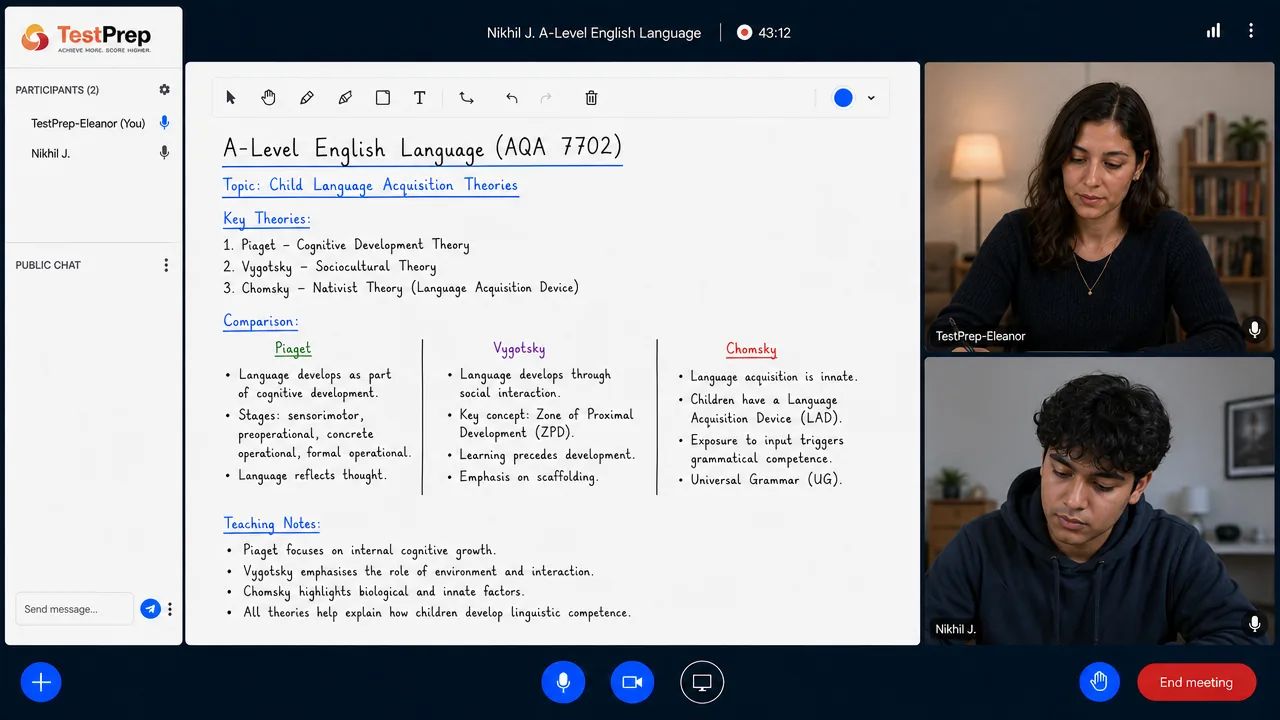
Theories and stages
- Behaviourist (Skinner)
- Nativist (Chomsky — LAD, UG)
- Cognitive (Piaget)
- Social-interactionist (Bruner, Vygotsky)
- 3
Phase 3 — Language diversity and change
Sociolects, dialects, change and Language discourses
- Gender (Lakoff, Tannen, Cameron)
- Social class, occupation and regional, national and international dialects (Trudgill, Labov)
- Change from 1600 to the present (Aitchison, Crystal; prescriptivism vs. descriptivism)
- Language discourses: analysing two texts about language, plus directed writing
- 4
Phase 4 — NEA: Language in Action
Language Investigation and Original writing
- Choosing a focus and research question
- Data collection and transcription
- Original writing: a style model from The Power of Persuasion, Storytelling or Information
- Commentary evaluating the style model, the writing process and the final piece
How lessons work
Terminology fluency
AO1 (applying methods of language analysis with accurate terminology) is about 26% of the A-level. We issue weekly term-banks and quizzes so students don't waste exam time searching for the right word.
Corpus tools for NEA
Where the data calls for it, free tools (AntConc, Voyant) let students count frequencies and collocations quickly, so the numbers can support their own qualitative analysis.
The student's own data
AQA lists code switching and mixing between English and other languages among possible investigation areas, and bilingual students can collect original data there. We help students plan how to collect and organise their data; as AQA requires, they collect it themselves.
Advice
A-Level English Language: common mistakes and study tips
MistakeTreating textual analysis as literary appreciation ('this metaphor is effective').
FixA-Level Language rewards linguistic terminology — declarative sentence, modal verb, adjacency pair, phatic talk. Literary terms only count when tied to linguistic effect.
MistakeChildren's language development essays that cover one theorist only.
FixWeigh several theories and studies (Skinner, Chomsky, Bruner, Vygotsky, Piaget) against the data in the question. AO2 rewards critical understanding of concepts and issues, so evaluate the theories rather than just describe them.
MistakeLanguage-change answers that read as surface chronology.
FixStrong answers organise by linguistic level — phonological, lexical, semantic, syntactic — with a specific period example for each.
MistakeLanguage Investigations with an unfocused question, or with data the student did not collect.
FixAQA wants a specific focus and data the student collects themselves; its own examples are narrow (the writing of two children aged 8, the language of sports commentary). Size the data to the question; corpus tools such as AntConc or Voyant can add counts that support the qualitative analysis.
Study tips
- Use linguistic terminology (phoneme, morpheme, pragmatics) accurately and consistently.
- Be systematic on textual-analysis questions: work through each language level (lexis and semantics, grammar, pragmatics, discourse), then show how the levels connect.
- Practise Children's language development theories on real transcripts and samples of children's writing.
- Choose a Language Investigation topic for which you can collect your own concrete data, as AQA requires.
Ready to raise your A-Level English Language grade?
You can start one-to-one A-Level English Language lessons with a single lesson. Every package and price is on one page.
- Live one-to-one lessons online
- No package needed — book a single lesson
- Lesson times that fit your school week
You can also write to us through our contact page.
Other subjects
Related and other A-Level subjects
Often taken alongside this subject
- A-Level English LiteratureTaken together, Language and Literature make a good preparation for English or linguistics degrees.
- IGCSE English LanguagePre-A-Level foundation in reading and writing.
- A-Level PsychologyChildren's language development theories such as Piaget's and Vygotsky's also appear in AQA Psychology's Cognition and development option.
All A-Level subjects
- A-Level Biology
- A-Level Chemistry
- A-Level Physics
- A-Level Environmental Science
- A-Level Geology
- A-Level Mathematics
- A-Level Further Mathematics
- A-Level Computer Science
- A-Level Design & Technology
- A-Level Psychology
- A-Level History
- A-Level Geography
- A-Level Philosophy
- A-Level Politics
- A-Level Ancient History
- A-Level Sociology
- A-Level Global Perspectives & Research
- A-Level Economics
- A-Level Business
- A-Level Accounting
- A-Level English Literature
- A-Level English Language and Literature
A-Level English Language Prep — Frequently Asked Questions
The questions students ask most about A-Level English Language preparation.