A-Level Biology Tutoring & Prep Course
One-to-one A-Level Biology tutoring, with full past-paper practice and a personalised study plan built around your target grade.
Since 2008, TestPrep Europe has taught A-Level Biology through one-to-one tutoring and small-group courses on its own online learning platform. The programme combines the A-Level syllabus with subject teaching, problem solving and past-paper practice.
One-to-one and small groups · Live online · Edexcel, AQA, OCR and Cambridge specifications
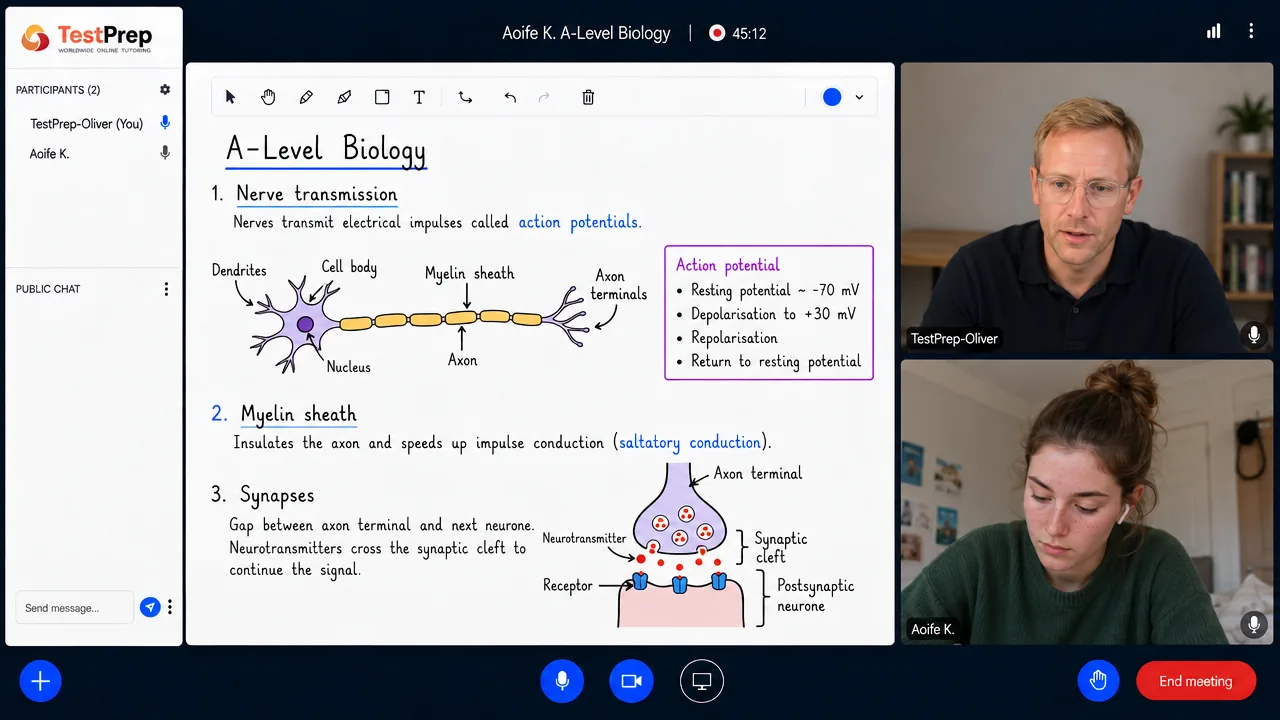
100% live online lessons
About the subject
A-Level Biology: what it covers and who it suits
A-Level Biology tutoring at TestPrep Europe follows the specification your school teaches: AQA 7402, OCR, Pearson Edexcel or Cambridge International (9700). We teach the full content, from Biological molecules to The control of gene expression, the practical work each board requires, and exam technique with close attention to command words.
- AQA, OCR, Edexcel and Cambridge International specifications taught to their own paper structure
- Required practicals (AQA), PAGs (OCR) and core practicals (Edexcel) practised in mark-scheme language
- Extended-response and essay technique (including AQA Paper 3's 25-mark essay) built up across the two years
Read more
A-Level Biology is a core subject for medicine, dentistry, pharmacy, veterinary science and the biomedical sciences: many UK universities require it for these courses or strongly prefer it, although exact requirements vary by university. The course runs from Biological molecules and Cells through Genetics, populations, evolution and ecosystems and The control of gene expression, and develops the experimental design and data analysis skills universities expect from incoming life-sciences students.
A-Level Biology covers the structure, function and ecology of living organisms. On AQA 7402 the content sits in eight sections: Biological molecules, Cells, Organisms exchange substances with their environment and Genetic information, variation and relationships between organisms in the first year, then Energy transfers in and between organisms, Organisms respond to changes in their internal and external environments, Genetics, populations, evolution and ecosystems and The control of gene expression in the second. OCR and Cambridge International organise the content differently, but the core is largely shared. Our A-Level Biology programme follows each student's own specification, with past-paper analysis, mark-scheme breakdowns and practical-skills preparation, working towards an A*.
One-to-one A-Level Biology tutoring
Our one-to-one A-Level tutoring is built around your current grade, your target grade and the exam board you are sitting. Each lesson works on your weak topics, drills AQA, OCR A, Edexcel, CIE past-paper questions and walks through mark schemes, so you know exactly how marks are awarded.
A private group for A-Level Biology
There is no open group timetable for this subject. Bring 3 or more students together and we open a private group course for you. The price per student depends on how many subjects you take, with 30 hours of live lessons in each: 1 subject (30 hours) €1,026, 2 subjects (60 hours) €1,919, 3 subjects (90 hours) €2,677 and 4 subjects (120 hours) €3,480. Each student buys their own place online, and we let you know as soon as your group is ready.
Exam
A-Level Biology exam format
Exam boards: AQA, OCR A, Edexcel, CIE
Paper 1 (AQA 7402)
35%2 hours, 91 marks. Topics 1–4: Biological molecules; Cells; Organisms exchange substances with their environment; Genetic information, variation and relationships between organisms. DNA replication, protein synthesis and genetic diversity are therefore examined here. 76 marks of short and long answer questions plus 15 marks of extended response, including relevant practical skills.
Paper 2 (AQA 7402)
35%2 hours, 91 marks. Topics 5–8: Energy transfers in and between organisms (photosynthesis, respiration); Organisms respond to changes in their internal and external environments; Genetics, populations, evolution and ecosystems; The control of gene expression. 76 marks of short and long answer questions plus a 15-mark comprehension question.
Paper 3 (AQA 7402)
30%2 hours, 78 marks. All of topics 1–8 plus practical skills: structured questions including practical techniques (38 marks), critical analysis of given experimental data (15 marks) and one essay from a choice of two titles (25 marks).
One-to-One Tutoring
A-Level Biology Private Tutoring
Fully customised one-to-one A-Level tutoring with experienced Cambridge / Edexcel specialists. A* preparation across every A-Level subject.
- A fully personalised A-Level lesson plan
- Maths, Further Maths, Sciences, Economics and every other subject
- Past-paper and mock-exam-driven coaching
- Flexible schedule and pacing
How it works
- 1
Tell us your goal
We start from your school syllabus, your exam date and the result you are aiming for.
- 2
Your own plan
We map out the lessons you need, unit by unit.
- 3
Live one-to-one lessons
Meet your tutor online at times that suit your week.
- 4
Regular progress checks
Homework and a short check after each lesson show how you are getting on.
Start one-to-one A-Level Biology
Ideal for students aiming at A*, Oxbridge or Russell Group universities, or anyone who needs help in specific subjects.
Book one-to-one lessonsNo package needed — you can book a single lesson.
Even our newest A-Level tutor has been teaching A-Level prep since 2016.
100% First-Lesson Money-Back Guarantee
Not satisfied? Full refund, no questions asked.
Secure Payments
Powered by Stripe with 256-bit encryption.

Flexible Billing
Pay in EUR — local cards welcome, instalments available.
Lessons cancelled less than 3 hours before the start count as taken. Full terms
Included in lessons
Practice built into your A-Level Biology lessons
Every topic you cover in A-Level Biology is reinforced with question sets your tutor puts together for you. This programme has no separately sold question bank or practice test.
Mock exams included in the programme- Targeted questions on every topic
- Practice sets built around your weak areas
- Exam-style practice with past papers and mark schemes
- Worked solutions and feedback on every question
Syllabus
A-Level Biology topics
Topic names are those of the AQA 7402 specification; other exam boards order and name them a little differently.
13.1 Biological molecules
- Monomers and polymers
- Carbohydrates
- Lipids
- Proteins
- Nucleic acids are important information-carrying molecules
- ATP
- Water
- Inorganic ions
23.2 Cells
- Cell structure
- All cells arise from other cells
- Transport across cell membranes
- Cell recognition and the immune system
33.3 Organisms exchange substances with their environment
- Surface area to volume ratio
- Gas exchange
- Digestion and absorption
- Mass transport
43.4 Genetic information, variation and relationships between organisms
- DNA, genes and chromosomes
- DNA and protein synthesis
- Genetic diversity can arise as a result of mutation or during meiosis
- Genetic diversity and adaptation
- Species and taxonomy
- Biodiversity within a community
- Investigating diversity
53.5 Energy transfers in and between organisms
- Photosynthesis
- Respiration
- Energy and ecosystems
- Nutrient cycles
63.6 Organisms respond to changes in their internal and external environments
- Stimuli, both internal and external, are detected and lead to a response
- Nervous coordination
- Skeletal muscles are stimulated to contract by nerves and act as effectors
- Homeostasis is the maintenance of a stable internal environment
73.7 Genetics, populations, evolution and ecosystems
- Inheritance
- Populations
- Evolution may lead to speciation
- Populations in ecosystems
83.8 The control of gene expression
- Alteration of the sequence of bases in DNA can alter the structure of proteins
- Gene expression is controlled by a number of features
- Using genome projects
- Gene technologies allow the study and alteration of gene function allowing a better understanding of organism function and the design of new industrial and medical processes
Approach
How we teach A-Level Biology
Study plan
- 1
Phase 1 — Year 1 core
Cells, biological molecules, enzymes
- Cell structure and transport
- Biological molecules
- Enzymes and immunity
- 2
Phase 2 — Year 1 organisms
Genetics, exchange, ecology
- DNA, replication, transcription, translation
- Exchange surfaces and transport
- Genetic diversity and biodiversity
- 3
Phase 3 — Year 2 systems
Energy, response, genetics, gene expression
- Photosynthesis and respiration
- Stimuli, nervous coordination and homeostasis
- Inheritance, populations and evolution
- Gene expression and gene technologies
- 4
Phase 4 — Practicals + mock
Required practicals + papers
- Required-practical exam questions
- Essay drills (AQA Paper 3)
- Full timed mock
How lessons work
Command-term discipline
Each command term has a structural template; we drill the templates so students don't mismatch shape and prompt under timed conditions.
Application via novel-context past papers
Application questions set familiar biology in unfamiliar contexts. We drill them on novel contexts so students stop trying to recall instead of reason.
Required practical technique
Practical-related exam questions reward specific procedural detail. We treat practicals as exam content, not as background.
Advice
A-Level Biology: common mistakes and study tips
Mistake'Describe' answers that drift into 'explain'.
FixDescribe = what; explain = why or how. Mixing them up is a common way for strong students to lose marks.
MistakeApplication questions answered from memory.
FixApplication questions test transfer to a novel context. Re-read the stimulus before recalling content.
MistakeGenetic-cross diagrams without parental phenotypes / genotypes labelled.
FixAlways label P, gametes, F1, F2 and ratios. Missing labels are easy mark losses.
MistakePractical answers without controls or variables.
FixIndependent, dependent and controlled variables must be named explicitly. Generic 'fair test' answers under-score.
MistakeStatistical tests applied without rationale.
FixAlways justify the choice of test (the chi-squared test, Student's t-test or a correlation coefficient) before computing.
Study tips
- Tackle past-paper questions topic by topic as soon as you finish each topic. AQA and OCR mark schemes show clearly what each command word expects.
- Practise drawing and labelling diagrams (cell structure, DNA replication, the heart, the nephron); accurate, labelled diagrams earn marks that vague ones lose.
- Drill the statistical tests named in the specification (the chi-squared test, Student's t-test and a correlation coefficient) using past data-analysis questions; they can appear on any paper.
- Build synoptic links across topics with concept maps; Paper 3 and its essay draw on all eight topics, so connecting respiration with exercise, or DNA with evolution, pays off.
Student results
A-Level success stories
Results our A-Level students shared in their own reviews.
Ready to raise your A-Level Biology grade?
You can start one-to-one A-Level Biology lessons with a single lesson. Every package and price is on one page.
- Live one-to-one lessons online
- No package needed — book a single lesson
- Lesson times that fit your school week
You can also write to us through our contact page.
Other subjects
Related and other A-Level subjects
Often taken alongside this subject
- A-Level ChemistryStandard medical / biosciences A-Level pairing.
- IB BiologyComparable rigour for students considering IB instead.
- AP BiologyComparable depth and similar exam technique.
All A-Level subjects
- A-Level Chemistry
- A-Level Physics
- A-Level Environmental Science
- A-Level Geology
- A-Level Mathematics
- A-Level Further Mathematics
- A-Level Computer Science
- A-Level Design & Technology
- A-Level Psychology
- A-Level History
- A-Level Geography
- A-Level Philosophy
- A-Level Politics
- A-Level Ancient History
- A-Level Sociology
- A-Level Economics
- A-Level Business
- A-Level Accounting
- A-Level English Literature
- A-Level English Language
- A-Level English Language and Literature
A-Level Biology Prep — Frequently Asked Questions
The questions students ask most about A-Level Biology preparation.