A-Level Philosophy Tutor & Online Tuition
Short answer
The A-Level Philosophy course is one-to-one tutoring, taught live online: every lesson is 90 minutes.
A private group is for 3 or more friends who sign up together (the group programme is 30 hours per subject); there are no published start dates, and we agree the start date and lesson times with you.
In one-to-one tutoring, packages are from €85 a lesson.
A-Level Philosophy tutoring for AQA 7172: epistemology, moral philosophy, and the metaphysics of God and of mind, across two 3-hour papers.
One-to-one and small groups · Live online · AQA specifications
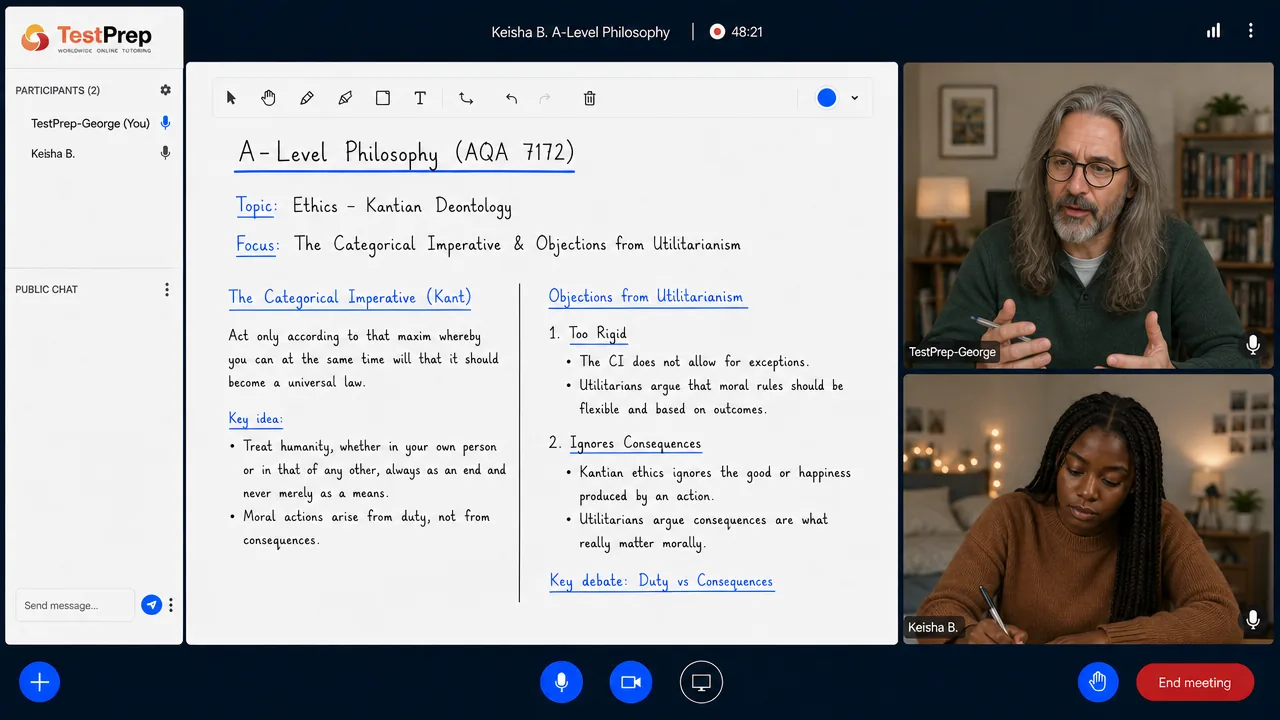
100% live online lessons
About the subject
A-Level Philosophy: what it covers and who it suits
A-Level Philosophy tutoring at TestPrep Europe follows the AQA 7172 specification: two 3-hour papers (Epistemology and moral philosophy; The metaphysics of God and the metaphysics of mind), each worth 100 marks and 50% of the A-Level. We teach epistemology, moral philosophy, metaphysics of God, and metaphysics of mind, with explicit attention to argumentative writing, the precise statement of arguments, and the 25-mark evaluative essay.
- AQA 7172 mapped across its four sections and their set texts
- Argument reconstruction (premise → conclusion) drilled as a habit
- Objections and responses learned in connected pairs
Read more
A-Level Philosophy systematically examines four areas: epistemology, moral philosophy, the metaphysics of God and the metaphysics of mind. It is a strong foundation for law, politics, academic philosophy and any career that demands rigorous critical thinking.
A-Level Philosophy teaches students to examine fundamental questions systematically and logically. Epistemology asks what knowledge is and whether it is reliable; moral philosophy investigates how we determine right action; the metaphysics of God weighs the arguments about God's existence, the problem of evil and religious language; the metaphysics of mind asks what the mind is, through dualist theories, physicalist theories and functionalism. Our programme trains philosophical argumentation and structured essay writing.
One-to-one A-Level Philosophy tutoring
Our one-to-one A-Level tutoring is built around your current grade, your target grade and the exam board you are sitting. Each lesson works on your weak topics, drills AQA past-paper questions and walks through mark schemes, so you know exactly how marks are awarded.
A private group for A-Level Philosophy
There is no open group timetable for this subject. If 3 or more of you sign up together, we open a private group course for you. The price per student depends on how many subjects you take, with 30 hours of live lessons in each: 1 subject (30 hours) €1,031, 2 subjects (60 hours) €1,927, 3 subjects (90 hours) €2,689 and 4 subjects (120 hours) €3,496. Each student buys their own place online, and we let you know as soon as your group is ready.
Exam
A-Level Philosophy exam format
Exam boards: AQA
Paper 1: Epistemology and moral philosophy (AQA 7172)
50%3 hours, 100 marks. Section A: five questions on Epistemology (What is knowledge?, Perception as a source of knowledge, Reason as a source of knowledge, The limits of knowledge). Section B: five questions on Moral philosophy (Normative ethical theories, Applied ethics, Meta-ethics).
Paper 2: The metaphysics of God and the metaphysics of mind (AQA 7172)
50%3 hours, 100 marks. Section A: five questions on the Metaphysics of God (The concept and nature of 'God', Arguments relating to the existence of God, the problem of evil, Religious language). Section B: five questions on the Metaphysics of mind (Dualist theories, Physicalist theories, Functionalism).
One-to-one A-Level tutoring
A-Level Philosophy Private Tutoring
Private A-Level lessons planned around your exam board's specification, your current grade and the grade you are aiming for. Every lesson is live and online, with a tutor who teaches this subject.
- A lesson plan built around your exam board and target grade
- Past-paper questions worked through with the board's mark schemes
- Exam technique for each paper, from command words to timing
- Lesson times that fit around your school week
How it works
- 1
Tell us your goal
We start from your school syllabus, your exam date and the result you are aiming for.
- 2
Your own plan
We map out the lessons you need, unit by unit.
- 3
Live one-to-one lessons
Meet your tutor online at times that suit your week.
- 4
Regular progress checks
Homework and a short check after each lesson show how you are getting on.
Start one-to-one A-Level Philosophy
Right for you if you want a plan built around your exam board, flexible lesson times and a tutor's full attention.
Book one-to-one lessonsBefore choosing a package, you can book one paid lesson.
Our A-Level tutors began teaching in 2018 or earlier.
100% First-Lesson Money-Back Guarantee
Not satisfied? Full refund, no questions asked.
We do not offer free trial lessons. Payment is required before your first lesson.
Secure Payments
Powered by Stripe with 256-bit encryption.

Flexible Billing
Local cards welcome, instalments available.
Lessons cancelled less than 3 hours before the start count as taken. Full terms
Included in lessons
Practice built into your A-Level Philosophy lessons
Every topic you cover in A-Level Philosophy is reinforced with question sets your tutor puts together for you. This programme has no separately sold question bank or practice test.
Mock exams included in the programme- Targeted questions on every topic
- Practice sets built around your weak areas
- Exam-style practice with past papers and mark schemes
- Worked solutions and feedback on every question
Syllabus
A-Level Philosophy topics
Topic names are those of the AQA 7172 specification; other exam boards order and name them a little differently.
13.1 Epistemology
- What is knowledge?
- Perception as a source of knowledge
- Reason as a source of knowledge
- The limits of knowledge
23.2 Moral philosophy
- Normative ethical theories
- Applied ethics
- Meta-ethics
33.3 Metaphysics of God
- The concept and nature of 'God'
- Arguments relating to the existence of God
- Religious language
43.4 Metaphysics of mind
- What do we mean by ‘mind'?
- Dualist theories
- Physicalist theories
- Functionalism
Approach
How we teach A-Level Philosophy
Study plan
- 1
Phase 1 — Epistemology
Year 1, section 1 (Paper 1)
- Definitions of knowledge
- Perception and reason
- 2
Phase 2 — Moral philosophy
Year 1, section 2 (Paper 1)
- Utilitarianism, Kantian ethics, virtue ethics
- Meta-ethics and applied ethics
- 3
Phase 3 — Metaphysics of God
Year 2, section 3 (Paper 2)
- Concept of God
- Arguments for / against God's existence
- Religious language
- 4
Phase 4 — Metaphysics of mind + mock
Year 2, section 4 (Paper 2) + papers
- Dualism, physicalism, functionalism
- 25-mark essay drills
- Full timed mock
How lessons work
Argument reconstruction
Top bands always reconstruct arguments as premise → conclusion. We drill the habit from week 1.
Objections in pairs
Every objection is taught with the philosopher's response. Loose 'one weakness is …' answers consistently cap.
Evaluative essays as judgement
Top bands close with a justified judgement on the question. We drill the structural template.
Advice
A-Level Philosophy: common mistakes and study tips
MistakeArguments stated without premises.
FixTop bands reconstruct arguments as premise-1, premise-2 → conclusion. Loose paraphrase under-scores.
MistakeObjections raised without engagement.
FixTop bands engage with the objection — what does the philosopher reply? — not just list 'one weakness is …'.
MistakeExamples instead of analysis.
FixExamples support analysis but don't replace it. Top bands always state the principle being tested.
MistakeConclusions that summarise.
FixTop bands close with a justified judgement on the question, not a recap.
MistakeTreating thought experiments as decoration.
FixThought experiments are evidence in argumentative writing. Engage with what they test.
Study tips
- Summarise every argument in your own words first, then list the standard objections.
- On essays, balance strengths and weaknesses; one-sided arguments cap out at lower bands.
- Use philosophers' names and key terms accurately.
- Synthesise the dialogue between positions with your own view in the conclusion.
Ready to raise your A-Level Philosophy grade?
You can start one-to-one A-Level Philosophy lessons with a single lesson. Every package and price is on one page.
- Live one-to-one lessons online
- No package needed — book a single lesson
- Lesson times that fit your school week
You can also write to us through our contact page.
Other subjects
Related and other A-Level subjects
Often taken alongside this subject
- IB PhilosophyComparable rigour for IB students.
- A-Level PoliticsCommon pairing for political philosophy / theory students.
All A-Level subjects
- A-Level Biology
- A-Level Chemistry
- A-Level Physics
- A-Level Environmental Science
- A-Level Geology
- A-Level Mathematics
- A-Level Further Mathematics
- A-Level Computer Science
- A-Level Design & Technology
- A-Level Psychology
- A-Level History
- A-Level Geography
- A-Level Politics
- A-Level Ancient History
- A-Level Sociology
- A-Level Global Perspectives & Research
- A-Level Economics
- A-Level Business
- A-Level Accounting
- A-Level English Literature
- A-Level English Language
- A-Level English Language and Literature
A-Level Philosophy Prep — Frequently Asked Questions
The questions students ask most about A-Level Philosophy preparation.