A-Level Chemistry Tutor & Online Tuition
Short answer
The A-Level Chemistry course is one-to-one tutoring, taught live online: every lesson is 90 minutes.
A private group is for 3 or more friends who sign up together (the group programme is 30 hours per subject); there are no published start dates, and we agree the start date and lesson times with you.
In one-to-one tutoring, packages are from €85 a lesson.
A-Level Chemistry tutoring for AQA, OCR A and B, Edexcel and Cambridge 9701: physical, inorganic and organic chemistry plus the required practicals.
One-to-one and small groups · Live online · AQA, OCR, Pearson Edexcel and Cambridge International specifications
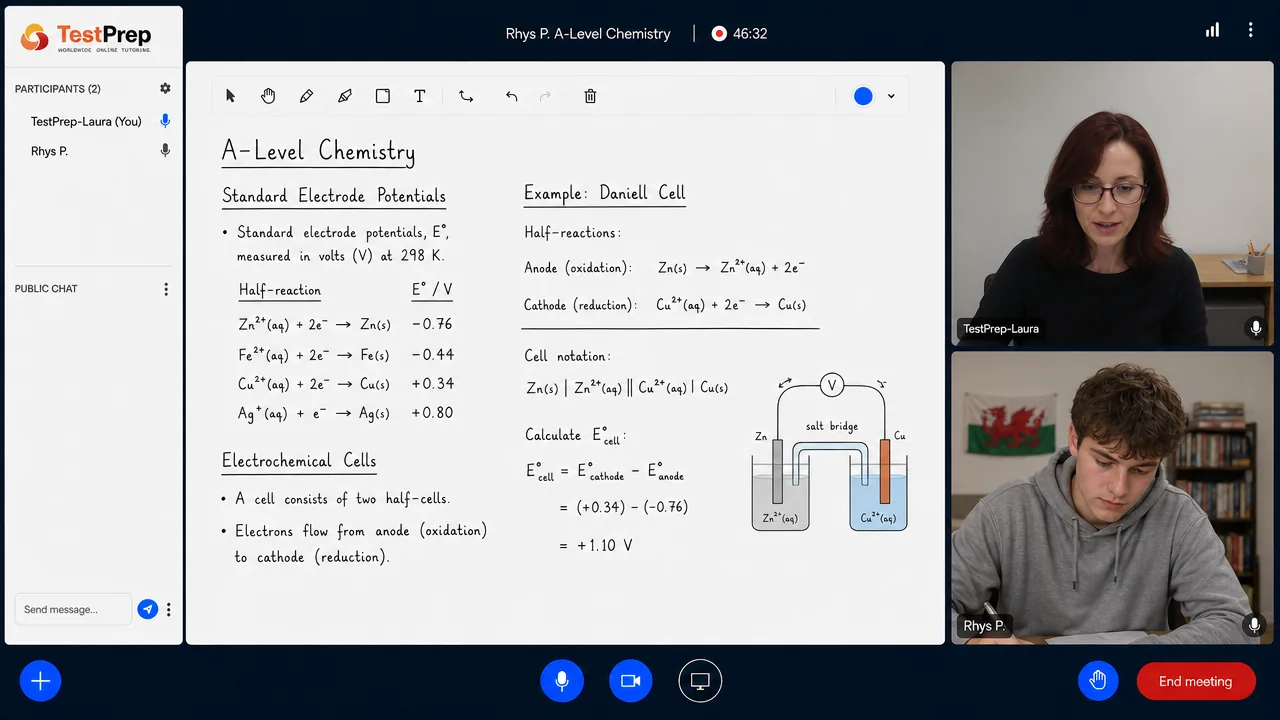
100% live online lessons
About the subject
A-Level Chemistry: what it covers and who it suits
A-Level Chemistry tutoring at TestPrep Europe covers AQA, OCR (A 'Chemistry A' and B 'Salters'), Edexcel and Cambridge International (9701). Structure may vary by board and syllabus code. We teach physical, inorganic and organic chemistry, mathematical chemistry, and required practicals to top-band standard.
Your lessons are taught by Laura Bennett, who teach A-Level Chemistry.
- AQA, OCR A, OCR B (Salters), Edexcel and Cambridge International specifications mapped explicitly
- Mathematical chemistry (moles, Kp/Kc, pH, Born-Haber, kinetics) drilled separately
- Organic synthesis taught with reaction maps across all functional groups
Read more
A-Level Chemistry is required or strongly preferred for many university courses, including medicine, pharmacy, chemical engineering, biochemistry and materials science. The specification spans Atomic structure, Bonding, organic reaction mechanisms, Thermodynamics and Electrode potentials and electrochemical cells, and develops the quantitative reasoning and experimental skills central to chemistry at university.
A-Level Chemistry covers the structure, properties, reactions and energetics of matter. On AQA 7405 the content falls into Physical chemistry (from Atomic structure, Amount of substance and Bonding to Thermodynamics, Rate equations, Electrode potentials and electrochemical cells and Acids and bases), Inorganic chemistry (Periodicity, Group 2, Group 7(17), Transition metals) and Organic chemistry (functional groups from Alkanes to Aromatic chemistry, Organic synthesis, Nuclear magnetic resonance spectroscopy and Chromatography), with organic chemistry of particular relevance to pharmaceuticals and materials science. Our programme follows each student's exam board (AQA, OCR, Pearson Edexcel or Cambridge International) with past-paper practice and Practical Endorsement preparation, working towards an A*.
One-to-one A-Level Chemistry tutoring
Our one-to-one A-Level tutoring is built around your current grade, your target grade and the exam board you are sitting. Each lesson works on your weak topics, drills AQA, OCR A, Edexcel, CIE past-paper questions and walks through mark schemes, so you know exactly how marks are awarded.
A private group for A-Level Chemistry
There is no open group timetable for this subject. If 3 or more of you sign up together, we open a private group course for you. The price per student depends on how many subjects you take, with 30 hours of live lessons in each: 1 subject (30 hours) €1,031, 2 subjects (60 hours) €1,927, 3 subjects (90 hours) €2,689 and 4 subjects (120 hours) €3,496. Each student buys their own place online, and we let you know as soon as your group is ready.
Exam
A-Level Chemistry exam format
Exam boards: AQA, OCR A, Edexcel, CIE
Paper 1 (AQA 7405)
35%2 hours, 105 marks of short and long answer questions. Physical chemistry sections 3.1.1–3.1.4, 3.1.6–3.1.8 and 3.1.10–3.1.12 (Atomic structure, Amount of substance, Bonding, Energetics, Chemical equilibria, Le Chatelier's principle and Kc, Oxidation, reduction and redox equations, Thermodynamics, Equilibrium constant Kp, Electrode potentials and electrochemical cells, Acids and bases), all of Inorganic chemistry, and relevant practical skills.
Paper 2 (AQA 7405)
35%2 hours, 105 marks of short and long answer questions. Physical chemistry sections 3.1.2–3.1.6 and 3.1.9 (Amount of substance, Bonding, Energetics, Kinetics, Chemical equilibria, Rate equations), all of Organic chemistry, and relevant practical skills.
Paper 3 (AQA 7405)
30%2 hours, 90 marks. Any content and any practical skills: practical techniques and data analysis (40 marks), questions across the specification (20 marks) and multiple choice (30 marks).
One-to-one A-Level tutoring
A-Level Chemistry Private Tutoring
Private A-Level lessons planned around your exam board's specification, your current grade and the grade you are aiming for. Every lesson is live and online, with a tutor who teaches this subject.
- A lesson plan built around your exam board and target grade
- Past-paper questions worked through with the board's mark schemes
- Exam technique for each paper, from command words to timing
- Lesson times that fit around your school week
How it works
- 1
Tell us your goal
We start from your school syllabus, your exam date and the result you are aiming for.
- 2
Your own plan
We map out the lessons you need, unit by unit.
- 3
Live one-to-one lessons
Meet your tutor online at times that suit your week.
- 4
Regular progress checks
Homework and a short check after each lesson show how you are getting on.
Start one-to-one A-Level Chemistry
Right for you if you want a plan built around your exam board, flexible lesson times and a tutor's full attention.
Book one-to-one lessonsBefore choosing a package, you can book one paid lesson.
Our A-Level tutors began teaching in 2018 or earlier.
100% First-Lesson Money-Back Guarantee
Not satisfied? Full refund, no questions asked.
We do not offer free trial lessons. Payment is required before your first lesson.
Secure Payments
Powered by Stripe with 256-bit encryption.

Flexible Billing
Local cards welcome, instalments available.
Lessons cancelled less than 3 hours before the start count as taken. Full terms
Included in lessons
Practice built into your A-Level Chemistry lessons
Every topic you cover in A-Level Chemistry is reinforced with question sets your tutor puts together for you. This programme has no separately sold question bank or practice test.
Mock exams included in the programme- Targeted questions on every topic
- Practice sets built around your weak areas
- Exam-style practice with past papers and mark schemes
- Worked solutions and feedback on every question
Syllabus
A-Level Chemistry topics
Topic names are those of the AQA 7405 specification; other exam boards order and name them a little differently.
13.1 Physical chemistry
- Atomic structure
- Amount of substance
- Bonding
- Energetics
- Kinetics
- Chemical equilibria, Le Chatelier's principle and Kc
- Oxidation, reduction and redox equations
- Thermodynamics
- Rate equations
- Equilibrium constant Kp for homogeneous systems
- Electrode potentials and electrochemical cells
- Acids and bases
23.2 Inorganic chemistry
- Periodicity
- Group 2, the alkaline earth metals
- Group 7(17), the halogens
- Properties of Period 3 elements and their oxides
- Transition metals
- Reactions of ions in aqueous solution
33.3 Organic chemistry
- Introduction to organic chemistry
- Alkanes
- Halogenoalkanes
- Alkenes
- Alcohols
- Organic analysis
- Optical isomerism
- Aldehydes and ketones
- Carboxylic acids and derivatives
- Aromatic chemistry
- Amines
- Polymers
- Amino acids, proteins and DNA
- Organic synthesis
- Nuclear magnetic resonance spectroscopy
- Chromatography
Approach
How we teach A-Level Chemistry
Study plan
- 1
Phase 1 — Physical 1 + inorganic 1
Atomic, bonding, energetics
- Atomic structure and bonding
- Energetics and enthalpy
- 2
Phase 2 — Physical 2 + organic 1
Equilibrium, kinetics, hydrocarbons
- Kinetics and equilibria
- Alkanes, alkenes, alcohols, halogenoalkanes
- 3
Phase 3 — Physical 3 + inorganic 2 + organic 2
Year 2 content
- Acids/bases, Ka/pH, Born-Haber
- Transition metals
- Carbonyls, carboxylic acids, aromatic chemistry
- 4
Phase 4 — Synthesis + practicals + mock
Reaction maps + papers
- Reaction maps and synthesis problems
- Required practicals
- Past-paper timed mocks
How lessons work
Mathematical chemistry as a separate skill
Moles, Kp/Kc, pH, Born-Haber and kinetics are taught with explicit numerical workflows so method marks are protected under time pressure.
Reaction maps
Organic synthesis is taught as a connected map of functional groups, not as isolated reactions.
Mechanism precision
Curly arrows are taught with explicit origin → destination — examiners test arrow precision as much as product.
Advice
A-Level Chemistry: common mistakes and study tips
MistakeEquilibrium constant expressions with the wrong powers.
FixPowers come from the stoichiometric coefficients. Read the equation before writing Kc/Kp.
MistakepH and Ka calculations without checking dissociation assumptions.
FixWeak-acid pH assumes [HA] ≈ initial; check the assumption is reasonable before quoting.
MistakeBorn-Haber cycle arrows in the wrong direction.
FixAlways orient arrows by definition (formation, atomisation, ionisation, electron affinity, lattice). Direction errors cascade.
MistakeOrganic mechanisms with curly arrows starting from the wrong place.
FixCurly arrows start from a lone pair or bond, not from an atom. Mechanism rubrics test arrow origin and direction precisely.
MistakePractical answers without controlled variables.
FixIndependent, dependent and controlled variables must be named explicitly.
Study tips
- Draw organic mechanisms step by step with curly arrows; mark schemes award marks for arrow placement, intermediates and products independently.
- Drill Amount of substance calculations (moles, the ideal gas equation, titrations): on AQA, 20% of the marks require maths at GCSE level (Level 2) or above.
- Practise IR and NMR spectrum interpretation with real, unknown structures rather than memorising example questions.
- Build a concept map linking Physical, Inorganic and Organic chemistry; AQA's Paper 3 can draw on any part of the specification.
Student results
A-Level success stories
Results our A-Level students shared in their own reviews.
Ready to raise your A-Level Chemistry grade?
You can start one-to-one A-Level Chemistry lessons with a single lesson. Every package and price is on one page.
- Live one-to-one lessons online
- No package needed — book a single lesson
- Lesson times that fit your school week
You can also write to us through our contact page.
Other subjects
Related and other A-Level subjects
Often taken alongside this subject
- A-Level BiologyStandard medical / biosciences A-Level pairing.
- A-Level PhysicsStandard engineering / physical sciences A-Level pairing.
- IB ChemistryComparable rigour for IB students.
All A-Level subjects
- A-Level Biology
- A-Level Physics
- A-Level Environmental Science
- A-Level Geology
- A-Level Mathematics
- A-Level Further Mathematics
- A-Level Computer Science
- A-Level Design & Technology
- A-Level Psychology
- A-Level History
- A-Level Geography
- A-Level Philosophy
- A-Level Politics
- A-Level Ancient History
- A-Level Sociology
- A-Level Global Perspectives & Research
- A-Level Economics
- A-Level Business
- A-Level Accounting
- A-Level English Literature
- A-Level English Language
- A-Level English Language and Literature
A-Level Chemistry Prep — Frequently Asked Questions
The questions students ask most about A-Level Chemistry preparation.