IB Computer Science Tutoring & Prep Course
Pre-IB, Mid-IB and IB Revision Programmes
Short answer
The IB Computer Science course is one-to-one tutoring, taught live online: every lesson is 90 minutes.
A private group is for 3 or more friends who sign up together (the group programme is 30 hours per subject); there are no published start dates, and we agree the start date and lesson times with you.
In one-to-one tutoring, packages are from €85 a lesson.
IB Computer Science tutoring for the new guide first examined in May 2027: computer fundamentals, networks, databases, machine learning and OOP.
One-to-one and small groups · Live online · IB syllabus
Get AI feedback on your Extended Essay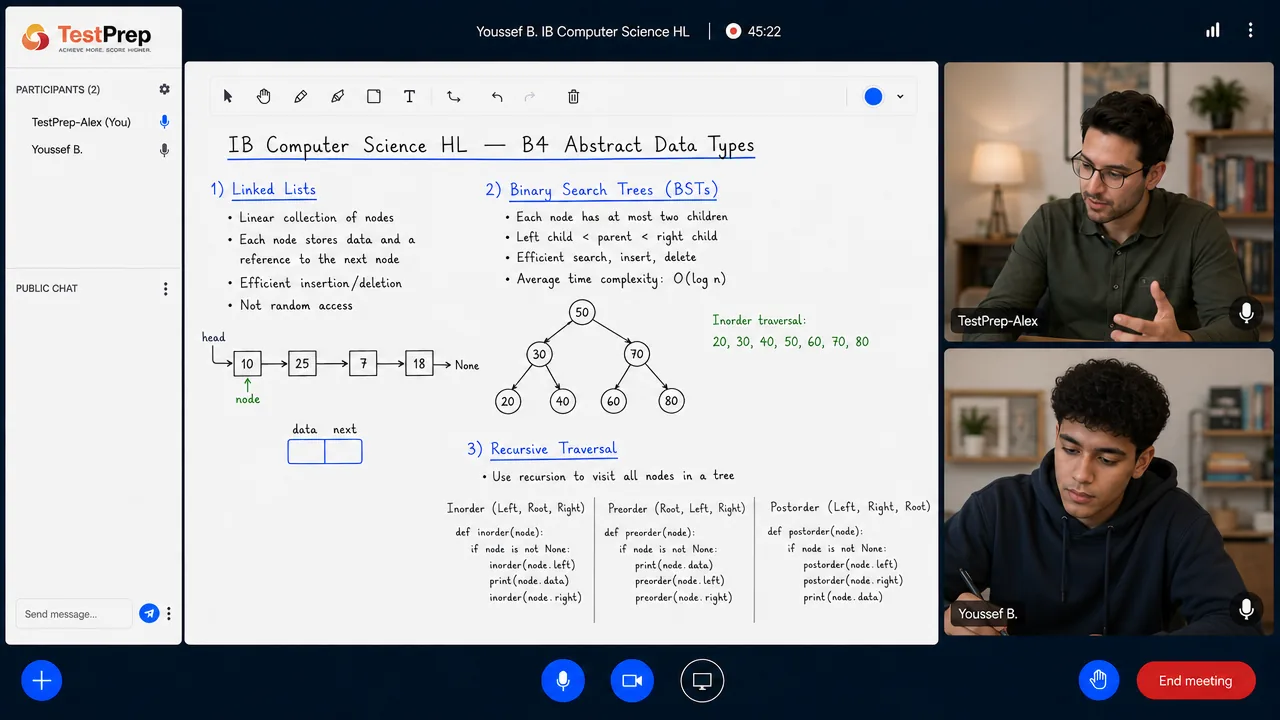
100% live online lessons
About the subject
IB Computer Science: what it covers and who it suits
IB Computer Science tutoring follows the new guide first examined in May 2027, built on two themes: A.1 Computer fundamentals, A.2 Networks, A.3 Databases and A.4 Machine learning, then B.1 Computational thinking, B.2 Programming and B.3 Object oriented programming (OOP), with B.4 Abstract data types at HL only. The option system and the old HL Paper 3 are gone: machine learning, OOP and databases are core for everyone, and the pre-released case study now sits in Paper 1 at both levels. The Internal Assessment — the computational solution, with no client requirement — is supported end-to-end with academic-integrity guidance.
Your lessons are taught by Arda Karagöz, Eylül Şahin, Tarkan Erol and Yiğit Karaca, who teach IB Computer Science.
- Seven shared topics (A.1–A.4, B.1–B.3) with extra HL-only content inside them, plus B.4 Abstract data types for HL
- Paper 2 practised in the school's language, Java or Python — no pseudocode expected
- Pre-released case study unpacked for Paper 1 Section B
Read more
The new IB Computer Science guide, first examined in May 2027, asks students to understand how computing systems work (Theme A: Concepts of computer science) and to solve real problems with computational thinking and code (Theme B: Computational thinking and problem-solving), in Java or Python.
Theme A concepts
A.1 Computer fundamentals, A.2 Networks, A.3 Databases and A.4 Machine learning — the whole of Paper 1 Section A.
Theme B programming
B.1 Computational thinking, B.2 Programming and B.3 Object oriented programming (OOP) in Java or Python, plus B.4 Abstract data types at HL.
The computational solution
An IA built around a problem the student chooses — no client needed — assessed on five criteria, with up to 2,000 words of documentation and a video of up to five minutes.
Case study and exam technique
Researching the challenges in the pre-released case study, tracing code, Big O reasoning and code-free algorithm questions.
IB Computer Science is foundational for students aiming at software engineering, data science, AI or cybersecurity — fast-growing fields with high demand.
Lessons are hands-on and taught in the language your school uses, Java or Python, and the computational solution gets feedback criterion by criterion. The code, documentation and video remain the student's own work.
Exam
IB Computer Science exam format
Paper 1
SL: 1 h 15 min / HL: 2 hSL: 35% / HL: 40%New guide, first examined May 2027. Section A: extended-response questions on Theme A, Concepts of computer science. Section B: questions on the pre-seen case study and its challenge questions (two at SL, four at HL). 50 marks at SL, 80 at HL.
Paper 2
SL: 1 h 15 min / HL: 2 hSL: 35% / HL: 40%Compulsory extended-response questions on Theme B, Computational thinking and problem-solving, in a Java or a Python version. One question tests algorithmic thinking without code; HL adds questions on HL-only topics. 50 marks at SL, 80 at HL.
Internal assessment
35 hSL: 30% / HL: 20%The computational solution (30 marks): a coded solution to a problem the student chooses, marked on five criteria. Documentation of up to 2,000 words, a video of up to five minutes and the full source code in the appendices.
One-to-one IB tutoring
IB Computer Science Private Tutoring
Private IB lessons at HL or SL: the topics you find hardest, your Internal Assessment and Extended Essay, and technique for every paper. Lessons are live and online and fit around your school timetable.
- A lesson plan built around your HL or SL course
- Internal Assessment (IA) guidance and feedback
- Extended Essay (EE) planning and feedback
- TOK coaching and feedback
- Past-paper practice marked against IB mark schemes
- Scheduling that fits your school timetable
How it works
- 1
Tell us your goal
We start from your school syllabus, your exam date and the result you are aiming for.
- 2
Your own plan
We map out the lessons you need, unit by unit.
- 3
Live one-to-one lessons
Meet your tutor online at times that suit your week.
- 4
Regular progress checks
Homework and a short check after each lesson show how you are getting on.
Start one-to-one IB Computer Science
Right for you if you are aiming for a 6 or a 7, need help in one subject, or want support with your IA or EE.
Book one-to-one lessonsBefore choosing a package, you can book one paid lesson.
Our IB tutors began teaching in 2018 or earlier.
IB Computer Science Extended Essay Grader
Get AI feedback on your Extended Essay against the IB criteria for your exam session: the new criteria (30 marks) from May 2027, and the 2018 criteria (34 marks) up to November 2026. You get detailed feedback on every criterion and an estimated A–E grade.
Your exam session
The IB marks the Extended Essay against new criteria from the May 2027 session. If you sit your exams in November 2026 or earlier, your essay is marked against the 2018 criteria.
Type of review
How is the A–E grade estimated?
The IB sets the Extended Essay's grade boundaries again every session; there is no fixed table. So the estimate follows the grade descriptors the IB asks schools to use for predicted grades. The IB publishes your final grade at the end of the session.
IA support
IB Computer Science IA support
Under the new guide the IA is called the computational solution: students choose their own problem and build a coded software solution for it, with no client requirement. The recommended 35 hours count for 30% at SL and 20% at HL, and both levels are marked out of 30 on the same five criteria.
Where we support you through the IA
- 1Criterion A: Problem specification (4 marks) — measurable success criteria and the computational context
- 2Criterion B: Planning (4 marks) — decomposition and a plan tied to the success criteria
- 3Criterion C: System overview (6 marks) — system model, algorithms and a testing strategy
- 4Criterion D: Development (12 marks) — a working product, the techniques behind it and testing shown on video
- 5Criterion E: Evaluation (4 marks) — how far the success criteria were met, and justified improvements
- 6Submission: documentation of up to 2,000 words (excluding code excerpts, comments and diagrams), a video of up to five minutes and appendices with the full source code
- 7Extended essay: separate from the IA — independent research of up to 4,000 words, assessed externally, which in computer science can use primary or secondary data
IB Computer Science Camps
Structured Prep Camps for IB Computer Science
Three programmes for every stage of IB Computer Science, each run as a private group of three or more friends, on dates set with the group.
PRE-IB CAMP
IB Computer Science: Pre-IB
Build strong IB Computer Science foundations before starting IB1.
- Core IB Computer Science concepts
- Introduction to IB assessment criteria
- Academic writing skills
- Study and note-taking techniques
MID-IB CAMP
IB Computer Science Mid-Year
Consolidate your IB Computer Science knowledge at the end of IB1.
- IB Computer Science IA preparation and planning
- Year-1 topic review
- Identifying knowledge gaps
- Adapting to the exam format
FINAL CAMP
IB Computer Science Final Revision
An intensive IB Computer Science revision marathon before the May exams.
- IB Computer Science full-syllabus review
- 10+ years of past papers
- Mock exams with detailed feedback
- Strategies to maximise your score
100% First-Lesson Money-Back Guarantee
Not satisfied? Full refund, no questions asked.
We do not offer free trial lessons. Payment is required before your first lesson.
Secure Payments
Powered by Stripe with 256-bit encryption.

Flexible Billing
Local cards welcome, instalments available.
Lessons cancelled less than 3 hours before the start count as taken. Full terms
Included in lessons
Practice built into your IB Computer Science lessons
Every topic you cover in IB Computer Science is reinforced with question sets your tutor puts together for you. This programme has no separately sold question bank or practice test.
Mock exams included in the programme- Targeted questions on every topic
- Practice sets built around your weak areas
- Exam-style practice with past papers and mark schemes
- Worked solutions and feedback on every question
Syllabus
IB Computer Science topics
The new IB Computer science guide is examined for the first time in May 2027 and is built on two themes, A and B. The sub-topics are shared by SL and HL; HL also studies B.4.
Topic names are the IB's own, from the current subject guide.
SLTopics shared by SL and HL
- A.1 Computer fundamentals
- A.2 Networks
- A.3 Databases
- A.4 Machine learning
- B.1 Computational thinking
- B.2 Programming
- B.3 Object oriented programming (OOP)
HLHL only
- B.4 Abstract data types
Approach
How we teach IB Computer Science
Study plan
- 1
Phase 1 — A.1 Computer fundamentals and A.2 Networks
Foundations
- Hardware, data representation and computer logic, operating systems (HL: A1.4 Translation)
- Network fundamentals, architecture, data transmissions and security
- Paper 1 Section A-style extended responses
- 2
Phase 2 — A.3 Databases and A.4 Machine learning
Data and machine learning
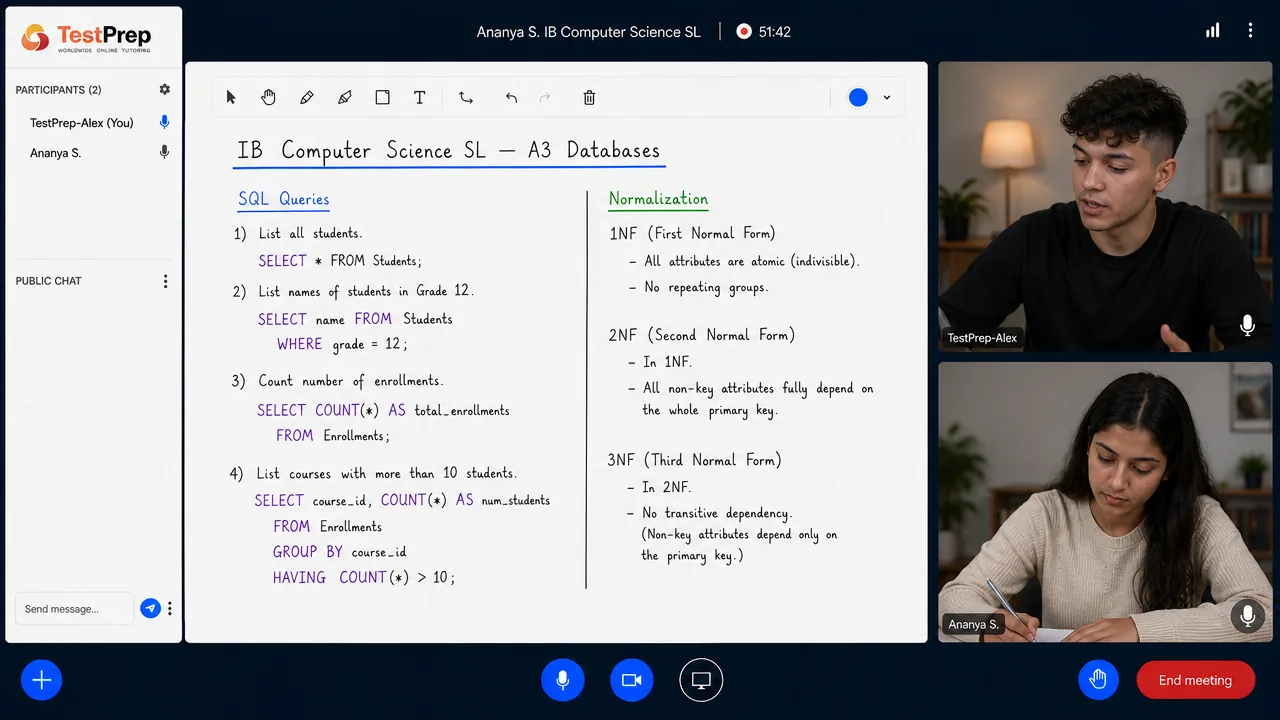
- Database design and SQL queries
- Machine learning fundamentals and ethical considerations; data preprocessing and machine learning approaches at HL
- 3
Phase 3 — B.1 Computational thinking, B.2 Programming and B.3 Object oriented programming (OOP)
Programming
- Decomposition, abstraction and tracing flowcharts
- Data structures, searching and sorting, Big O notation; recursion at HL
- Classes, objects and encapsulation; inheritance, polymorphism and design patterns at HL
- Regular coding in the school's language, Java or Python
- 4
Phase 4 — B.4 Abstract data types (HL) + case study + mock
Integrated preparation
- HL: linked lists, binary search trees and sets
- Researching the case study's challenges for Paper 1 Section B
- Computational-solution IA with academic integrity
- Timed Paper 1 and Paper 2 practice
How lessons work
Code and algorithmic thinking, in your language
We teach in the language your school uses, Java or Python, and practise tracing, Big O notation and describing algorithms without code, as Paper 2 requires.
The IA as a real software project
Problem specification, planning, system overview, development and evaluation are worked through in the order of the five criteria, with a testing strategy and a short demo video. The code and documentation remain the student's own work.
Case study unpacked early
As soon as the IB publishes the case study we build a vocabulary list, a technical-depth map and likely questions for each challenge — for SL and HL alike, since both now meet it in Paper 1.
Advice
IB Computer Science: common mistakes and study tips
MistakeStill drilling IB pseudocode as if it were examined.
FixThe new Paper 2 doesn't use pseudocode and doesn't expect it. Questions come in a Java or a Python version, and one question tests algorithmic thinking without any code. Practise in your school's language and trace algorithms by hand.
MistakeLooking for a client for the IA.
FixThe computational solution has no client requirement: you choose the problem. What earns marks is measurable success criteria, a clear decomposition and system overview, and a product complex enough for the course.
MistakeLeaving the testing strategy until the end.
FixThe testing strategy is set out in Criterion C and judged in Criterion D (12 of 30 marks), with examples shown in a video of up to five minutes. Plan tests against each success criterion from the start.
MistakeTreating HL-only content as optional reading.
FixHL papers add question parts on HL-only content — recursion, OOP across multiple classes, and B.4 Abstract data types such as linked lists and binary search trees. Drill them with code traces in your language.
MistakeStarting the case study too late.
FixThe case study is published 12 months before the May exam and examined in Paper 1 Section B at both levels (two challenges at SL, four at HL). Research each challenge early and build a technical vocabulary for it.
Ready to raise your IB Computer Science grade?
You can start one-to-one IB Computer Science lessons with a single lesson. Every package and price is on one page.
- Live one-to-one lessons online
- No package needed — book a single lesson
- Lesson times that fit your school week
You can also write to us through our contact page.
Other subjects
Related and other IB Diploma subjects
Often taken alongside this subject
- IB Math AADiscrete maths and proof skills support algorithmic reasoning and Big O analysis on Paper 2.
- IB PhysicsCommon HL pairing for STEM-track candidates.
- AP Computer Science AIts Java OOP overlaps with B.3 Object oriented programming (OOP) for students who take IB CS in Java.
All IB Diploma subjects
- IB English A: Language & Literature
- IB Turkish A: Language & Literature
- IB English B
- IB Economics
- IB Business Management
- IB Psychology
- IB Philosophy
- IB Global Politics
- IB History
- IB Geography
- IB Physics
- IB Chemistry
- IB Biology
- IB Environmental Systems & Societies (ESS)
- IB Math: Analysis & Approaches
- IB Math: Applications & Interpretation
- IB Visual Arts
IB Computer Science Prep — Frequently Asked Questions
The questions students ask most about IB Computer Science preparation.