IB Psychology Tutoring & Prep Course
Pre-IB, Mid-IB and IB Revision Programmes
Short answer
The IB Psychology course is one-to-one tutoring, taught live online: every lesson is 90 minutes.
A private group is for 3 or more friends who sign up together (the group programme is 30 hours per subject); there are no published start dates, and we agree the start date and lesson times with you.
In one-to-one tutoring, packages are from €85 a lesson.
IB Psychology tutoring for the new guide first examined in May 2027: the biological, cognitive and sociocultural approaches and research methods.
One-to-one and small groups · Live online · IB syllabus
Get AI feedback on your Extended Essay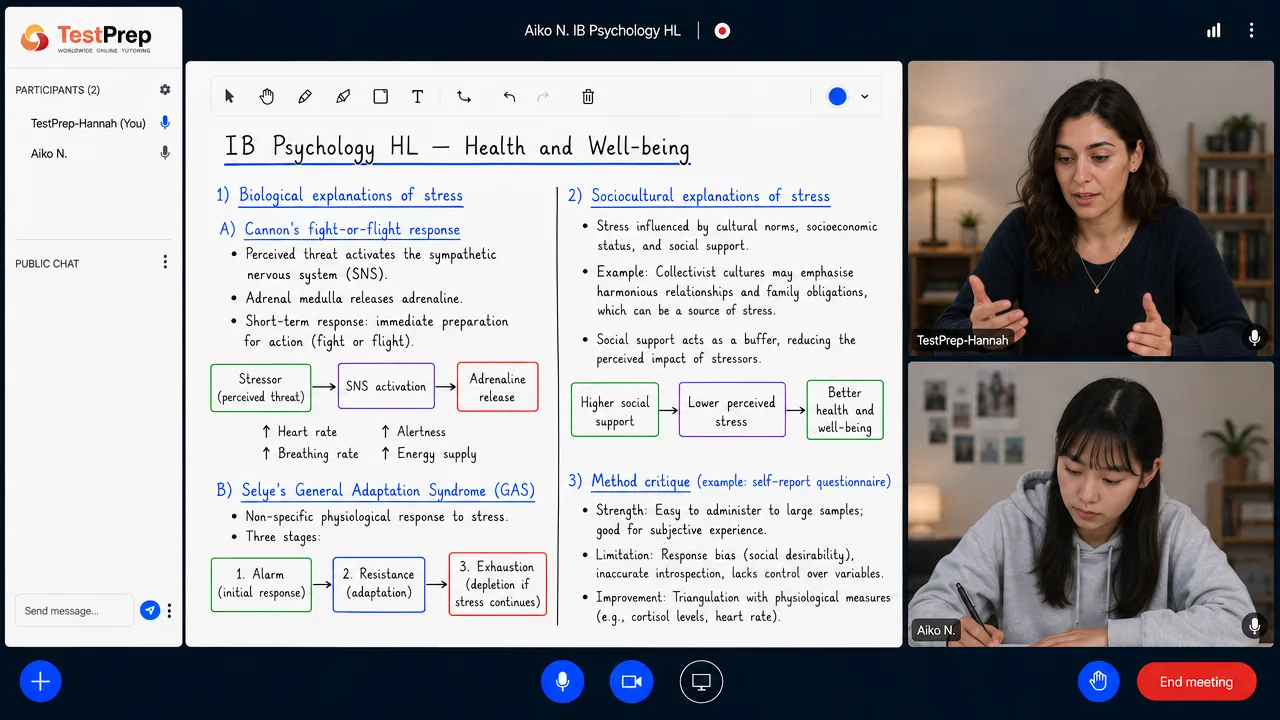
100% live online lessons
About the subject
IB Psychology: what it covers and who it suits
IB Psychology tutoring follows the new guide first examined in May 2027. The course content — Biological approach, Cognitive approach, Sociocultural approach and Research methodology — is studied through four contexts: Health and well-being, Human development, Human relationships, and Learning and cognition. The old HL option list is gone, and the Internal Assessment is now a research proposal rather than a conducted experiment. SL sits Paper 1 and Paper 2; HL adds Paper 3, a source-based paper on data analysis and interpretation. Each paper is practised separately, and the IA is coached under academic-integrity guidance.
Some of the teachers who teach IB Psychology: Aylin Şimşek, Berk Yavuz, Elif Çakır and Kaan Erdem.
- Content, contexts and the six concepts of the 2027 guide, practised through exam-style questions
- HL extensions — The role of culture, motivation and technology in shaping human behaviour; Data analysis and interpretation — prepared in depth for Paper 3
- Research-proposal IA scaffolded with ethical and academic-integrity safeguards
Read more
The new IB Psychology guide, first examined in May 2027, rewards applying concepts across contexts rather than memorising theories and studies. Students use the Biological, Cognitive and Sociocultural approaches and Research methodology through six concepts — bias, causality, change, measurement, perspective and responsibility — in four contexts.
Concepts, content and contexts
Linking the three approaches to Health and well-being, Human development, Human relationships, and Learning and cognition through the six concepts — the integration Paper 1 is built on.
Class practicals
One per context — an interview, an observation, a survey/questionnaire and an experiment — and the basis of Paper 2 Section A.
Research-proposal IA
Designing, not running, a study for a population of interest, with the method, procedure and data collection tool justified across four criteria.
HL data analysis
Reading graphs, interpreting descriptive and inferential statistics, and synthesising sources on culture, motivation and technology for Paper 3.
IB Psychology gives students a scientific framework for understanding mind and behaviour, and a strong base for psychology, medicine, education or the social sciences at university. The new guide puts psychological literacy first: applying psychology to real problems and reading research claims critically.
Our tutors teach each concept through real research and current examples, practise the class practicals for Paper 2 and the HL extensions for Paper 3, and build academic writing along the way.
Exam
IB Psychology exam format
Paper 1
SL and HL: 1 h 30 minSL: 35% / HL: 25%Integration of the concepts, content and contexts (35 marks; new guide, first examined May 2027). Section A: two short-answer questions on two of the three content areas. Section B: two questions applying content to an unseen scenario, each from a context. Section C: one of two concept-based extended responses.
Paper 2
SL and HL: 1 h 30 minSL: 35% / HL: 25%Applying concepts and content to research contexts (35 marks). Section A: four compulsory questions on the class practicals. Section B: evaluating an unseen study against two or more concepts.
Paper 3 (HL only)
HL: 1 h 45 minHL: 30%Data analysis and interpretation of research data (30 marks). Four questions on sources with quantitative and qualitative findings, focused on one HL extension: culture, motivation or technology.
Internal assessment
About 20 hSL: 30% / HL: 20%Research proposal (24 marks) for a population of interest, using one of the four class-practical methods; the research is not carried out. Up to 2,200 words, marked by the teacher and moderated by the IB.
One-to-one IB tutoring
IB Psychology Private Tutoring
Private IB lessons at HL or SL: the topics you find hardest, your Internal Assessment and Extended Essay, and technique for every paper. Lessons are live and online and fit around your school timetable.
- A lesson plan built around your HL or SL course
- Internal Assessment (IA) guidance and feedback
- Extended Essay (EE) planning and feedback
- TOK coaching and feedback
- Past-paper practice marked against IB mark schemes
- Scheduling that fits your school timetable
How it works
- 1
Tell us your goal
We start from your school syllabus, your exam date and the result you are aiming for.
- 2
Your own plan
We map out the lessons you need, unit by unit.
- 3
Live one-to-one lessons
Meet your tutor online at times that suit your week.
- 4
Regular progress checks
Homework and a short check after each lesson show how you are getting on.
Start one-to-one IB Psychology
Right for you if you are aiming for a 6 or a 7, need help in one subject, or want support with your IA or EE.
Book one-to-one lessonsBefore choosing a package, you can book one paid lesson.
Our IB tutors began teaching in 2018 or earlier.
IB Psychology Extended Essay Grader
Get AI feedback on your Extended Essay against the IB criteria for your exam session: the new criteria (30 marks) from May 2027, and the 2018 criteria (34 marks) up to November 2026. You get detailed feedback on every criterion and an estimated A–E grade.
Your exam session
The IB marks the Extended Essay against new criteria from the May 2027 session. If you sit your exams in November 2026 or earlier, your essay is marked against the 2018 criteria.
Type of review
How is the A–E grade estimated?
The IB sets the Extended Essay's grade boundaries again every session; there is no fixed table. So the estimate follows the grade descriptors the IB asks schools to use for predicted grades. The IB publishes your final grade at the end of the session.
IA support
IB Psychology IA support
Under the new guide the IA is a research proposal: students design a study for a population of interest affected by a real-life problem, using one of the four methods from the class practicals — and don't carry it out. What's assessed is how well they justify their methodological decisions, not whether the study is perfect. It takes about 20 hours, counts for 30% at SL and 20% at HL, and must not exceed 2,200 words.
Where we support you through the IA
- 1Criterion A: Introduction (6 marks) — a focused aim, the real-life problem and its impact on the population of interest, and two pieces of relevant research
- 2Criterion B: Research methodology (6 marks) — justifying an experiment, interview, observation or survey/questionnaire, the procedure and the ethical considerations
- 3Criterion C: Data collection (6 marks) — a data collection tool of at least five items, the decisions behind it and the likely challenges
- 4Criterion D: Discussion (6 marks) — potential findings and their implications for policy or practice, researcher bias and one additional method
- 5Ethics: written as if it had to pass an ethics committee; animals and sensitive topics such as abuse or self-harm are off limits
- 6Extended essay: under the new EE guide (first assessment 2027) a psychology EE is a literature review based on secondary sources only — no primary data — of up to 4,000 words
IB Psychology Camps
Structured Prep Camps for IB Psychology
Three programmes for every stage of IB Psychology, each run as a private group of three or more friends, on dates set with the group.
PRE-IB CAMP
IB Psychology: Pre-IB
Build strong IB Psychology foundations before starting IB1.
- Core IB Psychology concepts
- Introduction to IB assessment criteria
- Academic writing skills
- Study and note-taking techniques
MID-IB CAMP
IB Psychology Mid-Year
Consolidate your IB Psychology knowledge at the end of IB1.
- IB Psychology IA preparation and planning
- Year-1 topic review
- Identifying knowledge gaps
- Adapting to the exam format
FINAL CAMP
IB Psychology Final Revision
An intensive IB Psychology revision marathon before the May exams.
- IB Psychology full-syllabus review
- 10+ years of past papers
- Mock exams with detailed feedback
- Strategies to maximise your score
100% First-Lesson Money-Back Guarantee
Not satisfied? Full refund, no questions asked.
We do not offer free trial lessons. Payment is required before your first lesson.
Secure Payments
Powered by Stripe with 256-bit encryption.

Flexible Billing
Local cards welcome, instalments available.
Lessons cancelled less than 3 hours before the start count as taken. Full terms
Included in lessons
Practice built into your IB Psychology lessons
Every topic you cover in IB Psychology is reinforced with question sets your tutor puts together for you. This programme has no separately sold question bank or practice test.
Mock exams included in the programme- Targeted questions on every topic
- Practice sets built around your weak areas
- Exam-style practice with past papers and mark schemes
- Worked solutions and feedback on every question
Syllabus
IB Psychology topics
The new IB Psychology guide is examined for the first time in May 2027. The course works through four areas of content and four contexts, tied together by the concepts of bias, causality, change, measurement, perspective and responsibility.
Topic names are the IB's own, from the current subject guide.
SLTopics shared by SL and HL
- Biological approach
- Cognitive approach
- Sociocultural approach
- Research methodology
- Health and well-being
- Human development
- Human relationships
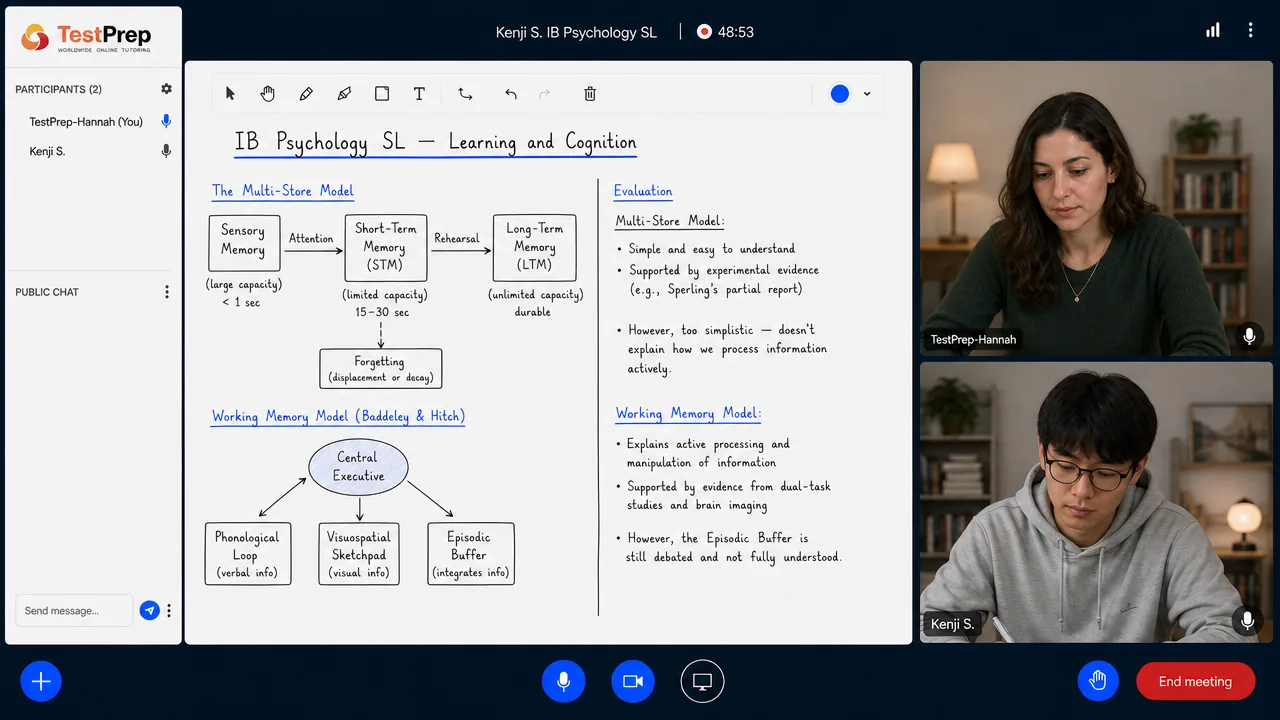
- Learning and cognition
The first four are the course content and the last four its contexts; HL adds two extensions.
HLHL only
- The role of culture, motivation and technology in shaping human behaviour
- Data analysis and interpretation
Approach
How we teach IB Psychology
Study plan
- 1
Phase 1 — Content and concepts
Biological, Cognitive and Sociocultural approaches
- Key terms such as Localization of function, Schema theory and Social identity theory, each tied to one or more of the six concepts
- Short-answer practice for Paper 1 Section A
- 2
Phase 2 — Contexts and class practicals
Health and well-being, Human development, Human relationships, Learning and cognition
- Applying content to unseen scenarios for Paper 1 Section B
- The four class practicals — interview, observation, survey/questionnaire, experiment — written up for Paper 2 Section A
- 3
Phase 3 — IA + HL extensions
Research proposal; culture, motivation and technology; data analysis
- Research-proposal aim, method and data collection tool
- HL extensions: The role of culture, motivation and technology in shaping human behaviour; Data analysis and interpretation
- 4
Phase 4 — Papers + mock
Timed practice
- Concept-based extended responses for Paper 1 Section C and Paper 2 Section B
- Full mock under timed conditions, with Paper 3 for HL
How lessons work
Concepts first, studies second
Every content term is mapped to the six concepts and the four contexts, so students can carry one idea across contexts — the skill Paper 1 Section C and Paper 2 Section B reward.
Markbands made visible
Each section's markband is taught on its own terms — an explained example in Section A, developed application in Section B, a reasoned conclusion in Section C — and command terms are drilled under timed conditions.
IA with ethics and integrity
We coach the choice of population of interest, the method justification, the data collection tool and the ethical considerations. The proposal itself remains the student's own work.
Advice
IB Psychology: common mistakes and study tips
MistakeSection C essays built around a study rather than the concept.
FixPaper 1 Section C is concept-based and doesn't reward study detail. Build the answer around the concept in the question — causality, measurement, perspective — explain the links between concepts and argue to a clearly stated conclusion.
MistakeDefining a term in Section B without applying it.
FixSection B gives an unseen scenario. The top band needs well-developed application: tie the content to the people and behaviour in the scenario, not to a textbook definition.
MistakeGoing into Paper 2 without notes on your class practicals.
FixSection A's four compulsory questions are about the research methods of your class practicals. Keep a short record of each — aim, procedure, sampling technique, findings, ethics — as the guide itself recommends.
MistakeWriting the IA like a lab report.
FixThe new IA is a research proposal: nothing is run and no data is analysed. Marks come from justifying the method and procedure, designing a data collection tool of at least five items, and discussing implications, researcher bias and an additional method.
MistakeAn HL Paper 3 synthesis that leans on one source.
FixQuestion 4 asks you to judge a claim using at least three sources plus your own knowledge. The top band needs all three used effectively, with different points of view weighed.
Ready to raise your IB Psychology grade?
You can start one-to-one IB Psychology lessons with a single lesson. Every package and price is on one page.
- Live one-to-one lessons online
- No package needed — book a single lesson
- Lesson times that fit your school week
You can also write to us through our contact page.
Other subjects
Related and other IB Diploma subjects
Often taken alongside this subject
- AP PsychologyComparable content; AP exam technique is shorter, IB demands deeper essays.
- IB BiologyBiological approach overlaps with IB Biology nervous-system content.
All IB Diploma subjects
- IB English A: Language & Literature
- IB Turkish A: Language & Literature
- IB English B
- IB Economics
- IB Business Management
- IB Philosophy
- IB Global Politics
- IB History
- IB Geography
- IB Physics
- IB Chemistry
- IB Biology
- IB Computer Science
- IB Environmental Systems & Societies (ESS)
- IB Math: Analysis & Approaches
- IB Math: Applications & Interpretation
- IB Visual Arts
IB Psychology Prep — Frequently Asked Questions
The questions students ask most about IB Psychology preparation.