IGCSE Computer Science Tutoring & Prep Course
Short answer
The IGCSE Computer Science course is one-to-one tutoring, taught live online: every lesson is 90 minutes.
A private group is for 3 or more friends who sign up together (the group programme is 30 hours per subject); there are no published start dates, and we agree the start date and lesson times with you.
In one-to-one tutoring, packages are from €85 a lesson.
IGCSE Computer Science tutoring for Cambridge 0478/0984 and Edexcel 4CP0: data representation, networks, hardware, algorithms, pseudocode and programming.
One-to-one and small groups · Live online · Cambridge International and Pearson Edexcel syllabuses
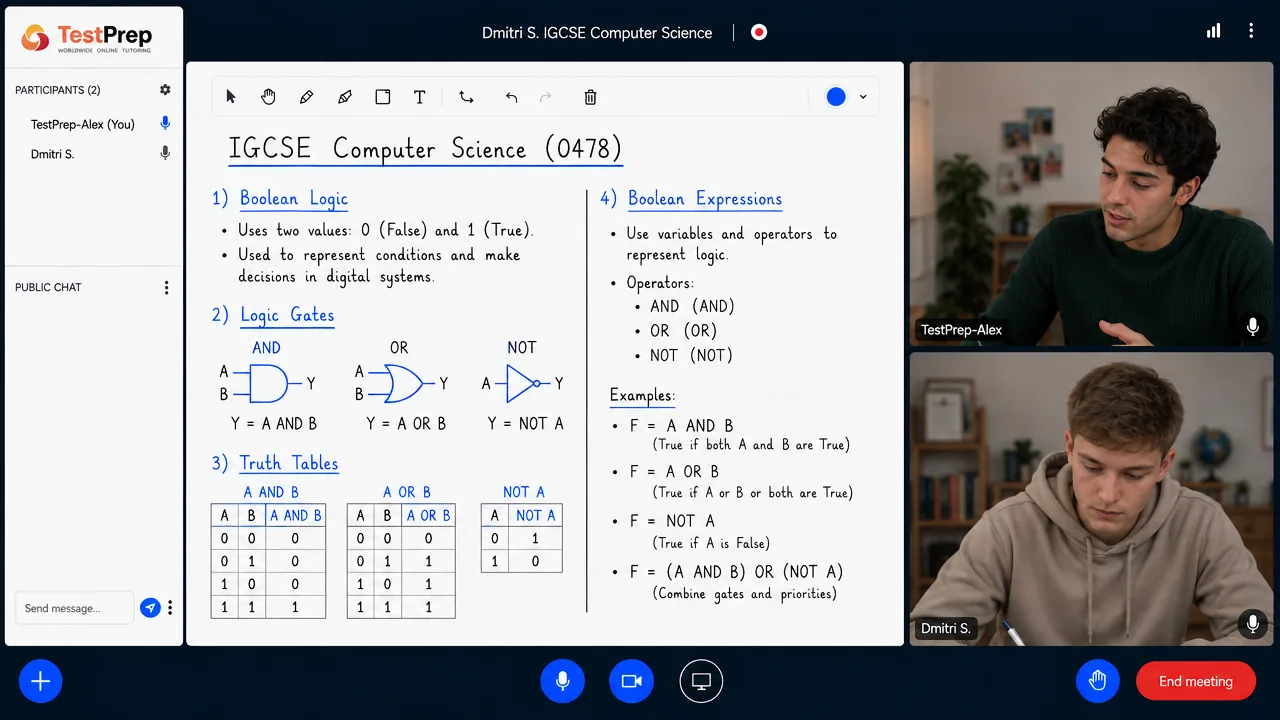
100% live online lessons
About the subject
IGCSE Computer Science: what it covers and who it suits
IGCSE Computer Science tutoring at TestPrep Europe covers Cambridge International (0478 / 0984) and Pearson Edexcel (4CP0) specifications. Structure may vary by board and syllabus code. We teach the theory paper (data representation, networks, hardware/software, ethics) and the programming paper (algorithm design, pseudocode, Python), plus the unseen 15-mark scenario question that closes Cambridge Paper 2.
- Cambridge 0478/0984 and Edexcel 4CP0 specifications mapped explicitly
- Pseudocode and Python practised side by side with board-specific notation
- Cambridge Paper 2's unseen scenario question practised on fresh problems (there is no pre-release material)
Exam
IGCSE Computer Science exam format
Theory paper
Concepts: data representation, networks, hardware, ethics and binary arithmetic.
Algorithms / problem-solving paper
Pseudocode tracing, debugging, designing algorithms and applying control structures.
Scenario question / on-screen programming
Cambridge Paper 2 ends with an unseen 15-mark scenario question (no pre-release material); Pearson Edexcel's Paper 2 is a 3-hour on-screen practical programming exam. — Cambridge International (0478 / 0984) and Pearson Edexcel (4CP0) structure this strand differently; structure may vary by board and syllabus code.
One-to-one IGCSE tutoring
IGCSE Computer Science Private Tutoring
Private IGCSE lessons planned around your syllabus code, your tier where the syllabus has one, and the grade you are aiming for. Every lesson is live and online, with a tutor who teaches this subject.
- A lesson plan built around your syllabus and target grade
- Past-paper questions worked through with the board's mark schemes
- Exam technique for each paper, from command words to timing
- Lesson times that fit around your school week
How it works
- 1
Tell us your goal
We start from your school syllabus, your exam date and the result you are aiming for.
- 2
Your own plan
We map out the lessons you need, unit by unit.
- 3
Live one-to-one lessons
Meet your tutor online at times that suit your week.
- 4
Regular progress checks
Homework and a short check after each lesson show how you are getting on.
Start one-to-one IGCSE Computer Science
Right for you if you want a plan built around your syllabus, flexible lesson times and a tutor's full attention.
Book one-to-one lessonsBefore choosing a package, you can book one paid lesson.
Our IGCSE tutors began teaching in 2018 or earlier.
100% First-Lesson Money-Back Guarantee
Not satisfied? Full refund, no questions asked.
We do not offer free trial lessons. Payment is required before your first lesson.
Secure Payments
Powered by Stripe with 256-bit encryption.

Flexible Billing
Local cards welcome, instalments available.
Lessons cancelled less than 3 hours before the start count as taken. Full terms
Included in lessons
Practice built into your IGCSE Computer Science lessons
Every topic you cover in IGCSE Computer Science is reinforced with question sets your tutor puts together for you. This programme has no separately sold question bank or practice test.
Mock exams included in the programme- Targeted questions on every topic
- Practice sets built around your weak areas
- Exam-style practice with past papers and mark schemes
- Worked solutions and feedback on every question
Syllabus
IGCSE Computer Science topics
1Data representation
- Binary, hex, two's complement, character sets, image and sound representation, compression.
2Data transmission and the internet
- Packet switching, error detection, encryption, the internet and the World Wide Web, cyber-security threats and mitigations.
3Hardware and software
- CPU, memory hierarchy, operating systems, application vs system software.
4Algorithms and programming logic
- Pseudocode, flowcharts, search and sort algorithms, trace tables, abstraction and decomposition.
- Topics 7–10 (algorithms, programming, databases, Boolean logic) make up the whole of Cambridge Paper 2.
5Programming (Python recommended)
- Data types, control structures, arrays, file handling, subroutines, parameter passing.
6Databases
- Single-table databases, queries, primary keys, validation and verification.
7Ethics, security and the digital society
- Cybersecurity, copyright, privacy and AI implications (where examined).
Topic groups as we teach them; your exam board's syllabus may name and order them differently.
Approach
How we teach IGCSE Computer Science
Study plan
- 1
Phase 1 — Data and hardware
Data representation, components
- Binary, hex, two's complement
- CPU components and fetch-execute cycle
- 2
Phase 2 — Networks, software, ethics
Systems and impact
- Network types and protocols
- OS and software layers
- Cyber security and ethics
- 3
Phase 3 — Programming + pseudocode
Algorithm design and code
- Pseudocode notation drills
- Python implementation of algorithms
- 4
Phase 4 — Scenario practice + mock
Scenario + papers
- Unseen scenario-question practice
- Past-paper Paper 1 + Paper 2 timed mocks
How lessons work
Pseudocode + Python in parallel
Pseudocode is the exam dialect; Python is the lab tool. Treating them as one leads to avoidable errors.
Trace tables as a habit
Trace tables are awarded marks directly. We make them automatic for any iteration or condition question.
Scenario question as a weekly habit
Cambridge's 15-mark scenario question is unseen, so we practise a fresh scenario every week instead of preparing a single released case.
Advice
IGCSE Computer Science: common mistakes and study tips
MistakePseudocode that drifts into Python or vice versa.
FixEach board uses its own pseudocode style. We drill the board-specific notation explicitly so students stop losing notation marks.
MistakeAlgorithm answers without a trace table.
FixTrace tables are explicitly rewarded for sequence/loop questions. Skipping them under-scores.
MistakeNetworks answers that conflate IP, MAC and URL.
FixEach address type has a specific role; mark schemes test the precise distinction.
MistakeBoolean logic with implicit operators.
FixAlways show NOT, AND, OR explicitly with brackets where order matters.
MistakeMeeting the Paper 2 scenario question cold.
FixThere is no pre-release: the 15-mark scenario is unseen. Practising a fresh scenario every week makes structuring an unfamiliar problem routine.
Ready to raise your IGCSE Computer Science grade?
You can start one-to-one IGCSE Computer Science lessons with a single lesson. Every package and price is on one page.
- Live one-to-one lessons online
- No package needed — book a single lesson
- Lesson times that fit your school week
You can also write to us through our contact page.
Other subjects
Related and other IGCSE / GCSE subjects
Often taken alongside this subject
- IGCSE MathematicsDiscrete-math foundations support algorithmic reasoning.
- IB Computer ScienceNatural progression for students continuing into IB CS.
- AP Computer Science AOOP-focused AP that complements the IGCSE foundation.
All IGCSE / GCSE subjects
- IGCSE Biology
- IGCSE Chemistry
- IGCSE Physics
- IGCSE Environmental Management
- IGCSE Combined Science
- IGCSE Coordinated Science
- IGCSE Mathematics
- IGCSE English Language
- IGCSE English Literature
- IGCSE ESL
- IGCSE History
- IGCSE Geography
- IGCSE Sociology
- IGCSE Economics
- IGCSE Business Studies
- IGCSE Accounting
- IGCSE Food & Nutrition
IGCSE Computer Science Prep — Frequently Asked Questions
The questions students ask most about IGCSE Computer Science preparation.