IGCSE Accounting Tutoring & Prep Course
Short answer
The IGCSE Accounting course is one-to-one tutoring, taught live online: every lesson is 90 minutes.
A private group is for 3 or more friends who sign up together (the group programme is 30 hours per subject); there are no published start dates, and we agree the start date and lesson times with you.
In one-to-one tutoring, packages are from €85 a lesson.
IGCSE Accounting tutoring for Cambridge 0452/0985: the full bookkeeping cycle, financial statements, control accounts and accounting ratios.
One-to-one and small groups · Live online · Cambridge International syllabuses
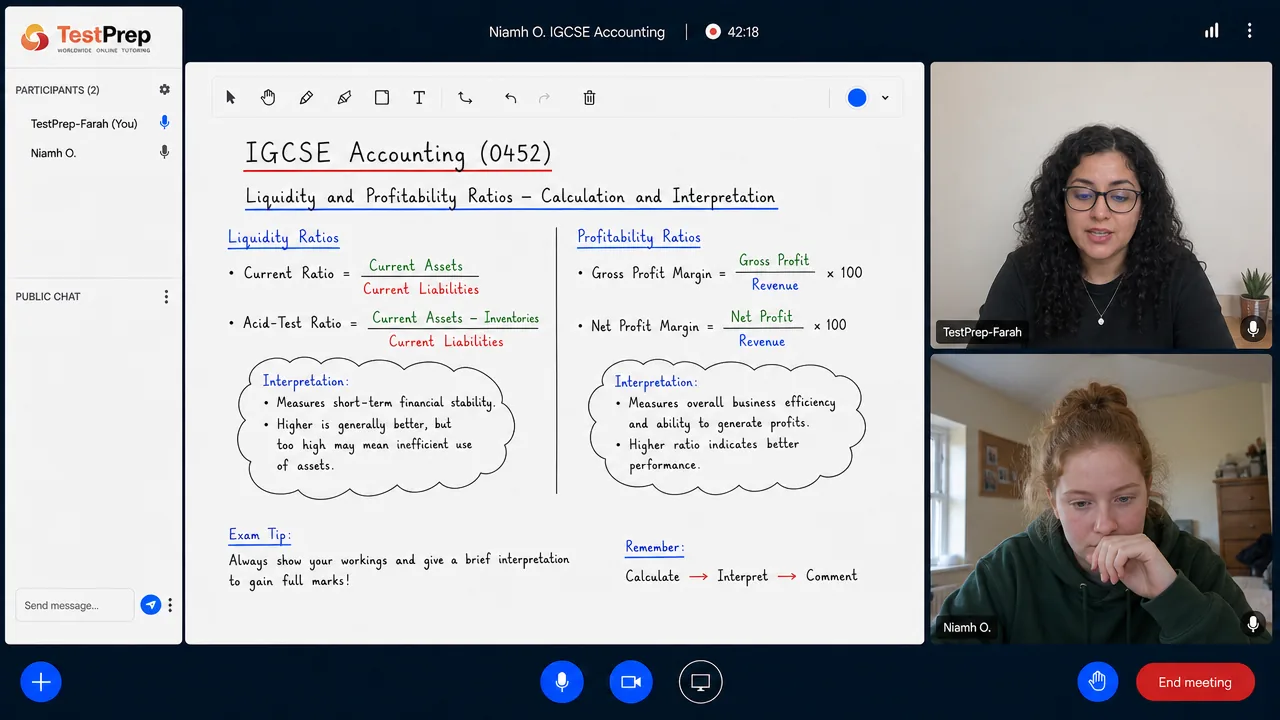
100% live online lessons
About the subject
IGCSE Accounting: what it covers and who it suits
IGCSE Accounting tutoring at TestPrep Europe covers the Cambridge International specification (0452 / 0985). Structure may vary by syllabus code. We teach the full bookkeeping cycle, financial statements, control accounts, accounting ratios and the analysis paper, with explicit attention to layout discipline and ratio interpretation.
- Cambridge 0452/0985 specifications mapped explicitly
- Full bookkeeping cycle (journal → ledger → trial balance → financial statements) practised end-to-end
- Accounting ratios drilled with interpretation in context
Exam
IGCSE Accounting exam format
Multiple-choice paper
Cambridge Paper 1 (from 2027): 40 questions in 1 hour 30 minutes, 30% of the grade; double-entry, ledger and trial-balance items at speed.
Structured written paper
Cambridge Paper 2: five compulsory questions, 1 hour 45 minutes, 100 marks, 70%; full statements of profit or loss, statements of financial position, adjustments and ratio analysis. — Layout discipline (correct headings, sub-totals, balance figures) is mark-scheme reality, not stylistic preference.
Theory and interpretation
Explanation of accounting principles and analysis of given financial data. — This page follows Cambridge International Accounting (0452 / 0985); structure varies by board and syllabus code.
One-to-one IGCSE tutoring
IGCSE Accounting Private Tutoring
Private IGCSE lessons planned around your syllabus code, your tier where the syllabus has one, and the grade you are aiming for. Every lesson is live and online, with a tutor who teaches this subject.
- A lesson plan built around your syllabus and target grade
- Past-paper questions worked through with the board's mark schemes
- Exam technique for each paper, from command words to timing
- Lesson times that fit around your school week
How it works
- 1
Tell us your goal
We start from your school syllabus, your exam date and the result you are aiming for.
- 2
Your own plan
We map out the lessons you need, unit by unit.
- 3
Live one-to-one lessons
Meet your tutor online at times that suit your week.
- 4
Regular progress checks
Homework and a short check after each lesson show how you are getting on.
Start one-to-one IGCSE Accounting
Right for you if you want a plan built around your syllabus, flexible lesson times and a tutor's full attention.
Book one-to-one lessonsBefore choosing a package, you can book one paid lesson.
Our IGCSE tutors began teaching in 2018 or earlier.
100% First-Lesson Money-Back Guarantee
Not satisfied? Full refund, no questions asked.
We do not offer free trial lessons. Payment is required before your first lesson.
Secure Payments
Powered by Stripe with 256-bit encryption.

Flexible Billing
Local cards welcome, instalments available.
Lessons cancelled less than 3 hours before the start count as taken. Full terms
Included in lessons
Practice built into your IGCSE Accounting lessons
Every topic you cover in IGCSE Accounting is reinforced with question sets your tutor puts together for you. This programme has no separately sold question bank or practice test.
Mock exams included in the programme- Targeted questions on every topic
- Practice sets built around your weak areas
- Exam-style practice with past papers and mark schemes
- Worked solutions and feedback on every question
Syllabus
IGCSE Accounting topics
1Source documents and books of original entry
- Invoices, credit notes, day books, cash book, petty cash book.
2Ledger accounting and trial balance
- Double-entry system, balancing accounts, locating errors, suspense accounts.
3Financial statements
- Statement of profit or loss, statement of financial position, adjustments for accruals and prepayments, depreciation.
4Accounting principles and policies
- Going concern, accrual, consistency, prudence, materiality, business entity.
- Principle-based 'explain why...' questions are routinely under-answered; canned definitions don't score.
5Analysis and interpretation
- Profitability, liquidity, efficiency ratios; using ratios to advise stakeholders.
6Other financial statements
- Partnerships, limited companies, manufacturing accounts, clubs and societies and incomplete records, all part of Cambridge 0452.
Topic groups as we teach them; your exam board's syllabus may name and order them differently.
Approach
How we teach IGCSE Accounting
Study plan
- 1
Phase 1 — Bookkeeping
Double entry
- Journal, ledgers, trial balance
- Books of prime entry
- 2
Phase 2 — Adjustments
Year-end entries
- Accruals and prepayments
- Depreciation methods
- Irrecoverable debts and provisions
- 3
Phase 3 — Financial statements
Sole trader / partnership / limited company
- Statement of profit or loss
- Statement of financial position
- Manufacturing accounts and incomplete records
- 4
Phase 4 — Analysis + mock
Ratios + papers
- Profitability, liquidity, efficiency ratios with interpretation
- Past-paper Paper 1 + Paper 2 timed mocks
How lessons work
Layout-first habits
We teach layouts as part of the answer — T-accounts, profit and loss, balance sheet — because mark schemes reward consistent presentation.
Adjustment checklist
A fixed end-of-year checklist (closing inventory → accruals → prepayments → depreciation → bad debts) prevents avoidable mark loss.
Ratio interpretation in context
Calculation alone is half the rubric. We coach interpretation — what a ratio means, what its trend implies, what action would address it.
Advice
IGCSE Accounting: common mistakes and study tips
MistakeLayouts that don't follow IGCSE conventions.
FixMark schemes reward standard IGCSE layouts (T-accounts, statement of profit or loss, statement of financial position). Non-standard layouts under-score.
MistakeAdjustments forgotten in final accounts.
FixAlways run a checklist: closing inventory, accruals, prepayments, depreciation, irrecoverable debts.
MistakeRatios calculated but not interpreted.
FixCalculation and interpretation are separately marked. Numbers without commentary cap the band.
MistakeTrial balance with debits ≠ credits.
FixIf totals don't match, there's an error. Don't 'plug' the balance — find the misposting.
MistakeConfusing capital expenditure and revenue expenditure.
FixCapex is recognised on the SOFP; revenue expenditure goes through P&L. Confusing them flows through to multiple final-account marks.
Ready to raise your IGCSE Accounting grade?
You can start one-to-one IGCSE Accounting lessons with a single lesson. Every package and price is on one page.
- Live one-to-one lessons online
- No package needed — book a single lesson
- Lesson times that fit your school week
You can also write to us through our contact page.
Other subjects
Related and other IGCSE / GCSE subjects
Often taken alongside this subject
- IGCSE Business StudiesStrong content overlap on finance and ratio analysis.
- IGCSE EconomicsCommon pairing for commerce-track students.
- A-Level AccountingNatural progression for students continuing into A-Level.
All IGCSE / GCSE subjects
- IGCSE Biology
- IGCSE Chemistry
- IGCSE Physics
- IGCSE Environmental Management
- IGCSE Combined Science
- IGCSE Coordinated Science
- IGCSE Mathematics
- IGCSE Computer Science
- IGCSE English Language
- IGCSE English Literature
- IGCSE ESL
- IGCSE History
- IGCSE Geography
- IGCSE Sociology
- IGCSE Economics
- IGCSE Business Studies
- IGCSE Food & Nutrition
IGCSE Accounting Prep — Frequently Asked Questions
The questions students ask most about IGCSE Accounting preparation.