IGCSE Chemistry Tutoring & Prep Course
Short answer
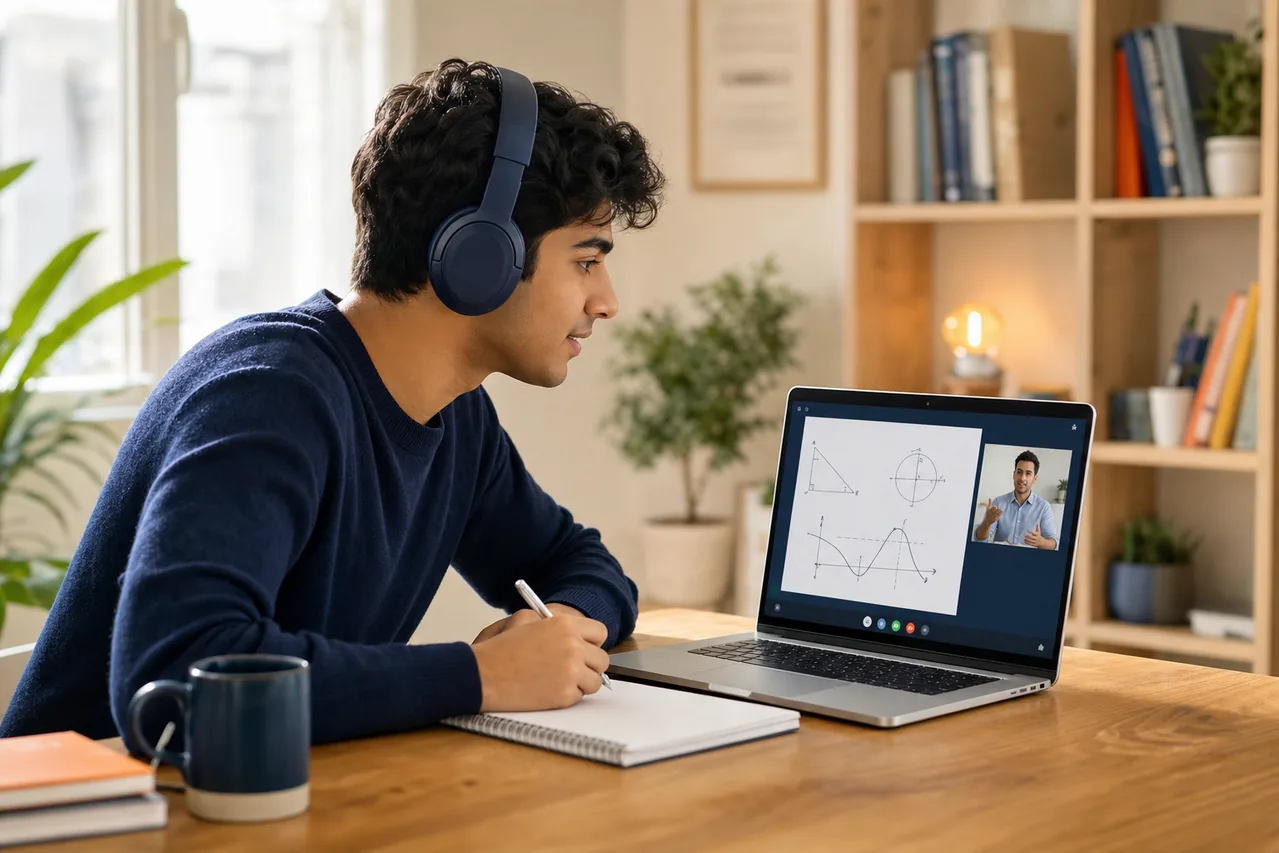
The IGCSE Chemistry course is one-to-one tutoring, taught live online: every lesson is 90 minutes.
A private group is for 3 or more friends who sign up together (the group programme is 30 hours per subject); there are no published start dates, and we agree the start date and lesson times with you.
In one-to-one tutoring, packages are from €85 a lesson.
IGCSE Chemistry tutoring for Cambridge 0620/0971 and Edexcel 4CH1: principles of chemistry, inorganic, physical and organic chemistry, practical skills.
One-to-one and small groups · Live online · Cambridge International and Pearson Edexcel syllabuses
100% live online lessons
About the subject
IGCSE Chemistry: what it covers and who it suits
IGCSE Chemistry tutoring at TestPrep Europe covers Cambridge International (0620 / 0971) and Pearson Edexcel (4CH1) specifications. Structure may vary by board and syllabus code. We teach the principles of chemistry, inorganic, physical and organic chemistry, plus practical / alternative-to-practical skills, with explicit command-term discipline.
Your lessons are taught by Banu Tekin, who teach IGCSE Chemistry.
- Cambridge 0620/0971 and Edexcel 4CH1 specifications mapped explicitly
- Quantitative chemistry (moles, formulae, equations) drilled to top-band standard
- Practical and alternative-to-practical paper technique built up on past papers
Exam
IGCSE Chemistry exam format
Multiple-choice / short-answer paper
Definitions, equations, ion tests and quick stoichiometry.
Theory paper
Extended calculation and explanation, including organic reactions and polymers.
Practical / Alternative to Practical
Reading apparatus, recording observations, analysing anomalous results, writing safe procedures. — Cambridge International (0620 / 0971) and Pearson Edexcel (4CH1) differ on practical assessment route; structure may vary by board and syllabus code.
One-to-one IGCSE tutoring
IGCSE Chemistry Private Tutoring
Private IGCSE lessons planned around your syllabus code, your tier where the syllabus has one, and the grade you are aiming for. Every lesson is live and online, with a tutor who teaches this subject.
- A lesson plan built around your syllabus and target grade
- Past-paper questions worked through with the board's mark schemes
- Exam technique for each paper, from command words to timing
- Lesson times that fit around your school week
How it works
- 1
Tell us your goal
We start from your school syllabus, your exam date and the result you are aiming for.
- 2
Your own plan
We map out the lessons you need, unit by unit.
- 3
Live one-to-one lessons
Meet your tutor online at times that suit your week.
- 4
Regular progress checks
Homework and a short check after each lesson show how you are getting on.
Start one-to-one IGCSE Chemistry
Right for you if you want a plan built around your syllabus, flexible lesson times and a tutor's full attention.
Book one-to-one lessonsBefore choosing a package, you can book one paid lesson.
Our IGCSE tutors began teaching in 2018 or earlier.
100% First-Lesson Money-Back Guarantee
Not satisfied? Full refund, no questions asked.
We do not offer free trial lessons. Payment is required before your first lesson.
Secure Payments
Powered by Stripe with 256-bit encryption.

Flexible Billing
Local cards welcome, instalments available.
Lessons cancelled less than 3 hours before the start count as taken. Full terms
Included in lessons
Practice built into your IGCSE Chemistry lessons
Every topic you cover in IGCSE Chemistry is reinforced with question sets your tutor puts together for you. This programme has no separately sold question bank or practice test.
Mock exams included in the programme- Targeted questions on every topic
- Practice sets built around your weak areas
- Exam-style practice with past papers and mark schemes
- Worked solutions and feedback on every question
Syllabus
IGCSE Chemistry topics
1Particulate nature and states of matter
- Kinetic theory, diffusion, changes of state, separation techniques.
2Atomic structure and the periodic table
- Electron configuration, group trends, ionic and covalent bonding, metallic bonding.
3Stoichiometry
- Moles, balanced equations, percentage yield, limiting reagents, empirical and molecular formulae.
- Mole calculations recur in every paper; rote-only learners under-score on multi-step questions.
4Reactions of acids, bases and salts
- Neutralisation, salt preparation routes, qualitative analysis and ion tests.
5Energetics, rates and equilibrium
- Exothermic / endothermic, energy profiles, factors affecting rate, reversible reactions.
6Redox and electrochemistry
- Oxidation states, electrolysis of molten and aqueous solutions, electroplating.
7Organic chemistry
- Homologous series, isomerism, alkanes, alkenes, alcohols, carboxylic acids, polymers.
Topic groups as we teach them; your exam board's syllabus may name and order them differently.
Approach
How we teach IGCSE Chemistry
Study plan
- 1
Phase 1 — Principles
Particles, atoms, bonding
- States of matter and kinetic theory
- Atomic structure and ionic/covalent bonding
- 2
Phase 2 — Quantitative chemistry
Moles, equations, yields
- Molar calculations
- Empirical/molecular formulae
- Yield and percentage calculations
- 3
Phase 3 — Inorganic + physical
Periodic table, rates, energetics
- Periodicity and key trends
- Rates of reaction
- Energetics and reversible reactions
- 4
Phase 4 — Organic + practical + mock
Reactions, practicals, mocks
- Organic homologous series and reactions
- Required practicals / alternative-to-practical
- Timed past-paper mock
How lessons work
Quantitative discipline
Mole calculations are taught with formula → rearrangement → substitution → answer; consistent layout protects method marks.
Organic with reaction maps
Homologous series and reactions are organised as reaction maps so students see the system, not isolated reactions.
Board-specific drilling
Cambridge and Edexcel use different syllabus emphasis. We tailor practice to the student's exact specification.
Advice
IGCSE Chemistry: common mistakes and study tips
MistakeEquations that aren't balanced or are missing state symbols.
FixBoth boards mark balanced equations and state symbols separately. Missing either is a predictable loss.
MistakeMole calculations without rearranging the formula.
FixShow formula, rearrangement and substitution. Method marks survive arithmetic slips.
MistakeOrganic naming inconsistencies.
FixApply IUPAC naming systematically — locants, prefixes, suffixes — every time.
MistakePractical paper answers without controlled variables.
FixPractical answers must name independent, dependent and controlled variables explicitly. Generic 'fair test' answers under-score.
MistakeEnergy-level diagrams without ΔH labelled.
FixLabel reactants, products and ΔH on every energy diagram. Examiners reward consistency.
Ready to raise your IGCSE Chemistry grade?
You can start one-to-one IGCSE Chemistry lessons with a single lesson. Every package and price is on one page.
- Live one-to-one lessons online
- No package needed — book a single lesson
- Lesson times that fit your school week
You can also write to us through our contact page.
Other subjects
Related and other IGCSE / GCSE subjects
Often taken alongside this subject
- IGCSE PhysicsStrong overlap in practical-paper technique and quantitative reasoning.
- IGCSE BiologyStandard triple-science partner; common practical-paper conventions.
- IB ChemistryNatural IGCSE → IB progression.
All IGCSE / GCSE subjects
- IGCSE Biology
- IGCSE Physics
- IGCSE Environmental Management
- IGCSE Combined Science
- IGCSE Coordinated Science
- IGCSE Mathematics
- IGCSE Computer Science
- IGCSE English Language
- IGCSE English Literature
- IGCSE ESL
- IGCSE History
- IGCSE Geography
- IGCSE Sociology
- IGCSE Economics
- IGCSE Business Studies
- IGCSE Accounting
- IGCSE Food & Nutrition
IGCSE Chemistry Prep — Frequently Asked Questions
The questions students ask most about IGCSE Chemistry preparation.